

Active Directory remains the backbone of identity management for most Saudi enterprises. Yet, many organizations across the Kingdom are operating with dangerous AD security gaps that attackers actively exploit. With NCA and SAMA regulations tightening and cyber threats becoming more sophisticated, ignoring these vulnerabilities is no longer an option.
In this article, we break down the five most common AD security gaps affecting Saudi organizations and show you exactly how to address them before they become costly breaches.
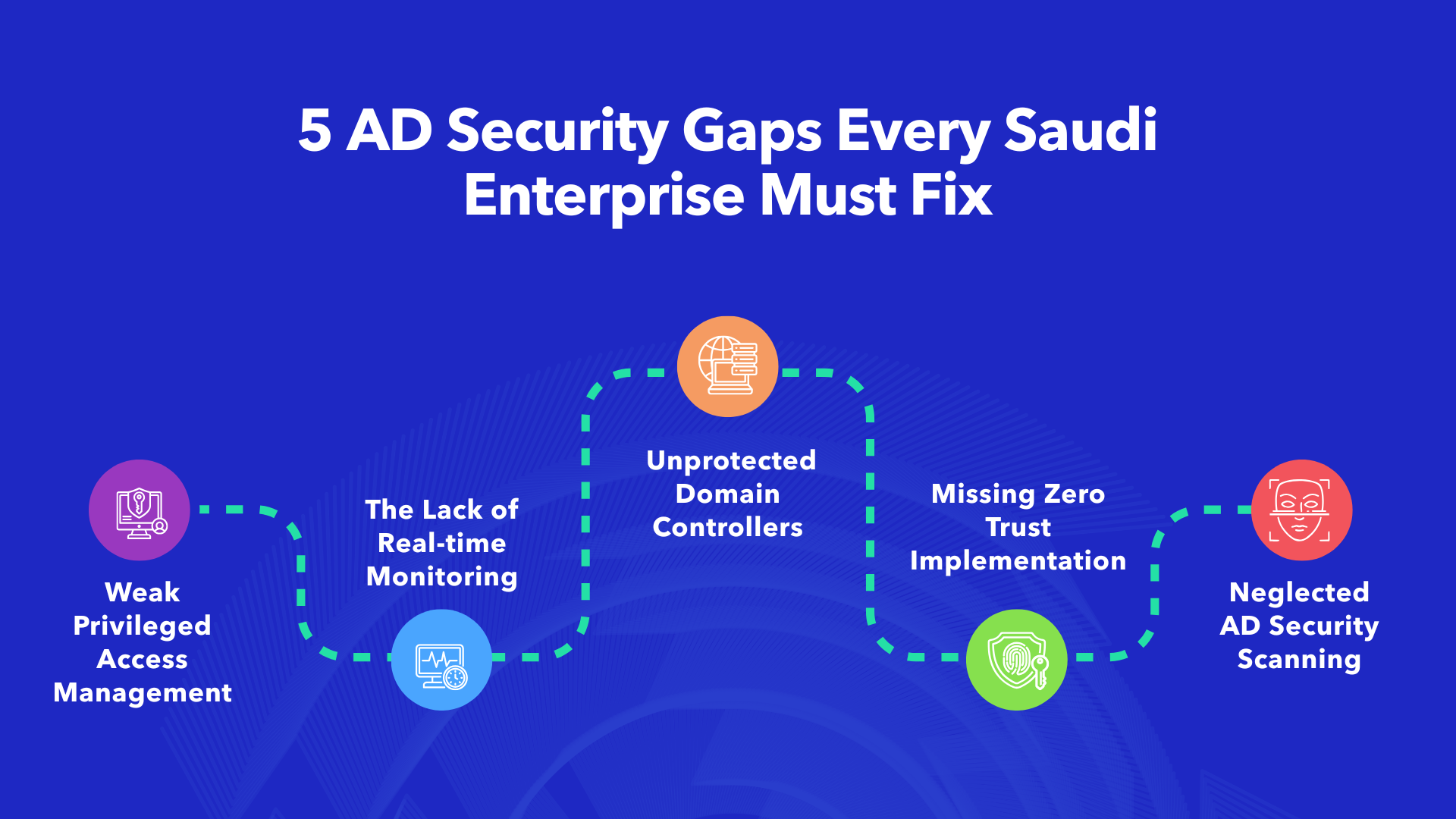
1. Weak Privileged Access Management: The Most Dangerous AD Security Gap
The first and most critical AD security gap we see in Saudi organizations is poor privileged access management. Too many IT teams still use shared admin accounts or leave excessive permissions in place long after they are needed.
This creates a massive attack surface. If one admin credential gets compromised, attackers gain the keys to your entire kingdom. According to Microsoft Security research, over 80% of breaches involve compromised privileged credentials.
Closing This AD Security Gap
Implement just-in-time privileged access. Remove standing admin rights and grant elevated permissions only when needed, for limited time periods. Alnafitha IT’s identity management solutions help Saudi enterprises enforce least-privilege access across their AD environments.
2. No Real-Time Monitoring: A Silent AD Security Gap
The second major AD security gap is the lack of real-time monitoring. Many Saudi organizations only discover unauthorized changes to their Active Directory days or weeks after they happen. By then, the damage is done.
Without real-time visibility into group policy modifications, user account changes, and permission escalations, your security team is flying blind. Attackers know this and use it to establish persistence in your environment.
How to Address This AD Security Gap
Deploy Active Directory auditing tools that provide instant alerts on critical changes. Look for solutions that track who changed what, when, and from where. Native Windows logging is not enough for enterprise environments.
3. Unprotected Domain Controllers: A Critical AD Security Gap
Domain controllers are the crown jewels of your Active Directory infrastructure. Yet, we regularly find Saudi organizations running domain controllers without adequate protection. This AD security gap puts everything at risk.
Common mistakes include running unnecessary services on domain controllers, allowing direct internet access, and failing to implement proper network segmentation.
Fixing This AD Security Gap
Harden your domain controllers following CIS benchmarks. Implement strict firewall rules, disable unnecessary services, and ensure domain controllers exist only in protected network segments with limited access paths.
4. Missing Zero Trust Implementation in Hybrid AD Environments
As Saudi organizations embrace Azure Active Directory alongside their on-premises infrastructure, a new AD security gap emerges. Many hybrid environments lack proper Zero Trust controls, treating cloud and on-premises identities inconsistently.
This gap is particularly dangerous because attackers can compromise cloud identities to pivot into on-premises resources, or vice versa. The expanded attack surface of hybrid AD demands a Zero Trust approach.
Solving This AD Security Gap
Adopt Zero Trust principles across your entire identity infrastructure. Verify every access request regardless of where it originates. Implement conditional access policies that evaluate user risk, device health, and location before granting access.
5. Neglected Security Scanning: A Risky AD Security Gap
The final AD security gap is something many organizations overlook entirely: regular vulnerability assessment. Active Directory configurations drift over time. New vulnerabilities emerge. Without ongoing scanning, you cannot know your true risk exposure.
Many Saudi enterprises run vulnerability scans on their networks but skip Active Directory entirely. This leaves dangerous misconfigurations and attack paths undetected.
Eliminating This AD Security Gap
Schedule regular AD security assessments. Use specialized tools that identify attack paths, stale accounts, excessive permissions, and misconfigurations. Make AD security scanning part of your quarterly security reviews.
Why Fixing AD Security Gaps Matters for Saudi Regulatory Compliance
Beyond the direct security benefits, addressing these AD security gaps helps Saudi organizations meet regulatory requirements. Both NCA’s Essential Cybersecurity Controls and SAMA’s Cyber Security Framework mandate strong identity and access management controls. Organizations with unaddressed AD security gaps risk compliance violations and potential penalties.
Closing the AD Security Gaps in Your Organization
Active Directory security is not a one-time project. It requires ongoing attention, the right tools, and expert guidance. The five AD security gaps we have covered represent the most common vulnerabilities we see in Saudi enterprises, but every organization has unique challenges.
The good news is that these gaps are fixable. With proper planning, the right technology partners, and a commitment to security best practices, you can transform your Active Directory from a liability into a secure foundation for your business.
At Alnafitha IT, we have been helping Saudi organizations secure their IT infrastructure since 1993. Our team understands the local regulatory landscape, the specific threats facing Saudi enterprises, and the practical challenges of implementing security in complex environments.
Lets identify and close the AD security gaps in your organization
Contact Alnafitha IT’s security experts today for a free consultation.