

Insider threat detection is one of the most overlooked gaps in enterprise security and one of the costliest. Most security teams focus their defenses on the perimeter: firewalls, intrusion detection, threat intelligence feeds. These are necessary. But the data consistently shows that some of the most damaging breaches come from people who already have legitimate access to your systems.
Insider threats are not a niche risk. In Saudi Arabia, the market for insider threat protection reached $93 million in 2023 and is projected to hit $268.7 million by 2030, growing at a compound annual rate of 16.4%. That growth reflects a real and expanding problem that organizations across government, finance, energy, and healthcare are confronting directly.
This article breaks down what insider threats actually look like in practice, and how three specific technologies, User Behavior Analytics (UBA), Active Directory (AD) monitoring, and Data Loss Prevention (DLP), work together to detect and stop them before serious damage is done.
The Four Faces of Insider Threats
Security teams often treat insider threats as a single category. In reality, they fall into four distinct types, and each one demands a different detection approach.

- Malicious insiders: Employees, contractors, or vendors who deliberately abuse their access to steal data, sabotage systems, or sell credentials. Research by Ponemon puts the average cost of a malicious insider incident at over $715,000.
- Negligent employees: Staff who click on phishing links, mishandle sensitive files, or misconfigure systems without any intent to cause harm. Negligence actually accounts for the majority of insider incidents.
- Compromised accounts: Legitimate user credentials stolen through phishing or brute force. The attacker operates inside the network as a trusted user, often for weeks before detection.
- Data exfiltration actors: Employees preparing to leave the organization who copy intellectual property, customer data, or financial records to personal devices or cloud storage.
What makes all four categories dangerous is the same thing: these users have valid credentials and legitimate reasons to be in your systems. Traditional perimeter security will not stop them.
How UBA Strengthens Insider Threat Detection Before Escalation
User Behavior Analytics works by establishing a baseline of what normal looks like for each user in your environment, then flagging deviations from that baseline in real time.
A finance manager who typically accesses accounting records during business hours will have a well-defined behavioral profile. If that same account suddenly starts pulling large volumes of HR data at 2 AM from an unusual IP address, UBA flags it immediately, even though the credentials are technically valid.
Modern UBA platforms use machine learning to continuously refine those baselines. They do not rely on manually defined rules that attackers can learn to avoid. Instead, they model actual behavior over time and assign risk scores to anomalous activity. Security teams see a prioritized queue of incidents rather than a flood of uncontextualized alerts.
ManageEngine ADAudit Plus, a solution available through Alnafitha IT’s SIEM and security monitoring offerings, brings this capability directly into Active Directory environments. It uses machine learning to build dynamic user behavior baselines and triggers alerts when those baselines are broken, reducing the false positives that cause alert fatigue in security operations centers.
AD Monitoring: A Core Layer of Insider Threat Detection
Active Directory is the backbone of identity and access management in most organizations. It controls who can access what, and it generates a continuous log of every authentication event, permission change, group policy modification, and account action across your environment.
The problem is that raw AD logs are enormous and difficult to interpret manually. Without dedicated monitoring, significant events, such as a user being silently added to a privileged group or an account accessing systems it has no business reason to touch, go unnoticed until after the damage is done.
AD monitoring tools parse these logs in real time, correlate related events, and surface the ones that indicate risk. Key signals include:
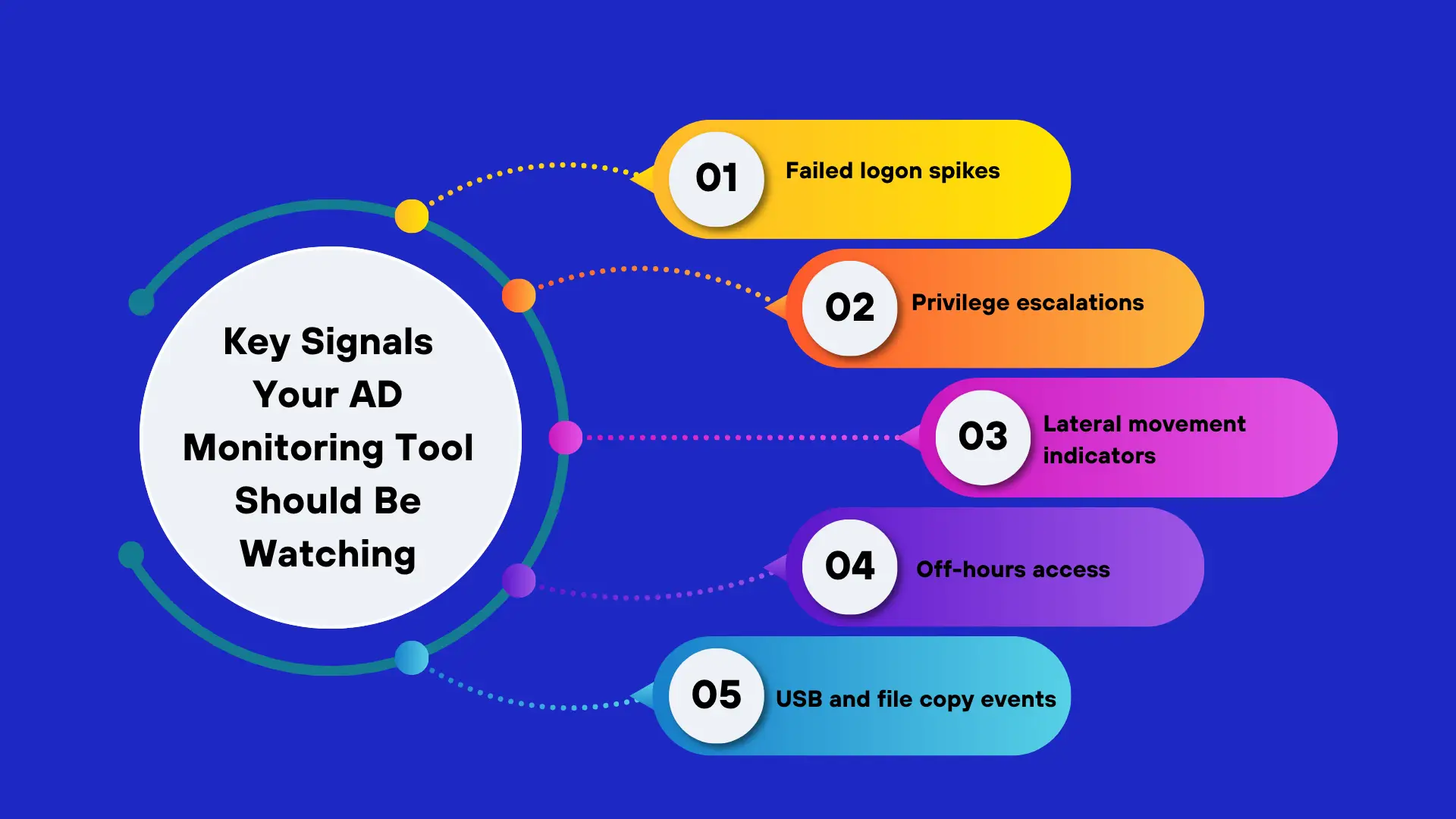
- Failed logon spikes: Often the early indicator of a brute-force attempt or a compromised account being tested.
- Privilege escalations: A standard user account suddenly granted admin rights is a major red flag.
- Lateral movement indicators: Unusual remote desktop sessions or process executions across multiple hosts.
- Off-hours access: Authentication to sensitive systems outside normal working patterns.
- USB and file copy events: Data being moved to removable media before a resignation or termination.
ADAudit Plus covers all of these scenarios with over 200 pre-built reports and real-time alerting. It also integrates with Log360, ManageEngine’s unified SIEM platform, to correlate AD events with logs from network devices, cloud environments, and endpoints for a complete picture of user activity.
DLP: The Final Line Against Data Exfiltration
Detection alone is not enough. Once you know that a user is behaving abnormally, you need the ability to stop data from leaving the organization while an investigation is underway.
Data Loss Prevention tools classify sensitive data across your file servers, endpoints, and cloud storage, then enforce policies that block or log attempts to move that data through unauthorized channels. This includes email attachments, USB transfers, cloud sync applications, and web uploads.
When DLP is integrated with UBA, insider threat detection becomes significantly more effective than either tool operating alone. UBA provides the behavioral context that helps DLP teams prioritize which alerts actually matter. A single file being copied to a USB drive may generate a DLP alert that gets buried in a queue. The same event, when flagged by UBA because it follows three weeks of unusual access patterns and a large data download, moves to the top of the incident response list.
NCA ECC Control 2-13 and the Compliance Imperative
For Saudi organizations operating under the National Cybersecurity Authority’s Essential Cybersecurity Controls, insider threat detection is not optional. NCA ECC Control 2-13 governs Cybersecurity Incident and Threat Management, with the explicit objective of ensuring timely identification, detection, effective management, and handling of cybersecurity incidents and threats to prevent or minimize negative impacts on operations.
Meeting this requirement means having documented insider threat detection processes and technical controls that demonstrate real-time monitoring, incident response workflows, and audit trails of security events. UBA, AD monitoring, and DLP solutions all generate the evidence that NCA assessors look for, including log retention, alert histories, anomaly detection records, and incident timelines.
ManageEngine Log360, implemented through Alnafitha IT’s SIEM solutions, comes with built-in compliance reporting templates that map directly to NCA ECC requirements. This significantly reduces the manual effort required to prepare for compliance reviews and audits.
Why These Three Technologies Work Together
UBA, AD monitoring, and DLP address insider threats from three different angles. UBA asks: is this user behaving normally? AD monitoring asks: what has this user actually done across the environment? DLP asks: is sensitive data moving somewhere it should not?
Each layer answers questions the others cannot. Used in combination through a unified SIEM platform like Log360, they reduce both the time it takes to detect a threat and the cost of containing it. Research from the 2026 Cost of Insider Risks Global Report shows that incidents contained within 30 days cost an average of $14.2 million, while those extending beyond 90 days reach $21.9 million. Speed of detection matters enormously.
Build Your Insider Threat Detection Program Now
Insider threats in Saudi Arabia are not a future risk. They are already showing up in breach reports, dark web credential leaks, and compliance audit findings. The organizations that will fare better are those that have put real insider threat detection capability at the center of their security posture
The technology to do this is proven, available, and deployable at enterprise scale. The question is how quickly your organization can move from awareness to implementation.
For further reading, see the 2026 Cost of Insider Risks Global Report
Additional reading: Ponemon Institute Insider Threat Report 2025 and the NCA Essential Cybersecurity Controls.
Ready to Address Insider Threats in Your Organization?
Alnafitha IT has been implementing ManageEngine security solutions across Saudi Arabia since 1993, working with government entities, financial institutions, and large enterprises. Our team can assess your current exposure, design a detection architecture that fits your environment, and handle the full deployment and ongoing support.