

The Hidden Cost of Disconnected IT Systems
If your IT department operates with separate tools for endpoint management, service desk, network monitoring, and security—you’re not alone. Most mid-to-large organizations in Saudi Arabia face the same challenge: multiple teams, multiple tools, zero unified visibility.
The impact? Slower incident response, duplicated efforts, and IT leaders who spend more time chasing problems than preventing them.
According to ManageEngine’s regional insights, Saudi Arabia is now among the top five markets globally for IT management solutions—driven largely by Vision 2030’s digital transformation mandates. Organizations across government, banking, healthcare, and enterprise sectors are actively seeking unified IT management platforms that bring order to complexity.
The question isn’t whether to centralize. It’s how.
What Does Unified IT Management Actually Look Like?
Unified IT management consolidates your core IT functions—endpoint control, service desk operations, network monitoring, security auditing, and analytics—into an integrated ecosystem. Instead of jumping between disconnected dashboards, your teams work from shared platforms with complete visibility into each other’s activities.
Here’s what changes:
Before: A user reports a slow computer.
The support team checks the device.
The infrastructure team checks the server.
The system admin checks Active Directory.
Three teams, three tools, no shared context. Resolution time: hours.
After: The same ticket triggers a unified view. The technician sees device specs, server health, recent patches, and related incidents—all in one place.
Resolution time: minutes.
This isn’t theoretical. It’s exactly what organizations like the Cultural Development Fund achieved after implementing a seven-product IT infrastructure management stack with Alnafitha IT.
The Seven Pillars of Modern IT Infrastructure Management
For Saudi enterprises evaluating IT infrastructure management solutions, here are the core capabilities that matter most:
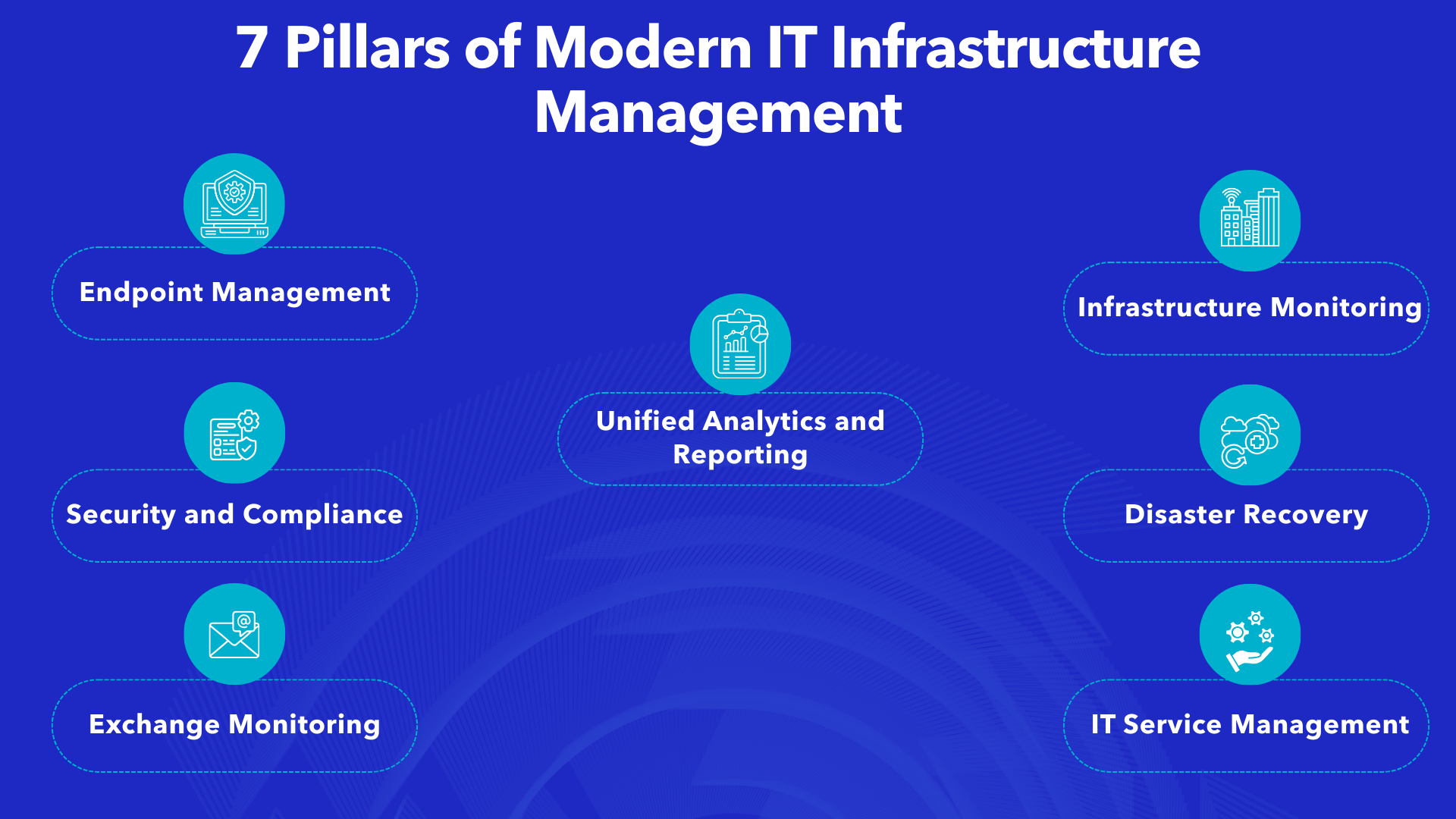
1. Endpoint Management
Centralized control over all devices—desktops, laptops, mobile—including patch deployment, software distribution, remote access, and security policies like USB restrictions.
Explore Alnafitha’s Automation & System Management solutions.
2. IT Service Management (ITSM)
A single platform for incident tracking, service requests, change management, and SLA enforcement. When integrated with asset management, your service desk becomes a command center—not a call center.
Learn more about Enterprise Service Management.
3. Network and Infrastructure Monitoring
Real-time visibility into servers, network devices, and critical infrastructure.
Proactive alerts mean problems get fixed before anyone notices them.
Discover IT Operations Management capabilities.
4. Security Auditing and Compliance
Complete audit trails for Active Directory changes, file server access, and user activity. Essential for meeting Saudi regulatory requirements and internal governance standards. See Identity & Access Management solutions.
5. Email and Exchange Monitoring
Dedicated visibility into email server performance, mailbox usage, and delivery health—critical for organizations where communication downtime directly impacts operations.
Learn how IT Operations Management keeps your critical systems running.
6. Backup and Disaster Recovery
Centralized backup management with reliable restoration capabilities.
Because the question isn’t if you’ll need recovery—it’s when.
Review Backup and Recovery options.
7. Unified Analytics and Reporting
A single dashboard that pulls data from all systems—giving leadership consolidated insights without manual report compilation.
Explore IT Analytics solutions.
Why Saudi Organizations Are Moving to Integrated Platforms
The shift toward unified IT management in Saudi Arabia isn’t just about efficiency—it’s about readiness. Vision 2030 has accelerated digital transformation timelines across every sector. Organizations that once had years to modernize now have months.
According to Intelligent CIO Middle East, ManageEngine—one of the leading IT management vendors—registered 40% revenue growth in Saudi Arabia in recent years, with government, banking, and insurance sectors leading adoption.
What’s driving this demand?
Compliance pressure. Saudi’s Personal Data Protection Law and sector-specific regulations require organizations to demonstrate control over their IT environments—including audit trails, access management, and incident documentation.
Operational efficiency. With IT teams expected to do more with less, automation and integration aren’t luxuries—they’re survival tactics.
Scalability. As organizations grow, point solutions create technical debt. Unified platforms scale without multiplying complexity.
Choosing the Right IT Infrastructure Management Partner
Selecting an IT infrastructure management solution is only half the equation. Implementation quality determines whether you get a unified platform or just another set of tools that don’t talk to each other.
Here’s what to look for in a partner:
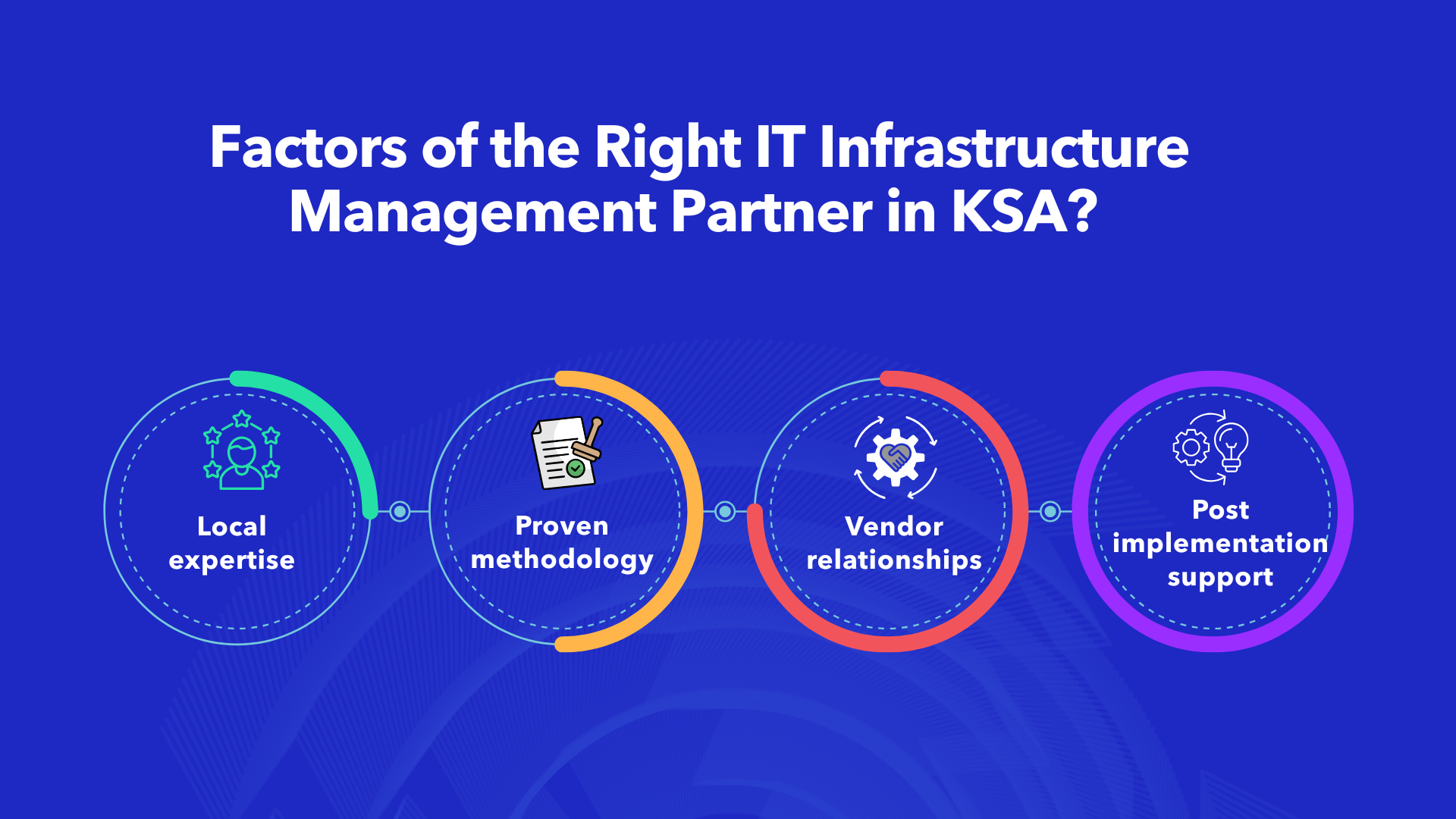
Local expertise. Does the partner understand Saudi market requirements, regulatory frameworks, and business culture?
Proven methodology. Look for structured approaches: requirements gathering, tailored implementation, thorough testing, and knowledge transfer.
Vendor relationships. Partners with platinum-level vendor certifications bring deeper technical expertise and priority support access.
Post-implementation support. The relationship shouldn’t end at deployment. Ongoing optimization, training, and support ensure long-term value.
Alnafitha IT has served over 7,000 organizations across Saudi Arabia since 1993, with deep expertise in ManageEngine, Microsoft, and enterprise IT solutions. As a platinum ManageEngine partner, Alnafitha brings both the technical depth and local market understanding that complex implementations require.
From Unintegrated to Unified: The Path Forward
For organizations still running IT with disconnected systems and manual handoffs, the question isn’t whether to centralize—it’s how soon. The longer teams operate in isolation, the more time and money gets lost in the gaps.
Unified IT management isn’t about adding more products. It’s about choosing the right ones and ensuring they work together. When infrastructure, support, and security teams share the same visibility, problems get solved faster, compliance becomes easier, and IT shifts from cost center to strategic enabler.
Start to Unify Your IT Operations
If your organization is evaluating IT infrastructure management solutions—or struggling with fragmented tools that don’t deliver the visibility you need—let’s talk.
Alnafitha IT helps Saudi enterprises design, implement, and optimize unified IT management platforms that align with business objectives and regulatory requirements.