

Quick Takeaway Saudi enterprises running fully in-house IT departments are absorbing costs most leadership teams never fully account for: salary premiums of 45-60% above regional norms, compliance overhead that consumes 3-5% of IT budgets, and a talent pool where fewer than 19% of private-sector IT positions are filled by Saudi nationals. Managed IT services offer a structured, financially defensible path out of that bind, and the market data supports the shift.
Introduction
If you are an IT Manager or CIO in Saudi Arabia trying to justify outsourced IT to a leadership team that is still comparing headcount costs on a spreadsheet, this article is written for you.
The conversation around managed IT services in the Kingdom has matured significantly. It is no longer a discussion about whether to outsource routine helpdesk tasks. It is a strategic decision that touches Saudisation compliance, NCA regulatory readiness, Microsoft ecosystem support, and the organisation’s ability to scale without rebuilding its IT department from scratch every two years.
Here is the business case, built on facts, not projections.
What In-House IT Actually Costs vs. Managed IT Services in KSA
Most cost comparisons between in-house IT and managed IT services start with salaries. That is the right instinct, but the number most teams put into the spreadsheet is wrong.
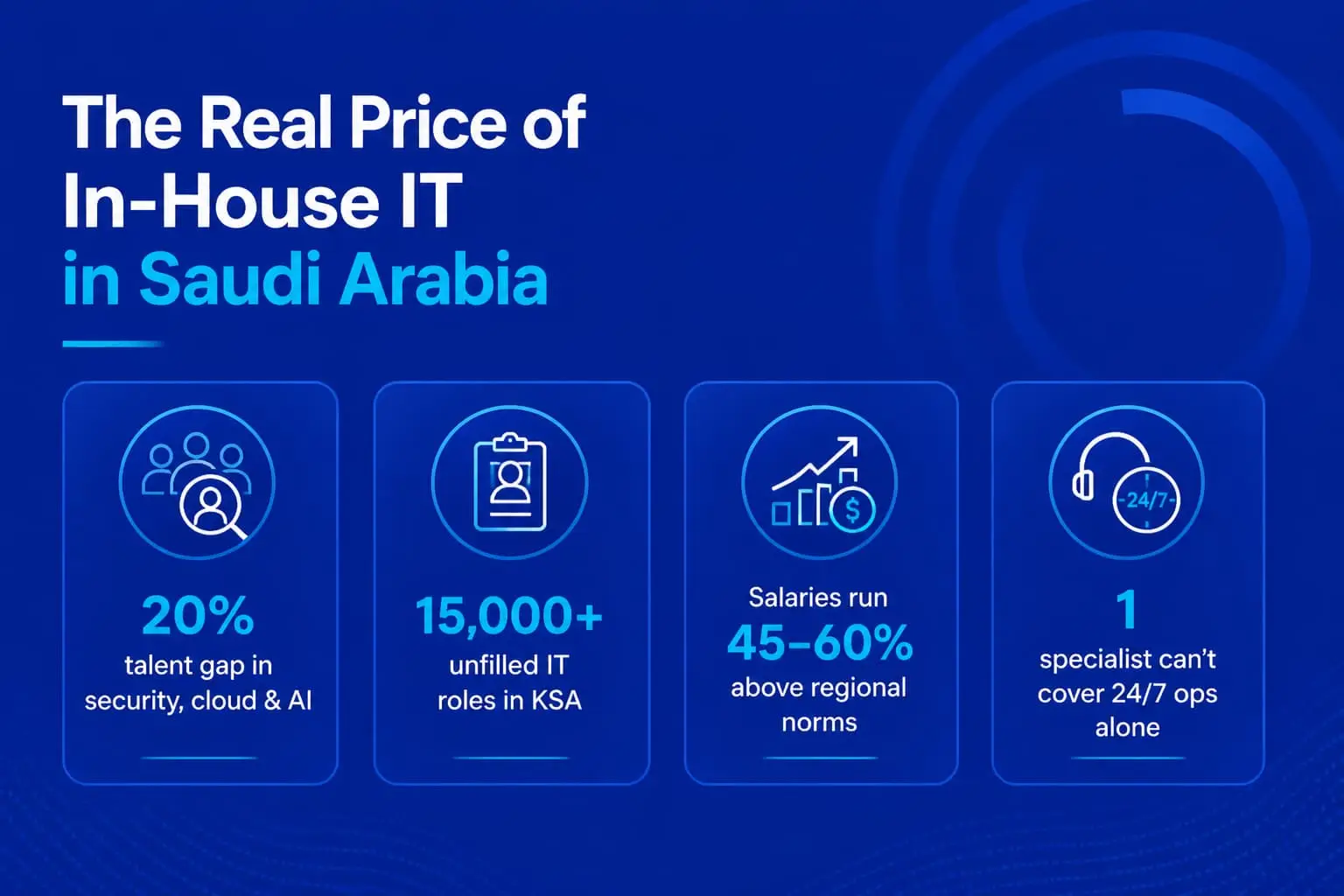
Saudi Arabia’s IT talent market is under significant strain. According to market research published in early 2026, a persistent 20% talent gap exists in critical fields including security operations, cloud architecture, and AI engineering. The market currently lacks more than 15,000 skilled professionals, even after government-backed training programmes. To compete for that limited pool, organisations are paying salary premiums 45-60% above regional norms, and those premiums keep rising.
Add to that:
- Recruitment and onboarding costs, which routinely reach 20-30% of a new hire’s annual salary
- Ongoing training investment, as technology stacks shift faster than internal teams can keep pace
- Redundancy requirements: a single in-house IT specialist cannot cover 24/7 monitoring, incident response, and strategic projects simultaneously
- Infrastructure capital expenditure, which for enterprise environments starts at millions of riyals before a single support ticket is resolved
The total cost of ownership for in-house IT is consistently higher than the salary line suggests.
What Managed IT Services Actually Deliver Financially
The Saudi Arabia managed services market was valued at USD 5.12 billion in 2025 and is projected to reach USD 7.83 billion by 2030, growing at a CAGR of 8.2%. That trajectory reflects real enterprise demand, not hype.
Enterprises that have made the shift to managed IT services report savings of up to 30% on total IT spending. The mechanism is straightforward: the CapEx model (buy servers, hire specialists, build redundancy) shifts to an OpEx model (predictable monthly or annual fees, scaled to actual usage). Leadership teams that struggle to approve capital projects find it considerably easier to approve a structured services agreement with defined SLAs and measurable outcomes.
Beyond cost, managed IT services deliver:
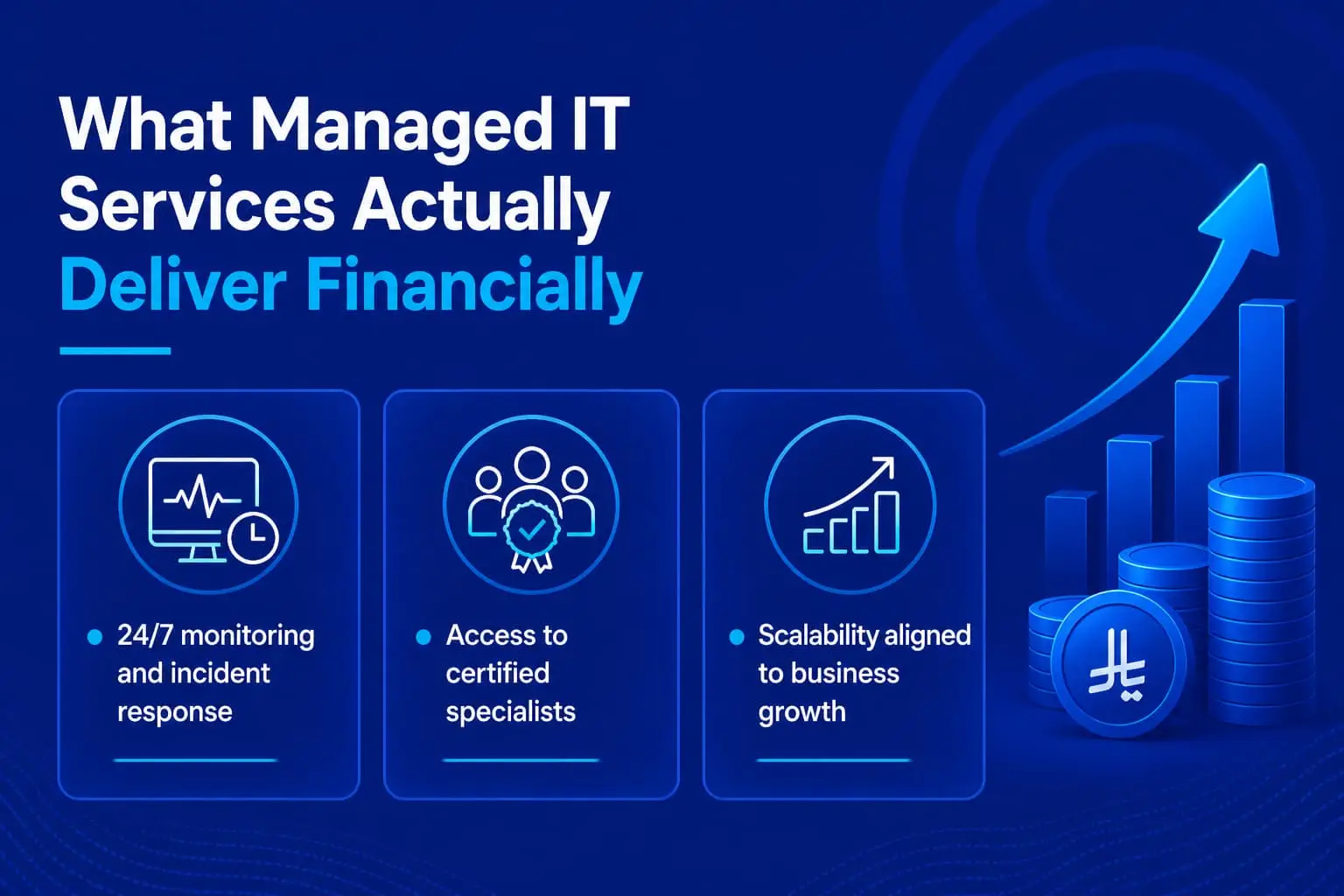
- 24/7 monitoring and incident response without the overhead of building a round-the-clock internal team
- Access to certified specialists across networking, cybersecurity, cloud, and ITSM, with expertise that would require multiple full-time hires if built in-house
- Scalability aligned to business growth, without the hiring cycles that slow down expansion
How Managed IT Services Address the Saudisation Challenge
Here is the variable that rarely appears in the in-house vs. outsourced comparison, but should.
Vision 2030’s Saudisation requirements place direct pressure on private-sector hiring. Yet only 18.6% of private-sector IT positions are currently filled by Saudi nationals. That gap creates a structural problem: organisations need to demonstrate local content in their workforce while simultaneously recruiting scarce technical talent in a market where salaries are rising at pace.
Managed IT services help close that gap in two ways. First, an established partner with a certified local team handles the specialist roles that are hardest to Saudise. Second, your in-house team can focus on higher-value, more accessible functions: governance, vendor management, and business alignment, areas better suited to progressive Saudisation over time.
This is not a workaround. It is sound workforce planning for the current regulatory environment.
Managed IT Services and Compliance: NCA, PDPL, and SAMA
Saudi Arabia’s regulatory landscape for IT is among the most active in the region. The National Cybersecurity Authority’s Essential Cybersecurity Controls (ECC), the Personal Data Protection Law (PDPL), and SAMA’s cybersecurity framework all carry real enforcement teeth.
Since PDPL came into full effect in September 2024, compliance costs have risen to an estimated 3-5% of Saudi IT budgets, with data localisation requirements adding further overhead. Organisations that try to manage NCA audit readiness, continuous monitoring, and incident reporting with stretched in-house teams are accepting a level of compliance risk that leadership should not be comfortable with.
A qualified managed IT services provider absorbs much of that burden by maintaining audit readiness, updating security controls as frameworks evolve, and providing the documentation that regulators require. That capability gap between what an in-house team can reasonably sustain and what compliance actually demands is often the clearest financial argument for outsourcing.
Explore how Alnafitha IT’s IT support and managed services portfolio is built to address precisely this environment, covering service desk, remote monitoring, cloud operations, and infrastructure management under a single, accountable agreement.
Microsoft Unified Support: Where the Financial Case Gets Stronger
Most large Saudi enterprises run heavily on Microsoft infrastructure: Azure, Microsoft 365, Dynamics, and the broader security stack. Managing that environment well requires more than a licensed administrator. It requires access to Microsoft’s own support architecture.
Microsoft Unified Support provides enterprise customers with 24/7 technical support, proactive health assessments, escalation management, and a designated Customer Success Account Manager who understands the organisation’s specific Microsoft deployment. For complex environments, including hybrid cloud, multi-entity deployments, or organisations in regulated industries, Unified Support is not a luxury. It is what keeps the environment stable and the business protected.
When delivered through a managed IT services engagement rather than a standalone procurement, Microsoft Unified Support becomes part of an integrated service layer. Your partner understands both the platform and the business context, which shortens resolution times and improves service outcomes.
Why Alnafitha for Managed IT Services in Saudi Arabia
Alnafitha IT has operated in Saudi Arabia since 1993. That tenure matters in a market where regulatory knowledge, local relationships, and enterprise trust are difficult to build quickly.
As a recognised Microsoft partner and a provider across nine IT solution areas, including managed services, cybersecurity, IT operations management, and enterprise service management, Alnafitha brings the depth that mid-market and enterprise organisations in the Kingdom need from a long-term managed IT partner.
The Enterprise Service Management solutions at Alnafitha cover the full scope of what IT leaders need to run a governed, auditable, and responsive IT function, from ITSM and asset management to 24/7 monitoring and cloud operations.
Conclusion
The financial case for managed IT services in Saudi Arabia is no longer difficult to make. The talent shortage is documented, the compliance costs are measurable, and the savings data is consistent. What is difficult is changing how leadership thinks about IT spending, moving from a headcount conversation to a capability conversation.
The organisations that are winning in Saudi Arabia’s current digital environment are not those with the largest in-house teams. They are the ones that made strategic decisions about where to build internal capability and where to partner for depth and scale.
If you are ready to move that conversation forward in your organisation, speak with Alnafitha IT’s team today.
Frequently Asked Questions
What are managed IT services and what do they typically include? Managed IT services refer to outsourcing IT operations, including infrastructure monitoring, helpdesk support, cybersecurity, cloud management, and ITSM, to a third-party provider under a defined SLA. In Saudi Arabia, leading providers cover 24/7 monitoring, endpoint management, incident response, compliance support, and strategic IT consulting within a single engagement.
How do managed IT services compare to in-house IT for cost? Enterprises adopting managed IT services typically save up to 30% on total IT spending by shifting from a capital expenditure model to a predictable operational expenditure model. Hidden costs of in-house IT, including recruitment, redundancy, training, and infrastructure maintenance, often exceed the visible salary line significantly.
Can managed IT services help with NCA and PDPL compliance in Saudi Arabia? Yes. Qualified managed IT services providers in the Kingdom maintain up-to-date knowledge of NCA Essential Cybersecurity Controls, PDPL requirements, and SAMA frameworks. They provide continuous monitoring, audit documentation, and security control updates as regulations evolve, capabilities that stretched in-house teams typically cannot sustain consistently.
How do managed IT services support Vision 2030 Saudisation requirements? By handling specialist technical roles through a partner with a certified local team, organisations can channel internal hiring toward governance and business-facing IT functions that are more accessible for progressive Saudisation. This creates a more sustainable workforce structure than attempting to hire and retain scarce technical nationals in a highly competitive market.
What should I look for in an SLA for managed IT services in Saudi Arabia? Key SLA elements include defined response and resolution times by incident severity, availability guarantees (typically 99.9% or higher for critical systems), compliance reporting obligations, escalation paths, and review frequency. For organisations with Microsoft environments, verify whether Microsoft Unified Support is included or available as part of the agreement.
Why are Saudi enterprises shifting from break-fix IT support to managed services? Break-fix models generate unpredictable costs, reactive responses, and no accountability for system health between incidents. Managed IT services shift the incentive structure: the provider is accountable for ongoing performance, which drives proactive monitoring, faster resolution, and the audit trail that compliance frameworks require.