

The essentials of Azure cost management, summarised
Key Takeaways
- Most Azure overruns are governance failures, not pricing failures. Unmanaged provisioning, missing tags, and idle dev/test resources push bills 30 to 60 percent above the original estimate within six months.
- A disciplined Azure cost management practice built on Azure Cost Management, Azure Advisor, reservations, and savings plans recovers 20 to 30 percent of spend without degrading performance.
- The Microsoft Saudi Arabia East region, confirmed for Q4 2026, makes data residency planning and re-architecture a cost decision as much as a compliance one under NCA ECC and PDPL.
- Alnafitha IT delivers Azure FinOps advisory and a cloud governance framework tuned to Saudi regulatory and commercial realities.
Cloud was sold to Saudi boards as a way to turn capital expenditure into flexible operating cost. For many organisations the opposite happened: bills arrive larger than forecast, finance cannot trace spend to a project, and engineering keeps provisioning because nothing stops them. This is rarely a problem with Azure pricing. It is a problem with Azure cost management discipline, and it is fixable.
The market pattern is consistent. Around 72 percent of organisations exceeded their cloud budgets last fiscal year, and studies place wasted cloud spend at 25 to 35 percent of the total bill. Industry FinOps research ties most of this to weak financial transparency and poor forecasting, not expensive infrastructure. For Saudi enterprises scaling Azure ahead of the local region launch, the cost of leaving these gaps open is about to rise.
Why Azure Cost Management Fails in Saudi Organisations
The estimate that wins budget approval is built from a clean architecture diagram. The bill six months later reflects how teams actually behaved. The gap between the two is where Azure cost management either earns its place or is exposed as absent. Four governance gaps cause most of the damage.
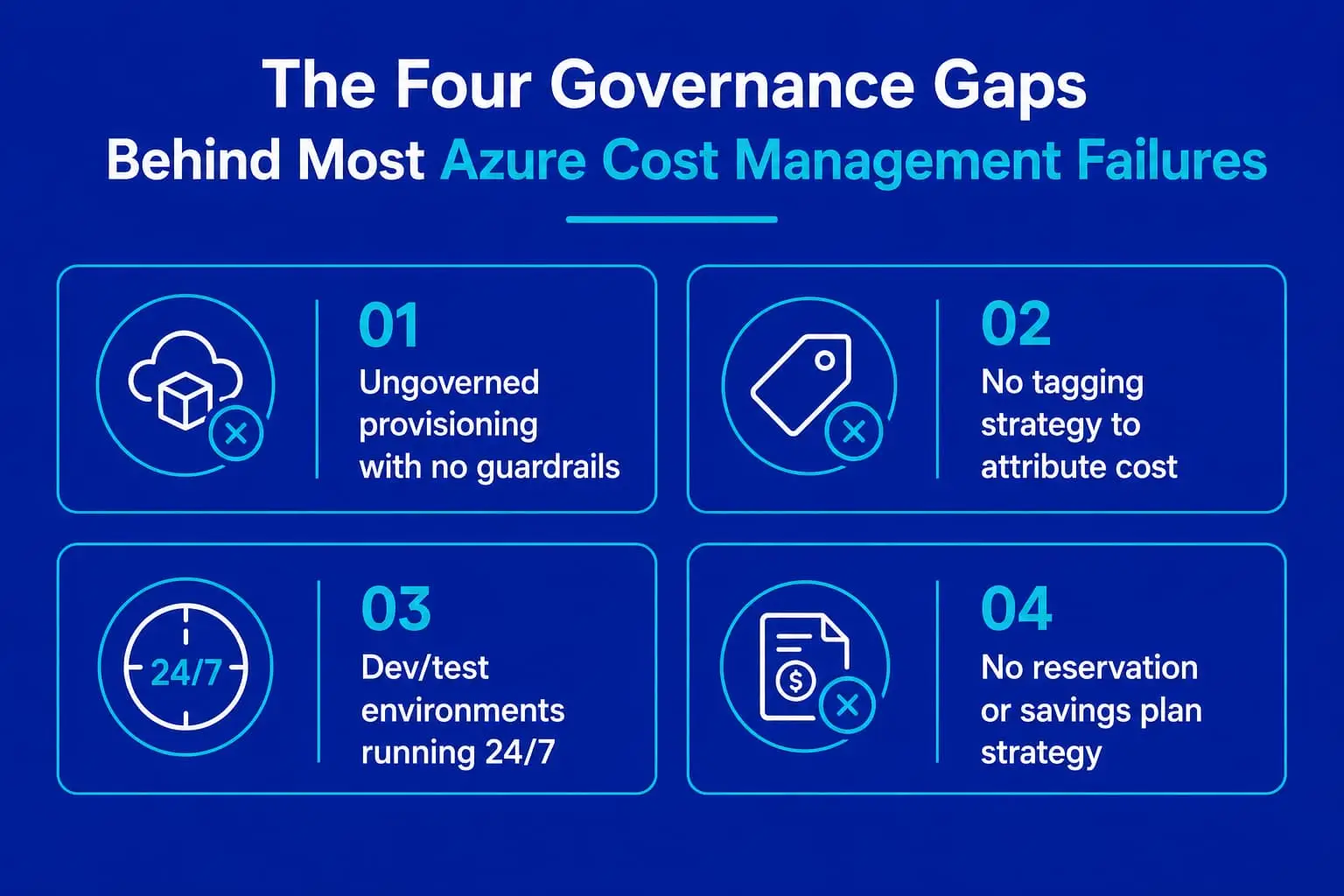
Ungoverned provisioning with no Azure cost management guardrails
When any engineer can spin up resources without policy controls, capacity grows faster than need. Without Azure Policy, budget thresholds, and approval workflows, the environment drifts well above its planned footprint. This is the single largest reason bills land 30 to 60 percent over the initial estimate within the first two quarters of go-live.
No tagging strategy, so Azure cost management cannot attribute spend
If resources are not tagged by business unit, project, environment, and owner, finance receives one undifferentiated number and cannot say which department or product is driving spend, so optimisation stays guesswork. Only a minority of organisations track cloud cost at the unit level. A tagging taxonomy enforced through Azure Policy is the foundation of credible Azure cost management.
Dev and test environments running at production rates around the clock
Non-production workloads rarely need to run 24 hours a day, yet they frequently do, billed at full compute rates through weekends and holidays. Automated start and stop schedules on dev and test resources are among the fastest wins available and cost nothing beyond the governing policy.
No reservation or savings plan strategy for stable workloads
Many Saudi organisations run predictable baseline workloads entirely on pay-as-you-go, the most expensive way to consume Azure. According to Microsoft Azure pricing, an Azure savings plan can cut eligible compute spend by up to 65 percent, while reserved instances reach up to 72 percent on steady workloads, and higher in certain Windows or SQL cases with Azure Hybrid Benefit. A layered approach, reservations for the steady state and savings plans for the flexible remainder, commonly delivers 40 to 55 percent against pay-as-you-go.
The Saudi Context: Azure Cost Management Under NCA ECC and PDPL
Microsoft has confirmed that customers will be able to run cloud workloads from the Saudi Arabia East region, located in the Eastern Province with three availability zones, from Q4 2026. That milestone changes the Azure cost management calculation in a way specific to the Kingdom.
Under the National Cybersecurity Authority Essential Cybersecurity Controls and Cloud Cybersecurity Controls, plus the Personal Data Protection Law overseen by SDAIA, certain data carries residency and sovereignty obligations that dictate which Azure region may host it, and backups, logs, and audit trails all count as data. When the local region opens, organisations will re-architect to place regulated workloads inside the Kingdom, and every placement decision carries a cost consequence through regional pricing, cross-region egress, and replication design.
This is why compliance and cost can no longer sit with separate teams. A re-architecture driven by NCA ECC or PDPL is also a cost event. Treating Azure cost management as a governance discipline rather than a billing afterthought is what lets finance, security, and engineering make those placement decisions once and make them correctly.
Fixing Azure Cost Management Gaps Without Reducing Performance
The fear that holds back cost programmes is that savings come at the expense of performance. Mature practice shows the opposite: organisations in the run phase of FinOps maturity report cloud cost reductions of 20 to 30 percent without degrading performance or reliability, because the savings come from waste, not from capacity workloads actually use. A structured Azure cost management programme works through a clear sequence.
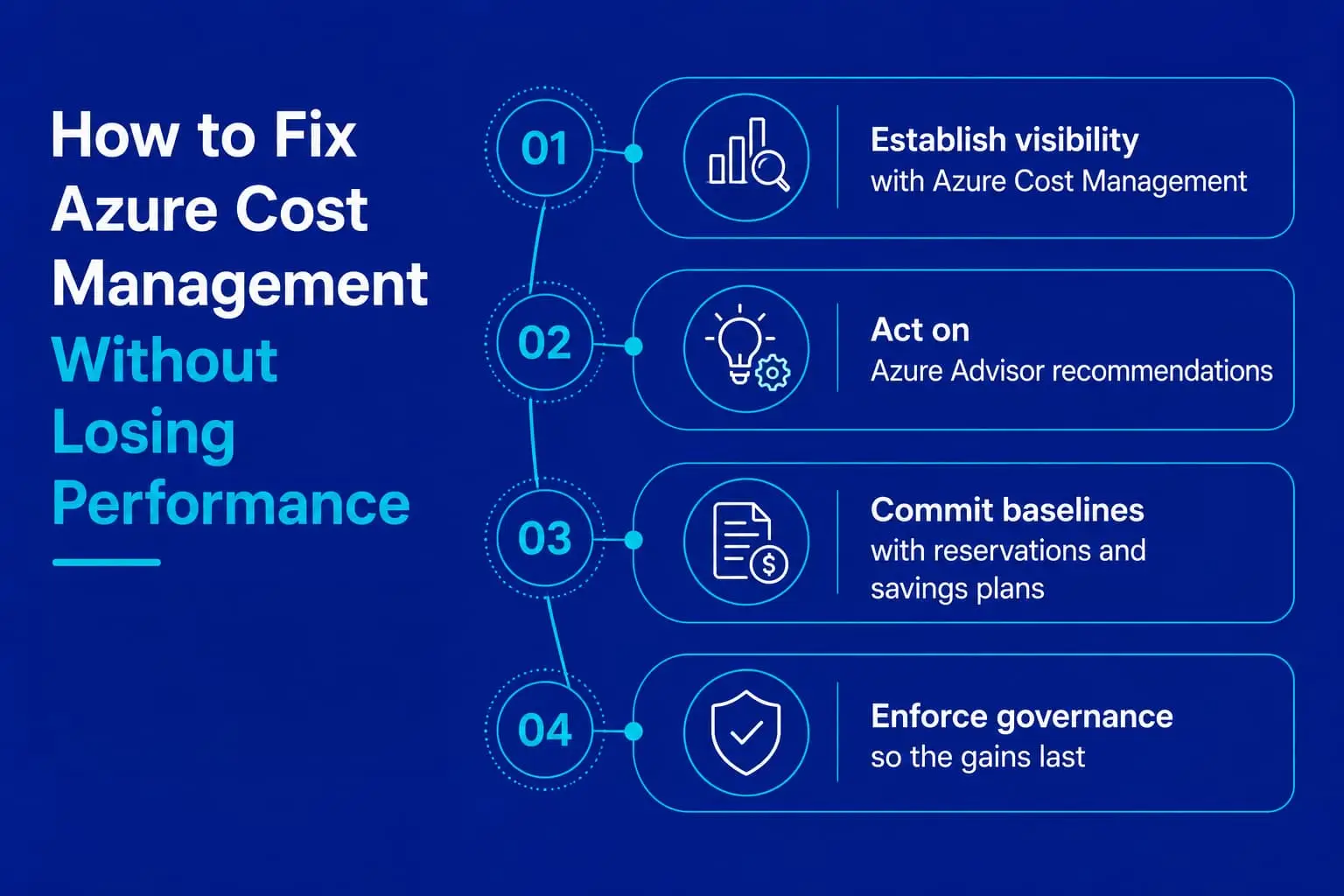
Establish visibility with Azure Cost Management
Azure Cost Management is the native platform for analysing spend, building budgets, configuring alerts, and exporting usage data for financial analysis. Cost views by tag, resource group, and subscription turn an opaque bill into an attributable one, and budget alerts warn finance before an overrun becomes a surprise.
Act on the recommendations from Azure Advisor
Azure Advisor analyses real usage and surfaces specific cost recommendations: right-sizing under-utilised virtual machines, identifying idle resources to decommission, and proposing reservation and savings plan purchases based on the last 30 days of pay-as-you-go consumption. Acting on these systematically, rather than reading them once, is where measurable savings appear.
Commit the stable baseline through reservations and savings plans
Once visibility reveals the genuine steady-state workload, that baseline should move off pay-as-you-go onto reserved instances, with savings plans covering the always-on but variable layer. Planning the commitment level correctly matters, because the wrong level wastes the discount, and this is where advisory expertise pays for itself.
Enforce governance so Azure cost management gains do not erode
Tagging policy, provisioning guardrails through Azure Policy, automated scheduling for non-production resources, and anomaly detection keep the environment disciplined after the cleanup. Without enforcement, the same gaps reopen within a quarter. Governance is what makes Azure cost management a durable practice rather than a one-time project.
How Alnafitha IT Delivers Azure Cost Management in the Kingdom
Closing these gaps requires both Azure engineering depth and a working knowledge of Saudi regulation. Alnafitha IT, a Microsoft partner serving the Kingdom across government and enterprise sectors, delivers Azure FinOps advisory and a cloud governance framework through its Cloud and Digital Innovation unit. The engagement combines Azure Cost Management configuration, Azure Advisor remediation, reservation and savings plan planning, and a tagging and policy framework aligned to NCA ECC and PDPL obligations.
Because the work is grounded in local compliance and commercial reality, placement and architecture decisions ahead of the Saudi Arabia East region are made with both the regulator and the bill in view. You can see the scope of Alnafitha’s cloud computing solutions, and for organisations procuring Azure through a partner, the Microsoft Cloud Agreement (CSP) provides flexible, competitively priced consumption with partner support built in.
Azure Cost Optimisation Assessment
Find out exactly where your Azure spend is leaking and how much you can recover without touching performance. Book your free Azure cost optimisation assessment with Alnafitha IT.
Conclusion
Azure cost overruns in Saudi organisations are not a sign that the cloud was the wrong choice. They are a sign that consumption outran governance. The estimate was sound; the controls that keep reality close to the estimate were missing. Visibility through Azure Cost Management, action on Azure Advisor, the right commitment strategy, and enforced governance recover a quarter to a third of the bill while performance holds steady. With the Saudi Arabia East region arriving in Q4 2026 and compliance now driving architecture, the organisations that treat Azure cost management as a discipline today will be the ones that scale on their own terms tomorrow.
Frequently Asked Questions
What is Azure Cost Management and what does it do?
Azure Cost Management is Microsoft’s native tooling for monitoring, allocating, and optimising Azure spend. It lets teams analyse cost by tag, resource group, and subscription, set budgets and alerts, and export usage data for financial analysis, giving finance and engineering a shared, attributable view of the bill.
Is Azure Cost Management free to use?
Azure Cost Management is available at no additional charge for managing your own Azure usage. Costs only arise if you bring in third-party FinOps tooling on top of it, which is optional and typically considered only at very large spend levels.
How much can Saudi organisations realistically save on Azure?
Organisations with mature cost practices commonly recover 20 to 30 percent of spend without performance loss. Where stable workloads move from pay-as-you-go onto a layered reservation and savings plan strategy, the saving on that committed portion can reach 40 to 55 percent.
How does the Microsoft Saudi Arabia East region affect cost decisions?
The region, confirmed for Q4 2026, lets regulated workloads run inside the Kingdom to meet NCA ECC and PDPL residency requirements. Each placement and replication decision carries a cost effect through regional pricing and egress, so re-architecture for compliance should be planned alongside cost from the outset.
What is the difference between reserved instances and savings plans?
Reserved instances commit to a specific VM family and region for one or three years and offer the deepest discount, up to 72 percent, suiting predictable steady-state workloads. Savings plans commit to a fixed hourly spend that flexes across compute services and regions, up to 65 percent, suiting workloads whose shape changes. Most enterprises use both.
How does Alnafitha IT help with Azure cost management?
Alnafitha IT delivers Azure FinOps advisory and a cloud governance framework using Azure Cost Management, Azure Advisor, and reservation planning, with tagging and policy aligned to Saudi regulatory requirements. Engagements typically begin with a free Azure cost optimisation assessment to quantify the opportunity before any commitment.