

Planning a Microsoft Azure migration in Saudi Arabia? There is more to it than moving workloads to the cloud.
Quick Takeaways
- Microsoft Azure Saudi Arabia East is confirmed for Q4 2026, with three availability zones in the Eastern Province built to full enterprise standards.
- NCA ECC and Cloud Cybersecurity Controls (CCC-2:2024) impose strict data residency and key management obligations on organizations using cloud services in the Kingdom.
- PDPL restricts cross-border data transfers and mandates risk assessments before any workload leaves Saudi borders.
- Veeam Backup for Microsoft Azure enables compliance-aligned data protection with immutability, encryption, and air-gapped backups built for regulated environments.
- Migration stalls when compliance obligations are treated as post-migration tasks. The checklist in this article helps you resolve them upfront.
Why Saudi Regulated Industries Cannot Approach Microsoft Azure Migration the Same Way as Everyone Else
Microsoft Azure migration in the Kingdom of Saudi Arabia carries a layer of complexity that most generic migration frameworks overlook. When your organization operates under the National Cybersecurity Authority (NCA), the Personal Data Protection Law (PDPL), SAMA, or any sector-specific regulatory body, the question is not simply whether your workloads run on Microsoft Azure. The question is whether your Microsoft Azure deployment satisfies the Kingdom’s data residency, sovereignty, and security control requirements from day one.
For organizations in government, financial services, healthcare, and critical national infrastructure, migration stalls are most often caused by one thing: starting the technical work before the compliance groundwork is laid. This article breaks down what you need to resolve before you initiate a single workload move, and explains how Alnafitha IT structures engagements that avoid these blockers entirely.
The Microsoft Azure Saudi Arabia East Region: What It Means for Compliance-Driven Organizations
In February 2026, Microsoft confirmed that customers will be able to run cloud workloads from its Saudi Arabia East datacenter region starting Q4 2026. The region is located in the Eastern Province and includes three availability zones, each with independent power, cooling, and networking infrastructure. This is not a shared or proximity arrangement. It is a full Microsoft Azure region, purpose-built to meet local data residency, low latency, and high availability requirements.
For regulated organizations, this changes the migration calculus significantly. Data that previously could not leave Saudi borders without regulatory risk can now remain within the Kingdom while still running on Microsoft Azure infrastructure. The region is being developed in close coordination with the Saudi Ministry of Communications and Information Technology (MCIT) and is aligned with Vision 2030 digital transformation objectives.
However, the physical presence of a Microsoft Azure region inside Saudi Arabia does not automatically resolve your compliance posture. The controls your organization must implement as a cloud tenant still apply.
NCA ECC and CCC: The Controls Framework Your Microsoft Azure Architecture Must Satisfy
The NCA Essential Cybersecurity Controls (ECC) set the minimum cybersecurity baseline for all organizations in the Kingdom. Any organization adopting cloud services must then layer on the Cloud Cybersecurity Controls (CCC-2:2024), which were updated specifically to address data localization requirements and apply to both cloud service providers and cloud service tenants.
For your Microsoft Azure environment, the CCC framework requires you to:
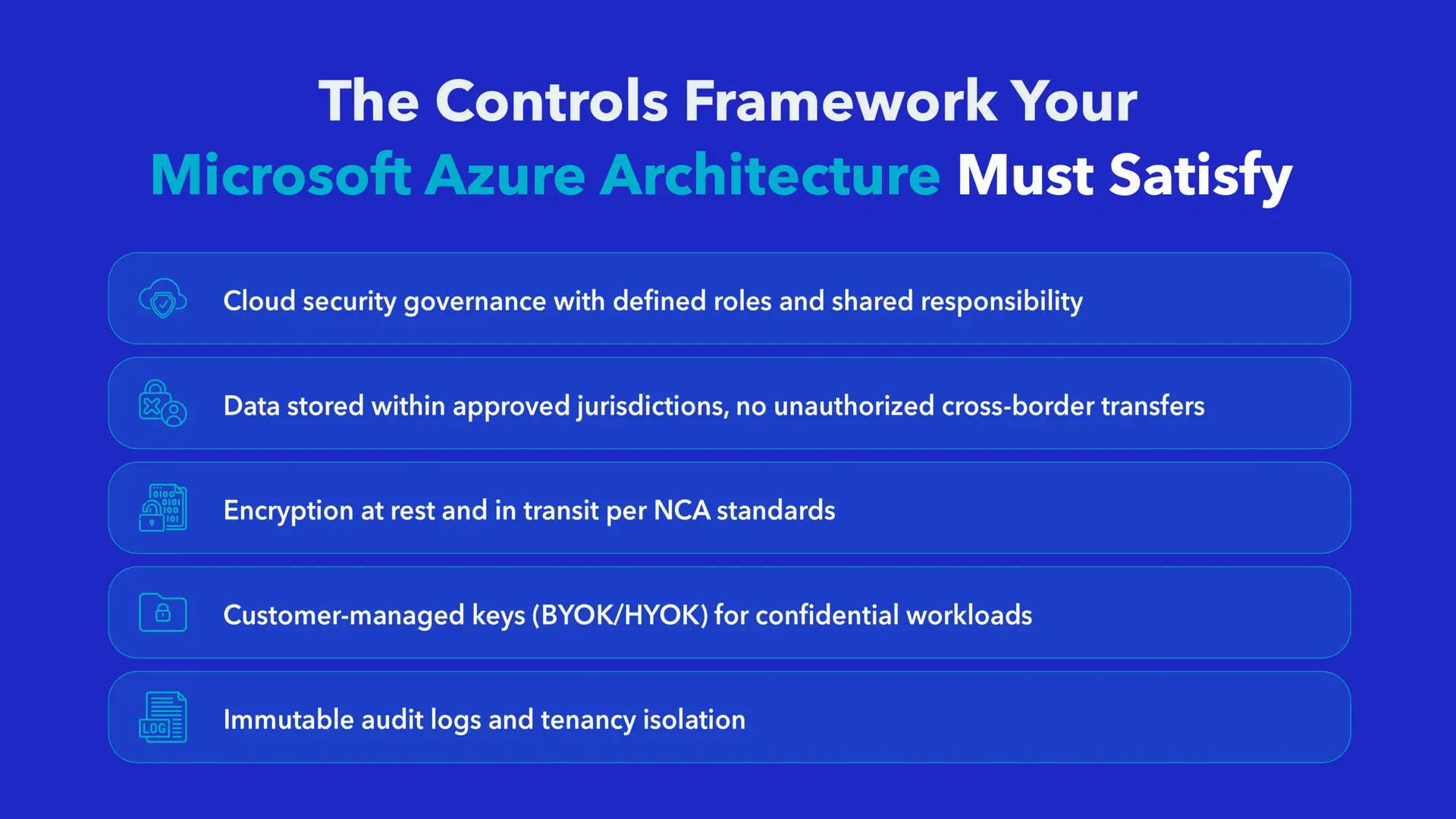
- Establish a cloud security governance framework with defined roles and shared responsibility boundaries
- Ensure all sensitive and classified data is stored within approved jurisdictions, with controls preventing unauthorized cross-border transfers
- Implement encryption for data at rest and in transit using NCA-approved cryptographic standards
- Deploy customer-managed encryption keys (BYOK or HYOK) for workloads classified at confidential level or above
- Maintain detailed logging, immutable audit trails, and tenancy isolation across your Microsoft Azure environment
Microsoft Azure supports all of these requirements at the infrastructure level through services including Azure Key Vault, Microsoft Defender for Cloud, Azure Policy, and role-based access control. But the configuration, governance model, and documentation that maps your controls to NCA requirements are your responsibility as the tenant. This is where most migration projects encounter their first serious delay.
PDPL Data Residency: What Your Cloud Architect Must Classify Before Migration Begins
The Personal Data Protection Law, enforced by SDAIA, places strict conditions on processing and transferring personal data outside Saudi Arabia. Before any data moves to Microsoft Azure, your organization must conduct a full data classification exercise to determine which datasets are subject to residency requirements.
Under PDPL, cross-border data transfers are restricted. They are only permissible when the receiving jurisdiction offers an equivalent level of protection, when the transfer is contractually necessary, or when it serves the Kingdom’s vital interests. For public sector entities and Critical National Infrastructure organizations, NCA CCC requirements effectively mandate that data remain within KSA borders.
The practical implication: your cloud architect needs to map every data category against its residency obligation before selecting Azure regions, configuring replication policies, or enabling geo-redundancy. Enabling geo-redundancy to a region outside Saudi Arabia without this analysis is a compliance risk, not a resilience feature.
Veeam Backup for Microsoft Azure: Data Protection That Holds Up Under Regulatory Scrutiny
Moving to Microsoft Azure does not transfer your data protection obligations to Microsoft. The shared responsibility model is explicit: Microsoft secures the infrastructure; you protect your data within it. For regulated Saudi organizations, this means your backup and recovery architecture must satisfy NCA CCC requirements for business continuity and incident response, as well as PDPL requirements for data integrity.
Veeam Backup for Microsoft Azure addresses this directly. It delivers agentless backup and recovery for Azure VMs, Azure SQL, and Azure Files, with the following capabilities that matter in regulated environments:
- Immutable backups with air-gapped storage, protecting against ransomware and unauthorized deletion
- Encryption at rest and in transit, configurable to meet NCA cryptographic standards
- Policy-based automation that enforces consistent protection across all workloads without manual intervention
- Granular recovery for VMs, files, application items, and SQL databases, with defined RTOs that satisfy business continuity plan requirements
- Veeam Data Cloud Vault, built on Azure Blob with predictable pricing and built-in immutability as the default, not an add-on
For organizations that need to validate recoverability before going live, Veeam Data Platform v13 introduced true instant recovery directly into Microsoft Azure with a secure cleanroom environment. This is not a test feature. It is the mechanism that gives your board and your regulators evidence that your cloud infrastructure can recover within your committed timeframes.
What to Resolve Before You Move: The Pre-Migration Compliance Checklist
Based on Alnafitha’s experience delivering Microsoft Azure infrastructure and cloud migration services to enterprise and government clients across Saudi Arabia, the following items must be resolved before technical migration work begins:
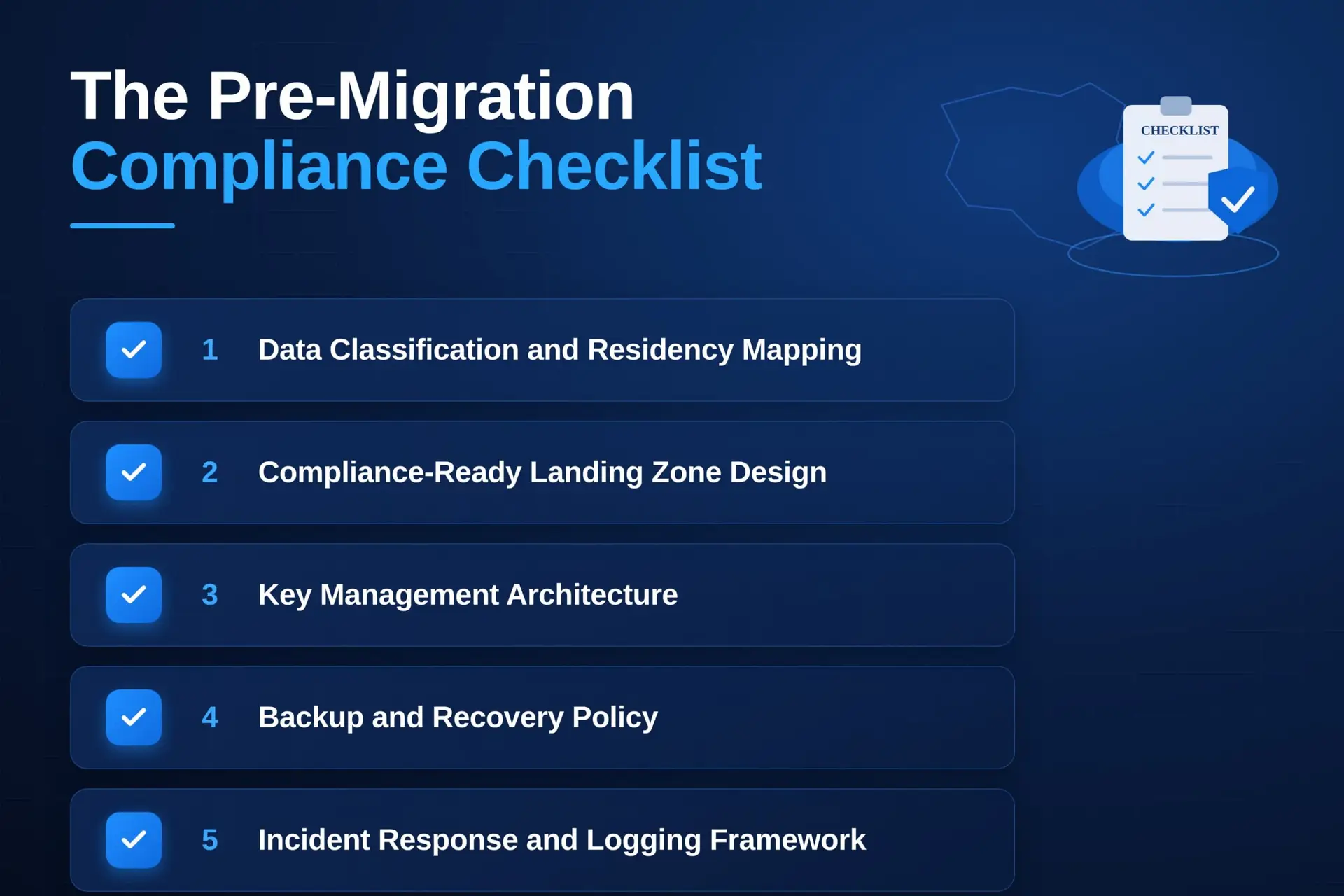
1. Data Classification and Residency Mapping
Identify every data category your organization processes. Classify it against PDPL, NCA CCC, and any sector-specific framework (SAMA for finance, NDMO for government). Document which datasets must remain in-country and configure Microsoft Azure accordingly.
2. Compliance-Ready Landing Zone Design
Your Microsoft Azure landing zone must include governance guardrails, network topology aligned with NCA requirements, role-based access controls, and Azure Policy definitions that enforce your compliance posture from the first resource deployment. A landing zone retrofitted for compliance after migration is significantly more expensive than one designed for it upfront.
3. Key Management Architecture
Determine whether you require customer-managed keys for your data classifications. Configure Azure Key Vault with HSM backing for your most sensitive workloads and document the key management lifecycle for audit purposes.
4. Backup and Recovery Policy
Define your RPO and RTO for each workload tier before migration. Deploy Veeam Backup for Microsoft Azure as part of the landing zone build, not as a post-migration task. Validate recoverability in the cleanroom environment before cutover.
5. Incident Response and Logging Framework
NCA CCC requires defined incident response procedures and immutable logging. Configure Microsoft Sentinel and Azure Monitor with log retention policies that satisfy your regulatory framework, and ensure your SOC team has visibility into your Microsoft Azure environment from day one.
How Alnafitha IT Structures Microsoft Azure Migration for Saudi Regulated Environments
Alnafitha IT has been delivering Microsoft infrastructure, cloud, and cybersecurity solutions to public and private sector organizations across Saudi Arabia since 1993. As a Microsoft partner and Veeam partner, Alnafitha brings both the technical depth to design compliant Microsoft Azure environments and the regulatory familiarity to navigate NCA ECC, CCC, and PDPL requirements at the architecture level.
Alnafitha’s cloud migration approach starts with a compliance and data residency assessment before any infrastructure work begins. This maps directly to the pre-migration checklist above and ensures your Microsoft Azure environment is built to satisfy NCA and PDPL requirements from the first deployment. Explore Alnafitha’s cloud computing solutions for infrastructure, backup, migration planning, and cloud security.
For organizations with specific NCA ECC and CCC compliance obligations, Alnafitha’s cybersecurity solutions practice covers cloud security controls implementation, key management architecture, and audit-ready documentation aligned with NCA frameworks.
Conclusion
The Microsoft Azure Saudi Arabia East region arriving in Q4 2026 removes the single biggest obstacle that regulated Saudi organizations faced when evaluating cloud migration: data residency uncertainty. Local availability zones mean your most sensitive workloads can now run on Microsoft Azure without leaving the Kingdom.
But residency is a condition, not a complete compliance posture. NCA ECC, CCC-2:2024, and PDPL together create a framework of technical and governance obligations that must be designed into your Microsoft Azure architecture from the start. Organizations that treat compliance as a post-migration task consistently spend more time and money fixing what could have been built correctly once.
The IT directors and cloud architects who move earliest on this planning, before the region goes live, are the ones who will be running production workloads with regulatory confidence on day one.
Ready to Plan Your Microsoft Azure Migration?
Alnafitha IT’s cloud and compliance team works with IT directors and cloud architects across Saudi Arabia to design Microsoft Azure environments that satisfy NCA ECC, CCC, and PDPL requirements before migration begins. If your organization is evaluating Microsoft Azure or planning a migration in 2025 or 2026, speak with our cloud experts today to start with an assessment.
Frequently Asked Questions
When will the Microsoft Azure Saudi Arabia East region be available for production workloads?
Microsoft confirmed in February 2026 that the Saudi Arabia East datacenter region will be available for customer workloads starting Q4 2026. The region is located in the Eastern Province and includes three availability zones with independent power, cooling, and networking.
Does hosting data on Microsoft Azure in Saudi Arabia automatically satisfy NCA data residency requirements?
Not automatically. The physical location of the datacenter resolves the geographic residency condition, but your organization still needs to configure Microsoft Azure correctly. This includes disabling geo-replication to non-Saudi regions for classified data, implementing customer-managed encryption keys, and establishing the governance controls required under NCA CCC-2:2024.
What is the difference between NCA ECC and NCA CCC?
The Essential Cybersecurity Controls (ECC) define the minimum cybersecurity baseline for all organizations in the Kingdom across five domains. The Cloud Cybersecurity Controls (CCC) are a specialized extension of the ECC that apply specifically when an organization uses cloud services, covering governance, data residency, technical protection, and shared responsibility between cloud providers and tenants. Both are mandatory for organizations subject to NCA oversight.
Does PDPL apply to all data stored on Microsoft Azure, or only personal data?
PDPL applies specifically to personal data, defined as any information that relates to a natural person who can be identified directly or indirectly. However, sector-specific requirements under NCA CCC and NDMO data governance frameworks extend residency and classification obligations beyond personal data to other categories of sensitive or government data. A full data classification exercise is the only reliable way to determine which rules apply to which datasets.
Why is Veeam Backup recommended alongside Microsoft Azure rather than relying on Azure-native backup?
Microsoft Azure’s native backup capabilities cover basic recovery scenarios, but regulated organizations require immutable, air-gapped backups with granular recovery, policy enforcement, and audit-ready documentation. Veeam Backup for Microsoft Azure provides these capabilities natively, with encryption configurable to NCA standards, defined RPO/RTO enforcement, and the cleanroom recovery validation that compliance teams and auditors expect.
How long does a compliant Microsoft Azure migration typically take for a Saudi regulated organization?
Timelines vary significantly based on workload complexity, data classification requirements, and the state of existing documentation. A typical enterprise migration that includes compliance assessment, landing zone design, Veeam deployment, and phased workload migration runs between three and nine months. Organizations that begin with a pre-migration assessment and completed data classification consistently complete migrations faster than those that start with infrastructure work.