

Smart Brief: Broadcom’s subscription-only VMware model has pushed renewal costs up by 2x to 5x for many Saudi enterprises, turning a routine procurement line into a board-level decision. This guide breaks down the licensing impact, the realistic migration options, and how IT Directors and Cloud Architects can build a defensible business case for VMware to Azure migration that satisfies NCA, PDPL, and NDMO requirements from day one.
The Broadcom Licensing Shock Driving VMware to Azure Migration
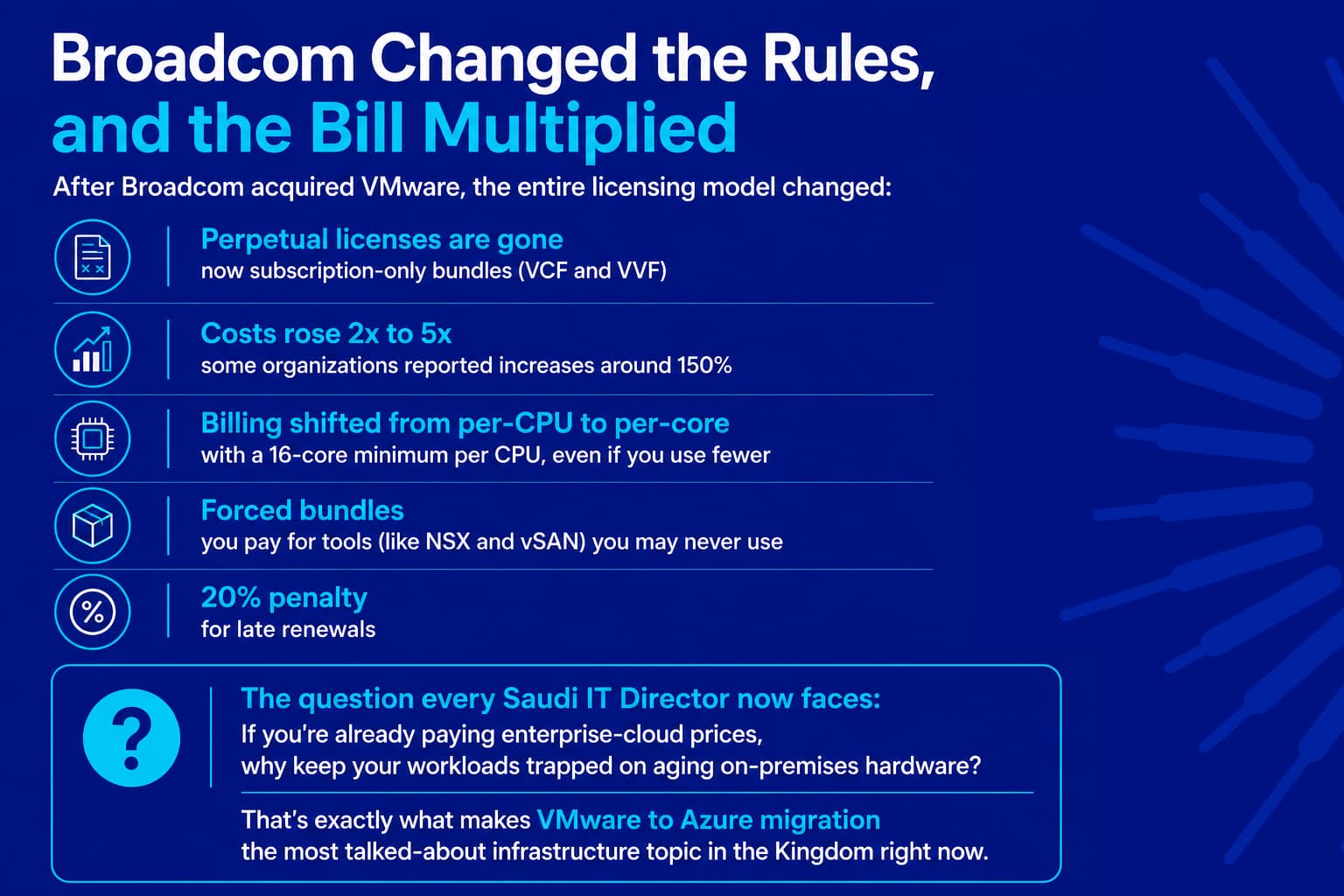
For more than a decade, VMware was the quiet foundation underneath most Saudi data centers. Then Broadcom completed its acquisition and rewrote the commercial model. Perpetual licenses were eliminated entirely and replaced with subscription-only bundles, primarily VMware Cloud Foundation (VCF) and vSphere Foundation (VVF). The roughly 8,000 individual VMware SKUs collapsed into a handful of mandatory packages, and billing moved from a per-CPU model to per-core with a minimum of sixteen cores charged per physical CPU.
The result is not a gentle increase. Independent advisors who benchmarked dozens of post-acquisition renewals report that annual costs rose two to five times for vSphere-only estates moving to the full VCF bundle, with some organizations reporting net increases around 150 percent. Core minimums alone inflate small-host estates by 20 to 40 percent versus the cores actually in use, because a host with eight or twelve core CPUs is still billed at sixteen. Add forced bundling of NSX and vSAN capabilities many teams never deployed, a 20 percent penalty for late renewals, and a shrunken reseller ecosystem, and the picture is clear: the architecture decisions that depended on the old economics no longer hold.
For Saudi IT Directors planning Vision 2030-aligned modernization, this is the moment to ask a harder question. If you are paying enterprise-cloud prices anyway, why keep the workloads trapped on aging on-premises hardware? That single question is what makes VMware to Azure migration the most discussed infrastructure topic in the Kingdom right now.
What VMware to Azure Migration Actually Means
VMware to Azure migration is the process of moving virtualized workloads off on-premises VMware infrastructure and into Microsoft Azure. It is not one path but a spectrum, and choosing the right one is where most projects succeed or stall.
At one end sits Azure VMware Solution (AVS), a first-party Microsoft service verified by VMware that runs your familiar vSphere, vSAN, and NSX stack on dedicated Azure infrastructure. Workloads move largely as-is, so applications need little or no refactoring and your team keeps using the tools and skills it already has. AVS is widely regarded as the lowest-risk first step, particularly for organizations facing a renewal deadline who cannot afford a multi-year re-architecture.
At the other end sits native migration, where virtual machines are rehosted onto Azure IaaS or modernized into platform services. This delivers the strongest long-term economics through elasticity and automation but demands deeper assessment and planning. Most Saudi enterprises land on a phased approach: relieve the immediate licensing pressure first, then modernize selectively once workloads are stable in the cloud.
Why Assessment Comes Before You Migrate
The most expensive migration mistakes happen before a single workload moves. Teams that skip discovery routinely over-provision in the cloud, miss application dependencies, and inherit compliance gaps they only discover during an audit. This is why a structured pre-migration assessment is non-negotiable for any serious VMware to Azure migration.
A proper assessment maps your application dependencies so workloads that belong together move together, analyzes on-premises server utilization against future cloud sizing, and produces a cost model grounded in your real usage rather than vendor list prices. Alnafitha’s Cloud Assessment service delivers exactly this: on-premises server assessment, database and application dependency mapping, and a cost-optimization analysis that becomes the evidence base for your business case. It also includes a Microsoft-sponsored assessment track, giving you a prioritized, Azure-specific set of recommendations before you commit budget.
For organizations still rationalizing their hypervisor footprint, Alnafitha’s virtualization platform services cover implementation, infrastructure upgrades, and health checks, ensuring the source environment is well-architected before anything migrates.
Keeping Your VMware to Azure Migration Compliant in Saudi Arabia
Cost is the trigger, but compliance is the constraint. Any VMware to Azure migration in the Kingdom must align with the regulatory landscape from the design phase, not bolt it on later.
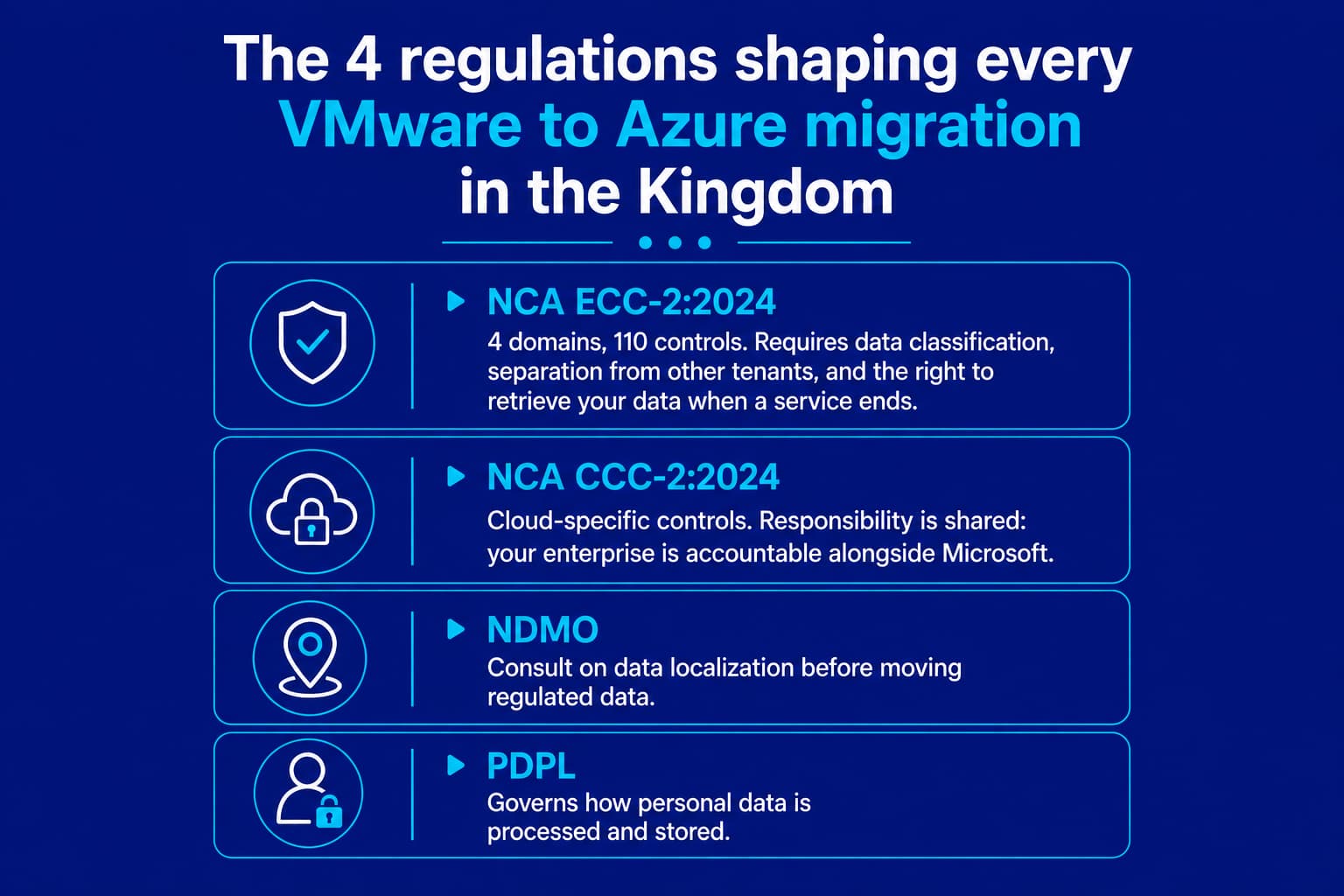
The updated NCA Essential Cybersecurity Controls (ECC-2:2024) restructure the framework into four domains and 110 controls, with explicit requirements for cloud computing and hosting: data classification, ensuring your data is separated from other entities’ environments, and the right to return data in a usable format when a service ends. The companion Cloud Cybersecurity Controls (CCC-2:2024) extend these obligations to both cloud service providers and cloud service tenants, meaning your enterprise carries responsibility alongside Microsoft. On data residency, the NCA now points organizations to consult the National Data Management Office (NDMO) on localization before moving regulated data, while PDPL governs how personal data is processed and stored. Microsoft’s data center region inside Saudi Arabia gives enterprises a strong path to satisfy these residency expectations without sacrificing Azure’s full service catalog.
The practical takeaway: build compliance controls into the migration architecture itself. A workload landing in Azure should already enforce data classification, network separation, and continuity requirements, not wait for a remediation project after go-live.
Building the Business Case for VMware to Azure Migration
A business case that wins board approval rests on four pillars, and a credible VMware to Azure migration proposal addresses all of them.
First, total cost of ownership. Compare the trajectory of VCF renewal costs, including core minimums and escalators, against an Azure consumption model. The honest comparison is not today’s bill versus tomorrow’s; it is the three-year curve under each scenario. Second, risk reduction. Quantify the exposure of staying: late-renewal penalties, audit risk, and hardware refresh cycles you can retire by exiting the data center. Third, compliance value. Position alignment with NCA ECC-2, CCC-2, PDPL, and NDMO guidance as a benefit delivered by the migration, not a cost. Fourth, business agility. Azure’s elasticity lets you scale for seasonal demand, integrate AI services, and shorten delivery cycles that fixed on-premises capacity simply cannot match.
This is also where resilience enters the case. Pairing migration with a modern continuity plan, such as Alnafitha’s disaster recovery and backup services, converts a defensive move into a strategic upgrade. The same workloads that were a licensing liability become the foundation for a more resilient, audit-ready estate.
How Alnafitha Delivers VMware to Azure Migration at Enterprise Scale
Migration projects fail on execution, not strategy. As a Microsoft partner with deep experience across the Saudi market and more than 7,000 customers, Alnafitha approaches VMware to Azure migration through a vendor-aware, assessment-first methodology: define objectives, analyze the current infrastructure, evaluate the right deployment model, and validate security and compliance before execution begins.
That end-to-end model, spanning assessment, migration, and post-migration optimization, is what separates a controlled transition from a costly improvisation. For enterprises weighing a Broadcom renewal against a cloud future, the cost of a thorough assessment is trivial next to the cost of getting the migration path wrong.
The Broadcom renewal clock is already running for most Saudi enterprises. The organizations that move first are not the ones who panic; they are the ones who assess, model the numbers, and build the case before the next invoice lands.
Ready to model your own VMware to Azure migration? Talk to Alnafitha’s migration team to start with a structured assessment built for the Saudi regulatory landscape.
Frequently Asked Questions
How much can a VMware to Azure migration save compared to renewing with Broadcom? Savings depend on your core count, current bundle, and workload profile. Many Saudi enterprises facing VCF renewals at two to five times their previous cost find that a phased Azure migration improves the three-year total cost of ownership, especially once hardware refresh and late-renewal penalties are factored in. A proper cost assessment is the only way to get an accurate figure for your environment.
Is Azure VMware Solution the same as migrating to native Azure? No. Azure VMware Solution (AVS) runs your existing VMware stack on Azure infrastructure with minimal changes, making it the fastest, lowest-risk first step. Native migration rehosts or modernizes workloads onto Azure IaaS and PaaS for stronger long-term economics. Most enterprises start with one approach and modernize selectively over time.
How do we keep a VMware to Azure migration compliant with NCA and PDPL? Compliance must be designed into the migration architecture. That means enforcing data classification and network separation per NCA ECC-2:2024 and CCC-2:2024, consulting the NDMO on data localization for regulated workloads, and aligning personal data handling with PDPL. Using Microsoft’s Saudi data center region helps satisfy residency expectations while retaining full Azure capabilities.
Do we need to refactor our applications before migrating? Not necessarily. With Azure VMware Solution, workloads move largely as-is, so most applications require little or no refactoring. Refactoring becomes relevant only when you choose to modernize specific workloads into cloud-native services, which can be done gradually after the initial migration stabilizes.
How long does a VMware to Azure migration take? Timelines vary with estate size and complexity, but the assessment phase typically defines the schedule. A structured pre-migration assessment that maps dependencies and sizing lets you sequence workloads in waves, reducing risk and avoiding the open-ended timelines that derail rushed projects.