

In offices across Riyadh, cloud migration plans have been sitting on hold, waiting for one thing: a local Azure region. This November, the waiting ends. Microsoft has confirmed its Azure Saudi Arabia region goes live, and the companies that already know which workload to move first will pull ahead of the ones still deciding.
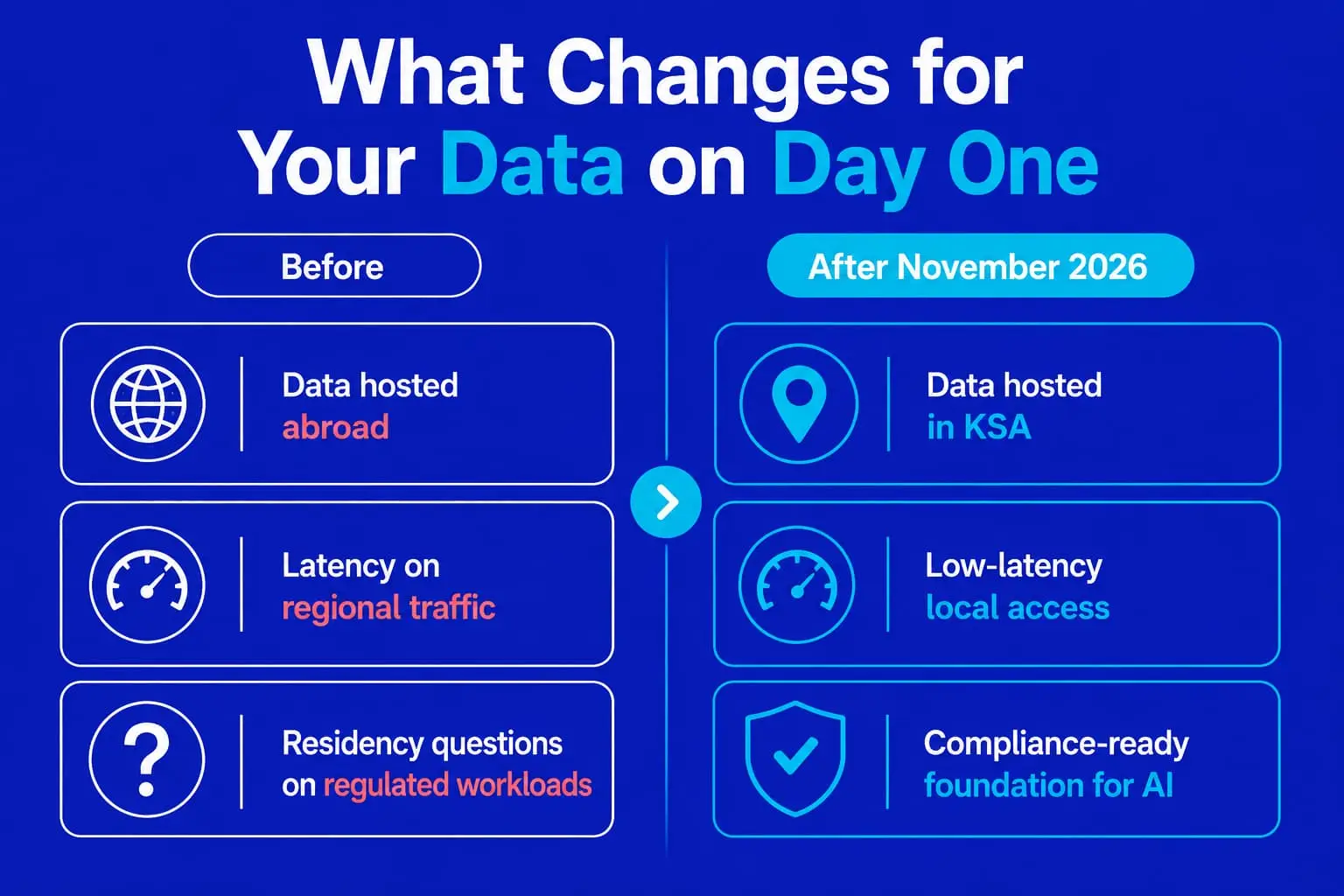
The region is built in the Eastern Province across three Availability Zones. What that gives you, in plain terms: local data residency, enterprise-grade security, and low-latency access to cloud and AI services, all inside the Kingdom.
The market has been waiting for this. One of the most common things Saudi decision-makers type into search is a version of the same question: when will Azure be available in Saudi Arabia? That question now has an answer, and it shifts the conversation from “if” to “how fast.”
Why the Azure Saudi Arabia Region Changes the Math
The numbers are hard to ignore. An IDC study projects that Microsoft, its partners, and customers using its cloud will generate an estimated $44 billion in new revenue for the Saudi economy between 2027 and 2030, with the new region contributing roughly 13.4% of that value.
But the strategic shift matters more than the headline figure. Regulated sectors, finance, healthcare, and government, held back specific workloads for one reason: the data had to stay in the Kingdom. A local region removes that blocker. Data residency stops being the reason not to migrate. For the full picture of what this means for compliance and performance, we covered what Microsoft’s new datacenter region means for your workloads when the timeline was first confirmed.
First-mover advantage is real, and short
Here’s the part most announcements skip: a region going live is not a migration. Turning on the infrastructure is the easy half. The hard half is knowing which workloads move first, mapping your application dependencies and readiness, and making the move without downtime.
That skill doesn’t change with the logo on the cloud. Over 30 years, we’ve moved Saudi organizations onto the platform that fits them, whether that meant taking Saudi Gulf Airlines from aging on-premise servers to a scalable cloud architecture, or migrating Ladun Investment Company with zero downtime to the business.
When the Azure Saudi Arabia region opens, that same discipline is what turns a new data center into your competitive edge, not a risky lift-and-shift.
The region opens the door. Whether your organization walks through it first, or watches competitors do it, is the decision on the table now.
Planning your move to the Azure Saudi Arabia region? Let’s map your first workload together.
Frequently asked questions
How do I choose the right cloud provider for a business in Saudi Arabia?
Match the platform to your workloads, compliance needs, and existing stack, not to the loudest brand. If you already run Microsoft 365, Dynamics, or Windows Server, the Azure Saudi Arabia region keeps that ecosystem consistent and your data local. The safest way to decide is a short assessment that maps your environment before you commit.
What are the data residency rules for cloud services in KSA?
Under the Personal Data Protection Law (PDPL), enforced by SDAIA, transferring the personal data of Saudi residents outside the Kingdom is restricted unless specific conditions are met, and organizations in regulated sectors must also align with the National Cybersecurity Authority (NCA) controls. A local Azure region lets you keep that data inside Saudi Arabia by design, which simplifies much of this.
How much does it cost to migrate to the Azure Saudi Arabia region?
There’s no single price, and any provider quoting one before seeing your environment is guessing. Migration cost depends on how many workloads you move, how complex your dependencies are, and how much gets modernized along the way versus lifted as-is. What controls the final number most is planning: a proper assessment prevents the surprise costs that come from migrating the wrong workload first. We scope it against your actual environment, so you get a real figure, not a range. Request a scoped estimate.
How long does migration to the Azure Saudi Arabia region take?
It depends on scope, not on the provider. A single application with clean dependencies moves far faster than a full estate of regulated workloads, where testing and compliance can’t be rushed. Rather than guess at a timeline, the teams that finish fastest assess first and move the right workload first, instead of migrating everything at once and firefighting later. A scoped assessment gives you a realistic timeline for your specific environment.