

Business continuity plan: Brief Takeaways
- In Saudi Arabia, a documented business continuity plan that has never been tested no longer satisfies regulators. ISO 22301, the NCA Essential Cybersecurity Controls, and the SAMA Cyber Security Framework all treat validation, not paperwork, as the proof of resilience.
- The most common audit finding is a credibility gap: a polished plan on the shelf and no evidence it works when systems actually fail.
- ISO 22301 Clause 8.5 makes exercising and testing a mandatory part of the standard, with formats ranging from tabletop walkthroughs to full failover drills.
- For CIOs and Risk Officers, the exposure is concrete: failed assessments, regulatory penalties, and recovery capability that collapses under real pressure.
- Alnafitha IT delivers the full validation lifecycle, from gap assessment and business impact analysis to ISO 22301 implementation and tested disaster recovery, so your plan holds up under scrutiny.
The Document Exists. The Capability Might Not.
Most large Saudi enterprises already own a business continuity plan. It was written, approved, filed, and in many cases forgotten. The uncomfortable question that auditors now ask is simpler than the document itself: when did you last prove it works?
This is where the gap appears. A business continuity plan is a set of assumptions about how your organization recovers when a cyberattack, outage, or natural disruption hits. Until those assumptions are tested, they remain assumptions. Recovery time targets that look reasonable on paper routinely fail in practice because a dependency was missed, a contact list went stale, or a backup was never validated end to end. The plan was real. The capability was not.
Saudi regulators have caught up to this distinction, and that shift is what turns an untested plan from a minor housekeeping issue into a compliance liability.
Why Your Business Continuity Plan Now Needs Testing for Compliance, Not Just Best Practice
Three frameworks shape how Saudi organizations are judged on continuity, and all three have moved the same direction.
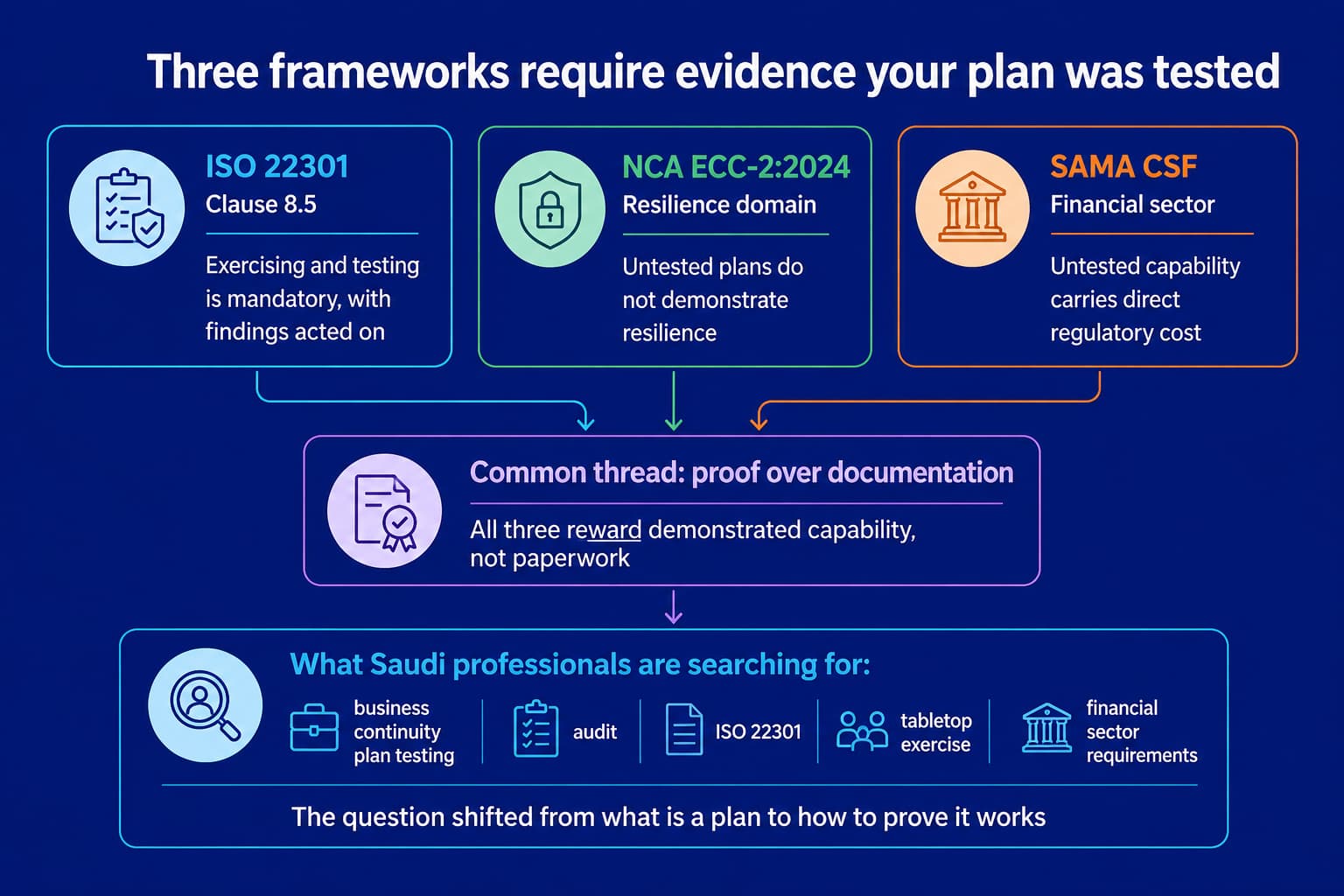
ISO 22301 is the international standard for business continuity management systems. Its Clause 8.5 is explicit: organizations must establish a programme of exercising and testing to validate continuity arrangements against defined objectives, then evaluate the results and act on the gaps. The standard’s own framing pushes back on the idea that continuity is a binder nobody opens. A certified business continuity management system is judged on demonstrated capability, not on the existence of a business continuity plan iso 22301 auditors can flip through. You can review the standard’s scope directly through the ISO 22301 standard page.
NCA Essential Cybersecurity Controls (ECC-2:2024) fold cybersecurity resilience directly into the core framework through the Business Continuity Management domain. For government entities, critical infrastructure operators, and essential service providers, the National Cybersecurity Authority requires evidence that continuity and incident response plans have actually been exercised. Documented plans that have never been tested do not demonstrate resilience, and that is precisely the standard an assessor applies. The official controls are published on the NCA regulatory documents portal.
SAMA Cyber Security Framework holds regulated financial institutions, including banks, insurers, and financing companies, to continuity and recovery expectations where untested capability carries direct regulatory consequence. In a sector where downtime translates into customer harm and reputational damage within minutes, a business continuity plan and disaster recovery posture that has not been validated is a finding waiting to happen.
The common thread is that all three frameworks now reward proof over documentation. The interesting demand signal sits in the search behavior of Saudi professionals themselves. Queries like business continuity plan testing, business continuity plan audit, tabletop exercise, and business continuity plan iso 22301 appear consistently in the local market, alongside direct questions about regulatory requirements for the financial sector. The audience is no longer asking what a plan is. They are asking how to prove theirs works.
What Real Business Continuity Plan Testing Looks Like
Testing is not a single event. ISO 22301 expects a progression of exercise types, each validating a different layer of readiness. Mature programs in the Kingdom typically work through several of these:
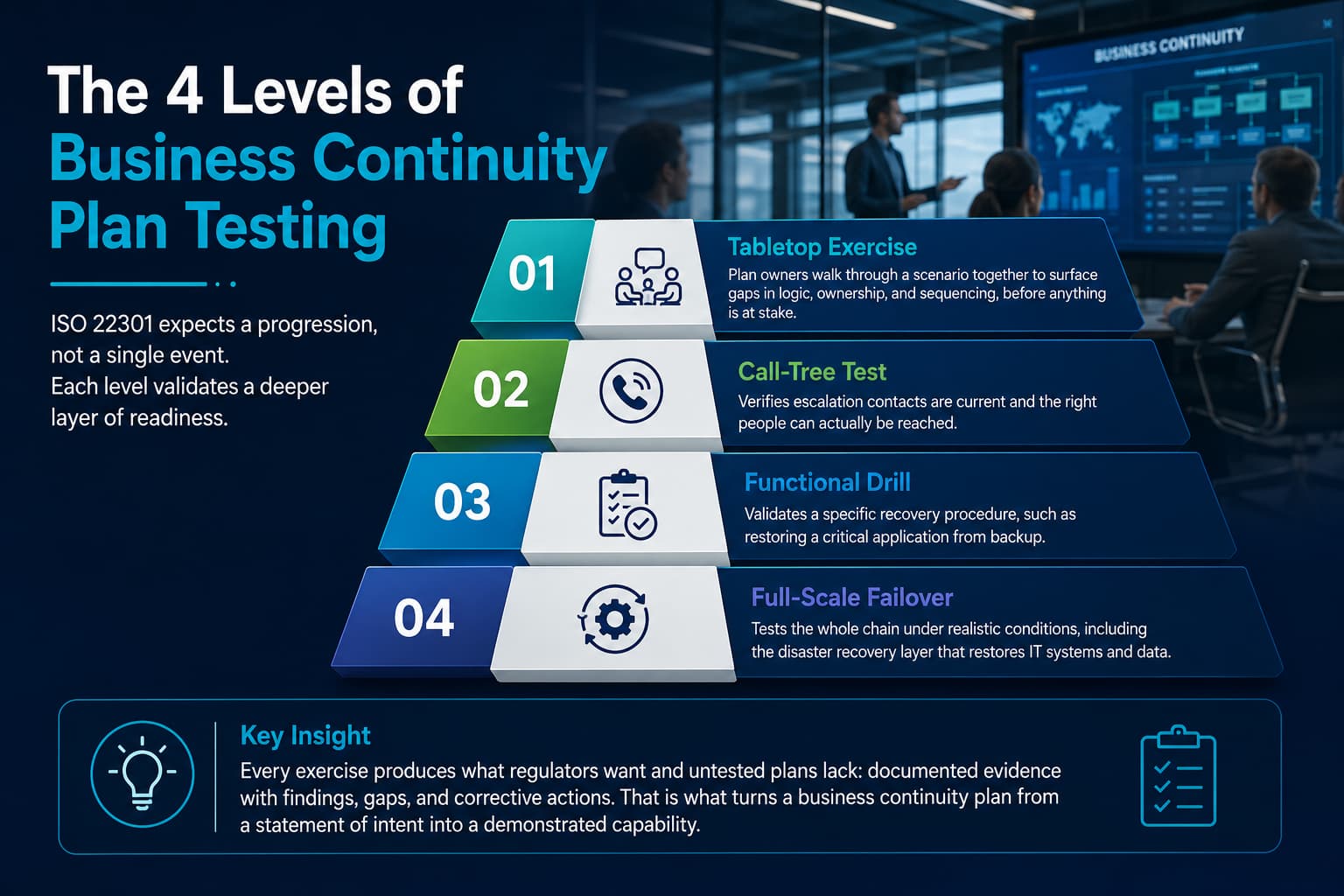
A tabletop exercise brings plan owners together to walk through a scenario and surface gaps in logic, ownership, or sequencing before anything is at stake. A call-tree test verifies that escalation contacts are current and that the right people can actually be reached. A functional drill validates a specific recovery procedure, such as restoring a critical application from backup. A full-scale failover tests the whole chain under realistic conditions, including the disaster recovery layer that restores IT systems and data.
Each exercise produces the one thing regulators want and untested plans lack: documented evidence, with findings, gaps, and corrective actions. That evidence is what converts a business continuity plan from a statement of intent into a demonstrated capability. It is also what distinguishes organizations that pass assessments from those that scramble through them.
The relationship between continuity and recovery matters here too. A business continuity plan keeps the organization operating; disaster recovery restores the underlying technology. They are tested together because they fail together. If you want the distinction mapped out clearly, Alnafitha covers it in Business Continuity Plan vs Disaster Recovery: Key Differences Explained.
How Alnafitha IT Closes the Gap Between Plan and Proof
Validating continuity capability requires more than a template. It requires a partner who understands both the international standard and the Saudi regulatory context, and who can carry an organization from assessment all the way to a tested, audit-ready posture. This is where Alnafitha IT operates.
The starting point is gap assessment and auditing. Alnafitha’s business continuity consultants review your current arrangements against the standards and frameworks that apply to you, identify where documentation and capability diverge, and produce a clear view of what passes an audit and what does not. This is the diagnostic that tells a CIO or Risk Officer exactly where the exposure sits.
From there, the work moves into business impact analysis and ISO 22301 implementation. Alnafitha designs a business continuity management system sized to the organization, establishes recovery priorities grounded in actual business impact, and builds the exercise and testing programme that Clause 8.5 demands. The deliverable is not a document. It is a system that has been validated and can prove it. These services sit within Alnafitha’s Business Continuity Management practice.
Underneath the management system, the technical layer has to hold. Alnafitha’s disaster recovery and backup capabilities ensure that recovery targets are achievable rather than aspirational, and that the failover steps in your plan have been executed, not just written. The continuity strategy and the IT recovery capability are tested as one chain, which is the only way to expose the dependencies that untested plans hide.
Finally, continuity testing feeds the wider governance picture. For organizations managing NCA ECC or SAMA obligations, Alnafitha’s risk and compliance services connect business continuity evidence to the broader cybersecurity governance program, so a single tested capability satisfies multiple regulatory demands at once.
With more than three decades in the Saudi market and the trust of over 7,000 organizations across government and enterprise sectors, Alnafitha brings the regional fluency that international templates cannot. The team knows which frameworks apply to which sectors, what assessors look for, and how to turn a shelved business continuity plan into a capability that survives contact with a real disruption.
Conclusion: Proof Is the New Plan
The era when a documented business continuity plan was enough has closed in Saudi Arabia. ISO 22301, NCA ECC-2:2024, and the SAMA framework now measure resilience by what an organization can demonstrate under pressure, and an untested plan demonstrates nothing. For CIOs and Risk Officers, the risk is no longer that a plan does not exist. It is that the existing plan creates false confidence and a documented compliance failure the moment it is examined.
Closing that gap is straightforward with the right partner. Validate the plan, test the recovery, and capture the evidence before an auditor or an incident does it for you.
Talk to Alnafitha’s business continuity specialists to assess, test, and prove your business continuity plan against the standards that govern your sector.
Frequently Asked Questions
Is business continuity plan testing mandatory in Saudi Arabia? For organizations under NCA ECC, SAMA, or pursuing ISO 22301 certification, yes in practice. ISO 22301 Clause 8.5 requires an exercise and testing programme, and the NCA requires evidence that continuity and incident response plans have been tested. A plan that exists but has never been exercised does not satisfy these expectations.
How often should a business continuity plan be tested? The frameworks do not fix a universal interval. Frequency should reflect your risk profile and the criticality of your operations, with high-impact systems tested more often. An annual cycle of exercises, supplemented by tests after any significant change to systems or processes, is a common baseline for Saudi enterprises.
What is the difference between a business continuity plan and disaster recovery? A business continuity plan covers how the whole organization keeps operating during a disruption, spanning people, processes, and technology. Disaster recovery focuses specifically on restoring IT systems and data. They are complementary and are most effective when built and tested together.
Which Saudi regulations require a tested business continuity plan? The main ones are ISO 22301 for certified continuity management, the NCA Essential Cybersecurity Controls (ECC-2:2024) Business Continuity Management domain for government and critical infrastructure entities, and the SAMA Cyber Security Framework for regulated financial institutions.
What is a tabletop exercise? A tabletop exercise is a discussion-based test where plan owners walk through a realistic disruption scenario together, examining how they would respond and documenting gaps in the plan. It is a low-cost, high-value first step that surfaces weaknesses before a functional drill or full failover.
Can Alnafitha help us pass an ISO 22301 or NCA ECC audit? Yes. Alnafitha provides gap assessment, business impact analysis, ISO 22301 business continuity management system implementation, disaster recovery validation, and the exercise programme that produces audit-ready evidence. The goal is a tested capability that holds up under regulatory assessment, not just a compliant-looking document.