

Digital transformation consulting: key takeaways
- Most transformation programs stall not because the technology is wrong, but because the strategy never reaches delivery. Only about one in three reaches its stated goals.
- A workable enterprise strategy rests on five connected pillars: governance, cloud, data, AI, and security. Treating any one in isolation is the fastest route to a stalled program.
- In Saudi Arabia these pillars carry regulatory weight. NCA ECC-2:2024, SAMA CSF, and the PDPL under SDAIA turn good practice into a compliance baseline.
- The right advisory partner earns its value by sequencing these pillars against measurable outcomes, not by producing a slide deck that sits unused.
Saudi boardrooms are not short on digital ambition. Budgets get approved, vendors get shortlisted, and pilots launch with real momentum. Then the program slows. The cloud migration outpaces the data strategy. Security gets bolted on at the end. Business units build in silos, and nobody can point to the return. Eighteen months later, the transformation looks impressive on paper and delivers very little.
This pattern sits behind a sobering number. Boston Consulting Group’s analysis of more than 850 organizations found that only around 35 percent of digital transformation programs achieve their objectives. Across BCG and McKinsey research, the consistent culprit is not weak technology. It is the absence of an enterprise strategy that sequences the work, aligns the business units, and ties every initiative to a measurable outcome.
The strategy itself is knowable. A transformation that reaches delivery rests on five pillars: governance, cloud, data, AI, and security. This article breaks down each one, shows how they connect, and maps them to the Saudi frameworks that now govern them, so you can act on the sequencing whether you lead IT for a Riyadh conglomerate or run transformation for a regulated financial institution.
Why most strategies fail, and where digital transformation consulting fits
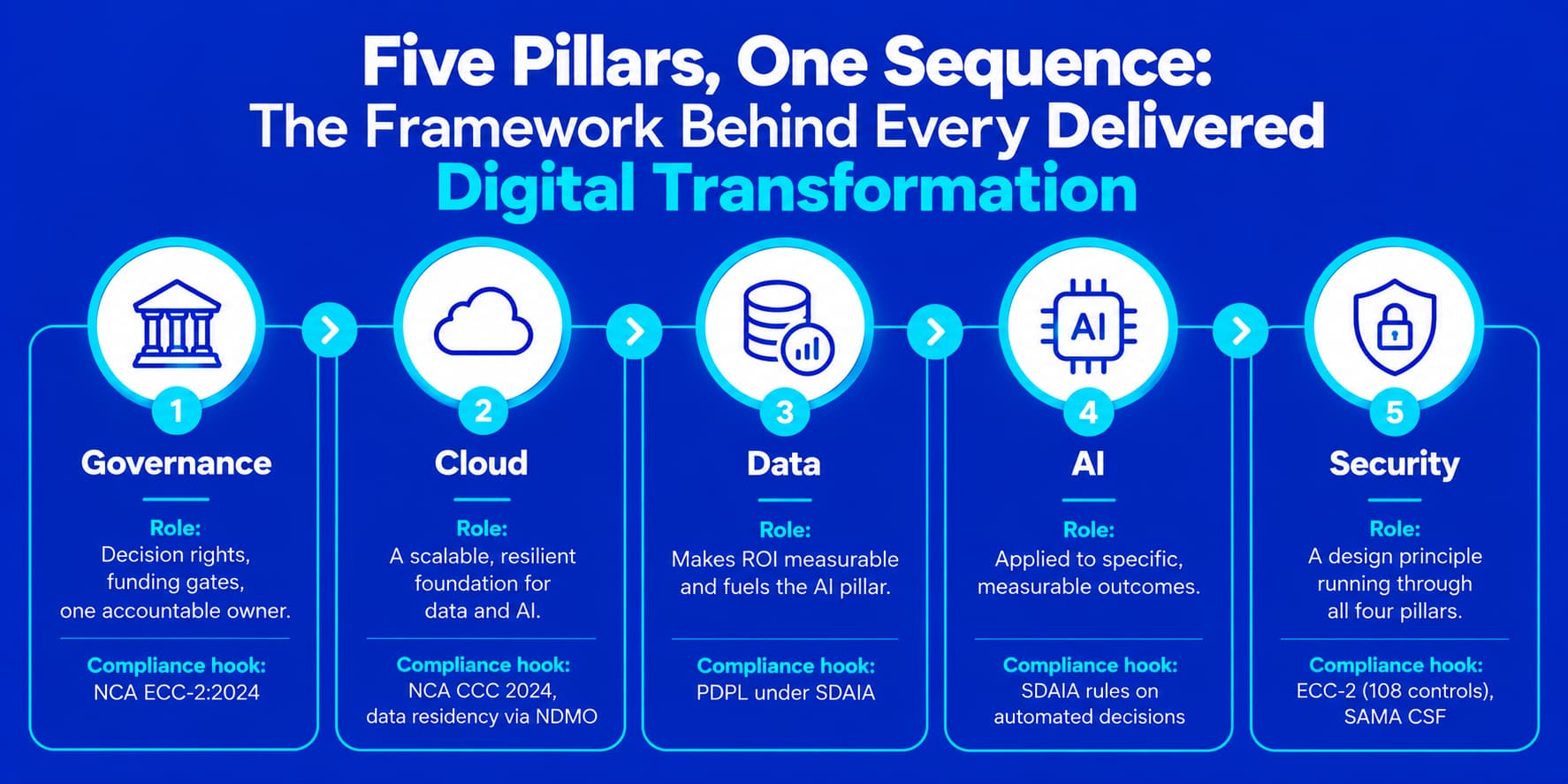
The failure is rarely technical. It is structural, and it shows up in four recurring ways.
Strategy stays fragmented. Business units run their own initiatives with no shared roadmap, so a finance cloud project never connects to the data platform operations is building. Return on investment stays unclear, because goals framed as “adopt AI” rather than “cut invoice processing time by 40 percent” give leadership no way to judge progress. Governance arrives too late, defined after initiatives are already running, so nobody owns the trade-offs. And security becomes an afterthought, which in Saudi Arabia is a direct regulatory risk.
The right advisory partner exists to close these four gaps. It replaces the slide deck with a sequenced roadmap, defines the governance that holds the program together, and keeps every pillar tied to business value.
Pillar 1: Governance as the operating system
Governance makes the other four pillars deliverable. It means three things: clear decision rights, funding gates tied to outcomes, and a single accountable owner for the transformation. Decision rights settle which of two competing initiatives gets the budget. Funding gates release money in stages against measured results. A single owner prevents the fragmentation that stalls most programs.
Governance also carries a compliance dimension. The National Cybersecurity Authority treats governance as the first domain of its Essential Cybersecurity Controls, so defining it early also builds the foundation your ECC-2:2024 alignment will need. This is where enterprise architecture becomes practical. Alnafitha IT’s enterprise architecture practice helps Saudi organizations connect strategic direction to applications, data, and technology, then govern the whole through one model. The benefit is direct: leadership sees one view of the transformation instead of nine competing ones.
Pillar 2: Cloud as the sequenced foundation
Cloud is the enabling layer for data, AI, and modern security, which is why it comes second. Migrating before you have decided what your data and governance models require is how programs rebuild the same workloads twice.
A cloud strategy covers migration approach, hybrid architecture where on-premises systems must stay, cost control, and resilience for critical applications. In the Kingdom it also intersects with data residency. The NCA updated its Cloud Cybersecurity Controls in 2024, and localization requirements now route through the National Data Management Office under SDAIA. A cloud decision is therefore also a data-residency decision, and it belongs in the strategy rather than after the migration. The outcome of a well-sequenced cloud pillar is capacity: scaling workloads on demand and giving data and AI a foundation they can build on.
Pillar 3: Data as the layer that makes everything measurable
Data turns transformation from activity into evidence. A data strategy covers where data lives and who owns it, how it moves between systems, and how its quality holds. That is the difference between a dashboard leadership trusts and one it quietly ignores.
For Saudi organizations, data carries the heaviest regulatory load of the five. The Personal Data Protection Law under SDAIA has been fully enforceable since September 2024, establishing individual data rights, breach notification duties, and cross-border transfer rules. Under the PDPL, decisions about where personal data sits and how it flows are compliance decisions, and they belong in the strategy from the outset. Clean, governed data makes ROI visible, satisfies the regulator, and becomes the fuel the AI pillar depends on.
Pillar 4: AI as an outcome engine
AI is the pillar most often chased for its own sake. The discipline is to apply it to specific, measurable problems. “Implement an AI platform” is the vague, technology-centric goal research identifies as a leading cause of failure. “Use AI to triage and route service tickets to cut resolution time” is an outcome.
AI also depends on the pillars beneath it: the cloud to run on, the data to learn from, and the governance to set its boundaries. SDAIA governs both data and AI in the Kingdom and has signaled further rules on automated decision-making, so an AI pillar planned with compliance in view stays useful as the regulation matures. Investing in Arabic-language AI capability, rather than English models with translation added, tends to serve Saudi deployments better in practice.
Pillar 5: Security as a design principle
Security most often arrives last and should be present first. Designing it in means embedding controls into governance, cloud, data flows, and AI as they are built. That is exactly how the Saudi frameworks are structured. The NCA’s Essential Cybersecurity Controls (ECC-2:2024) streamlined the framework from 114 controls to 108 and aligned it with standards such as ISO 27001. Financial institutions carry the added SAMA Cybersecurity Framework.
A transformation that treats security as a final gate finds its gaps during an audit, the most expensive possible moment. Building and running these controls in-house also stretches most teams through a live program. Alnafitha IT’s managed IT support and operations services extend an internal team with round-the-clock monitoring and certified expertise, so the security pillar stays maintained rather than deprioritized under deadline pressure.
How digital transformation consulting sequences the five pillars into one roadmap
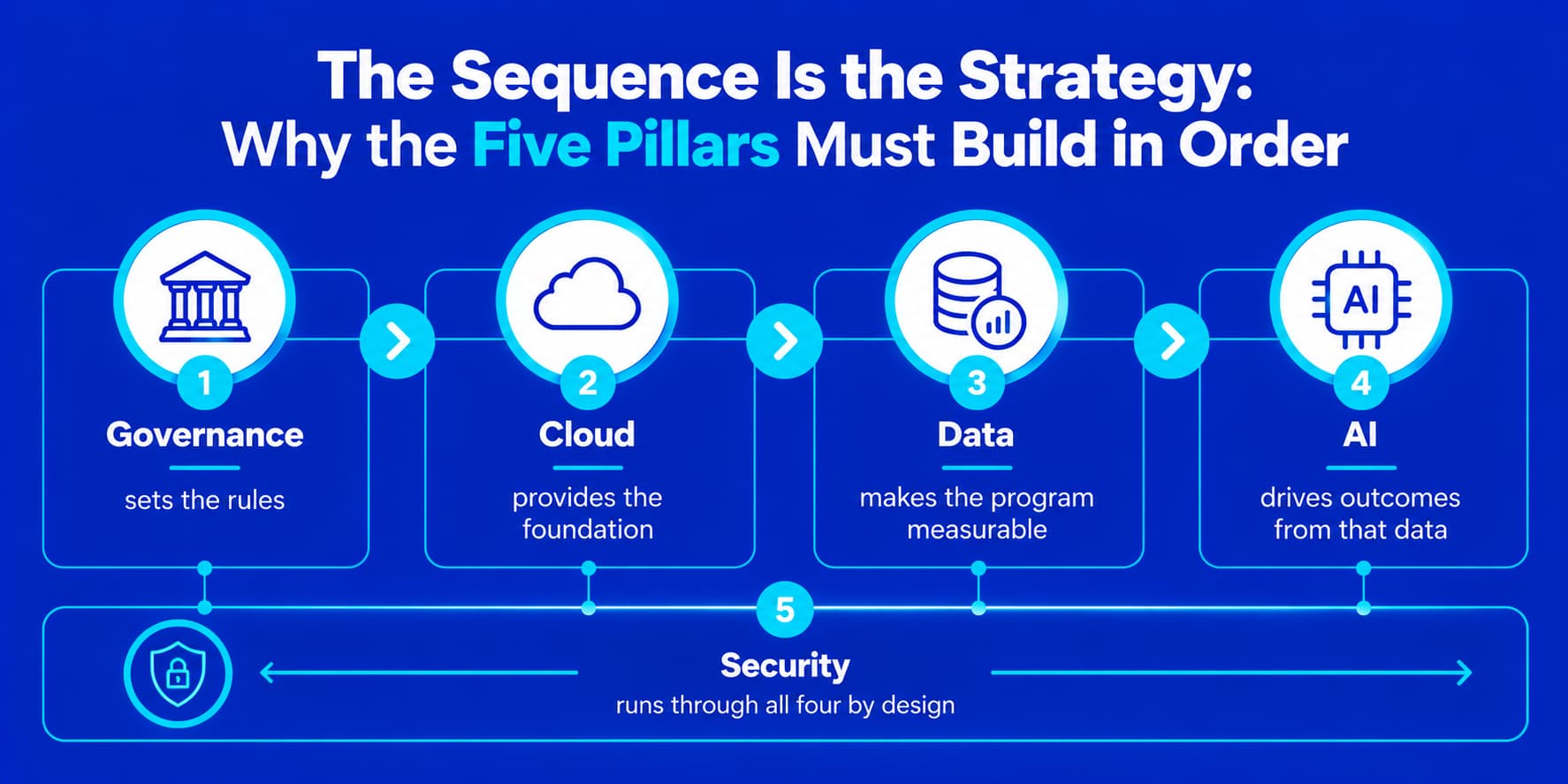
The pillars are not a parallel checklist. They are a sequence, and the sequence is the strategy. Governance sets the rules. Cloud provides the foundation. Data makes the program measurable. AI drives outcomes from that data. Security runs through all four by design. Each pillar carries its own Saudi compliance hook, so a program sequenced this way builds its NCA, SAMA, and PDPL alignment as it goes.
This is the core of what strong digital transformation consulting delivers: one enterprise moving through a governed, measurable roadmap toward Vision 2030, instead of nine business units running nine disconnected projects. As a Saudi company operating in the Kingdom since 1993, Alnafitha IT builds these roadmaps with the local regulatory landscape designed in from the first workshop.
If your strategy has stalled between ambition and delivery, the fastest way to find the gap is a structured conversation about where your five pillars stand today. Book a strategy consultation with Alnafitha IT and turn a slide deck into a plan your business units can act on.
Frequently asked questions
What is digital transformation consulting?
It is advisory work that helps an organization plan, sequence, and govern the modernization of its technology and operations against measurable outcomes. In practice it means building a roadmap across governance, cloud, data, AI, and security, aligning business units to it, and ensuring the program reaches delivery. In Saudi Arabia it also means mapping that roadmap to NCA, SAMA, and PDPL requirements from the start.
What are the main pillars of an enterprise digital transformation strategy?
The five connected pillars are governance, cloud, data, AI, and security. Governance sets decision rights and funding discipline, cloud provides the scalable foundation, data makes the program measurable, AI drives specific outcomes, and security is designed through all four rather than added at the end.
Why do so many digital transformation programs fail?
BCG and McKinsey research finds only around a third reach their goals, and the causes are structural: fragmented strategy, unclear ROI, governance defined too late, and security treated as an afterthought. Sequencing the pillars and tying each initiative to a measurable outcome avoids these traps.
How does digital transformation in Saudi Arabia differ from other markets?
The core strategy is the same, but the compliance layer is mandatory and distinct. NCA ECC-2:2024 governs cybersecurity controls, SAMA CSF applies to financial institutions, and the PDPL under SDAIA has governed personal data since September 2024, including data-residency decisions. These frameworks turn best practice into a regulatory baseline and align with Vision 2030.
Where should a Saudi organization start if its transformation has stalled?
Start with governance and a current-state assessment of all five pillars, not another tool purchase. Identify where decision rights are unclear, which initiatives lack a measurable outcome, and where compliance gaps sit against NCA, SAMA, and PDPL. A structured consultation with a Saudi-based partner can surface these quickly and turn them into a sequenced roadmap.