

Quick Takeaway
- Running an on-premise contact center in Saudi Arabia carries hidden costs that go well beyond hardware: aging infrastructure, siloed systems, and the inability to scale during peak demand are all operational risks with a real price tag.
- Saudi organizations adopting a cloud contact center must account for three regulatory frameworks: the CST Cloud Computing Regulations, NCA ECC-2:2024, and PDPL – all of which Zoom Contact Center addresses through local KSA data residency.
- Zoom Contact Center, deployed through Alnafitha’s Modern Communications unit, consolidates voice, digital channels, CRM integration, and AI-assisted routing into a single cloud platform built for enterprise requirements in the Kingdom.
Why This Comparison Matters Now for Saudi Organizations
Customer service operations across Saudi Arabia are under more pressure than they were five years ago. The combination of Vision 2030’s push toward digital-first service delivery, rising customer expectations, and tighter data protection obligations under PDPL has created a specific problem for organizations still running on-premise contact center infrastructure: the longer they wait, the more expensive the transition becomes – and the more compliance risk they carry in the meantime.
This article breaks down the actual cost structure of on-premise versus cloud contact center deployment, addresses the regulatory requirements that apply specifically to voice and interaction platforms in Saudi Arabia, and explains how Zoom Contact Center – delivered through Alnafitha – resolves the main objections IT Directors, Customer Service Directors, and Operations Managers raise during the evaluation process.
The Real Cost of On-Premise vs. Cloud Contact Center for Saudi Organizations
The capital expenditure involved in building and maintaining an on-premise contact center is well understood: server hardware, PBX systems, telephony infrastructure, and data center space. What tends to be underestimated is the total cost of ownership once those systems are in place.
Hardware refresh cycles run every five to seven years on average. In Saudi Arabia, where enterprise IT procurement lead times can be long and local spare parts availability for legacy systems is limited, an unplanned hardware failure during a high-traffic period – Ramadan peak, year-end financial activity, government service demand spikes – carries direct revenue and reputational costs.
Beyond hardware, on-premise contact centers require dedicated IT staff for infrastructure management, licensing management for each component, and vendor support contracts that compound year over year. When a CRM, a ticketing system, and the voice platform are all from different vendors and operate on separate stacks, agents are forced to work across multiple screens, duplicate data entry is common, and supervisors lack a consolidated view of interaction history or SLA performance.
Scaling agent capacity is another structural weakness. Adding seats on an on-premise system typically means procuring additional hardware, reconfiguring the telephony stack, and waiting weeks or months. For a contact center handling seasonal peaks, that model is incompatible with operational agility.
What a Cloud Contact Center Delivers Instead
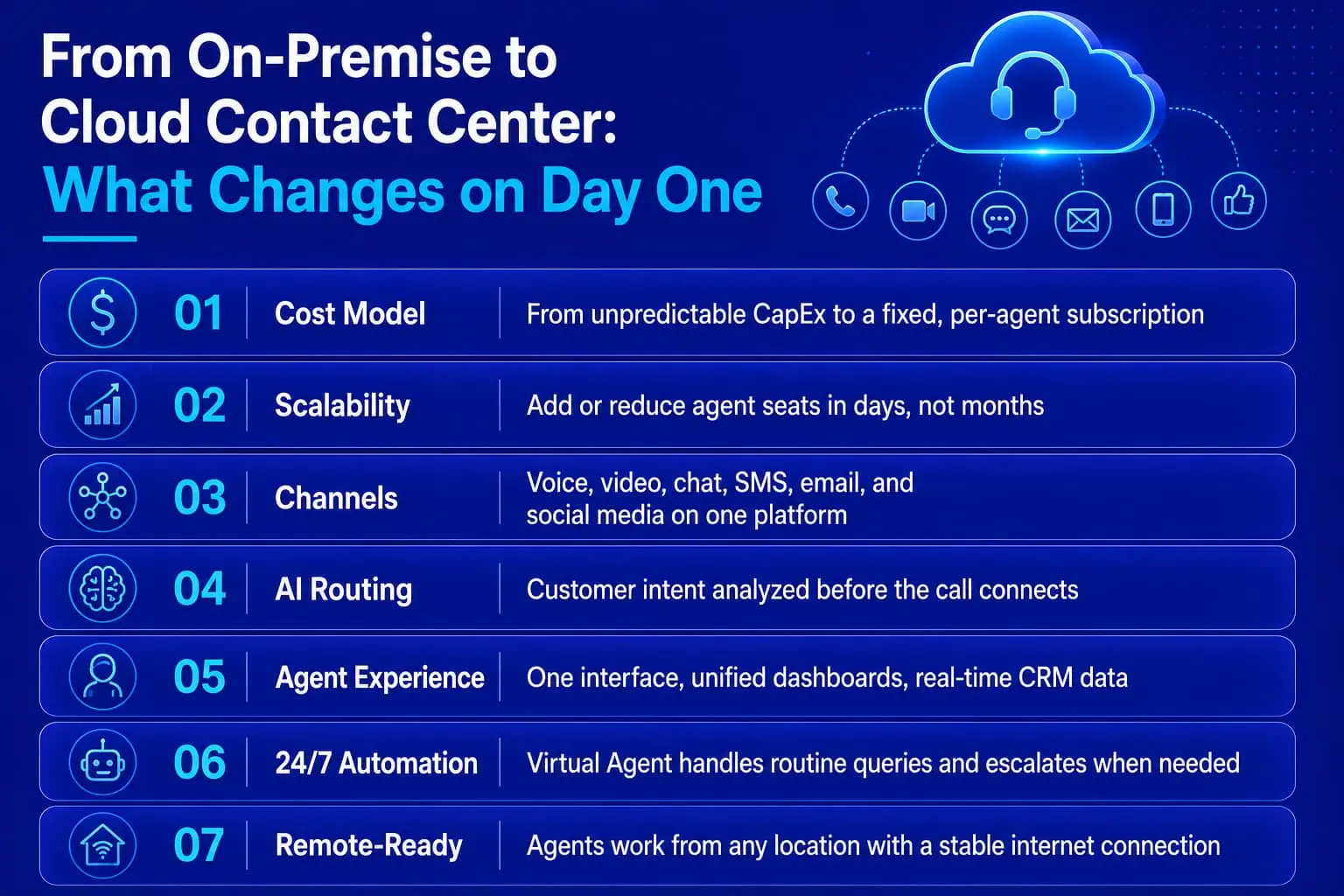
A cloud contact center shifts the model from capital expenditure to a predictable, per-agent subscription. Infrastructure management, uptime obligations, platform updates, and security patching all move to the provider. Organizations pay for what they use and scale in days, not months.
The operational change goes beyond cost. A modern cloud contact center like Zoom Contact Center consolidates voice, video, web chat, SMS, email, and social media channels into a single platform. Agents work from one interface. Supervisors access unified dashboards. Interaction history follows the customer across channels and is available in real time to the agent handling the next contact.
AI-assisted routing, which analyzes customer intent before connecting the call, reduces average handle time and improves first-contact resolution without requiring a separate analytics platform. Zoom’s AI Expert Assist delivers real-time guidance to agents during live interactions – pulling relevant knowledge articles and CRM data automatically based on the conversation in progress. Zoom Virtual Agent handles routine queries around the clock before escalating to a live agent, which is directly relevant for Saudi organizations dealing with high volumes of repetitive service requests.
For organizations managing remote or hybrid contact center teams – a model that has become standard for many Saudi enterprises post-2020 – a cloud contact center removes the dependency on physical network infrastructure entirely. Agents connect from any location with a stable internet connection.
Cloud Contact Center Compliance in Saudi Arabia: CST, NCA ECC-2:2024, and PDPL
This is the area where cloud contact center evaluations in Saudi Arabia most often stall. It is also the area that deserves the most precise attention.
1. CST Cloud Computing Regulations
The CST Cloud Computing Regulatory Framework requires cloud service providers that handle data for Saudi-based customers to register with the CST. Organizations must verify that their provider operates under this framework. They must also ensure that all interaction data, such as voice recordings and chat transcripts, remains within the Kingdom.
2. Adhering to NCA ECC-2:2024
The updated NCA ECC-2:2024 framework mandates that organizations establish clear data classification requirements. It requires data separation from the environments of other tenants and strict contractual cybersecurity obligations. Because contact centers handle sensitive interaction data, they fall under the mandatory scope of this tier-based compliance model.
3. Data Privacy Under PDPL
Saudi Arabia’s Personal Data Protection Law (PDPL) applies directly to contact center environments. Voice recordings and chat logs are considered personal data under the law. Therefore, organizations must establish robust consent mechanisms. They are also required to define strict data retention periods and document all data flows to ensure transparency.
4. The Role of Local Data Residency
Zoom Contact Center supports these requirements by operating through three dedicated cloud regions inside Saudi Arabia. Data in transit and data at rest remain within the Kingdom. This approach directly supports CST registration, NCA compliance, and the PDPL localization expectations for regulated sectors.
Connecting Your Cloud Contact Center to CRM and Ticketing Systems
One of the most consistent pain points for Customer Service Directors evaluating a cloud contact center transition is integration with existing systems. The fear is reasonable: a migration that breaks CRM connectivity or disrupts ticketing workflows creates immediate operational problems.
Zoom Contact Center provides out-of-the-box adapters for Salesforce, Microsoft Dynamics 365, ServiceNow, Zendesk, Freshdesk, and ManageEngine, alongside REST APIs and webhooks for custom integrations. This means an agent receiving an inbound call can see the full CRM record, open ticket history, and previous interaction logs in real time – without switching applications.
How Alnafitha Delivers Zoom Contact Center for Saudi Enterprises
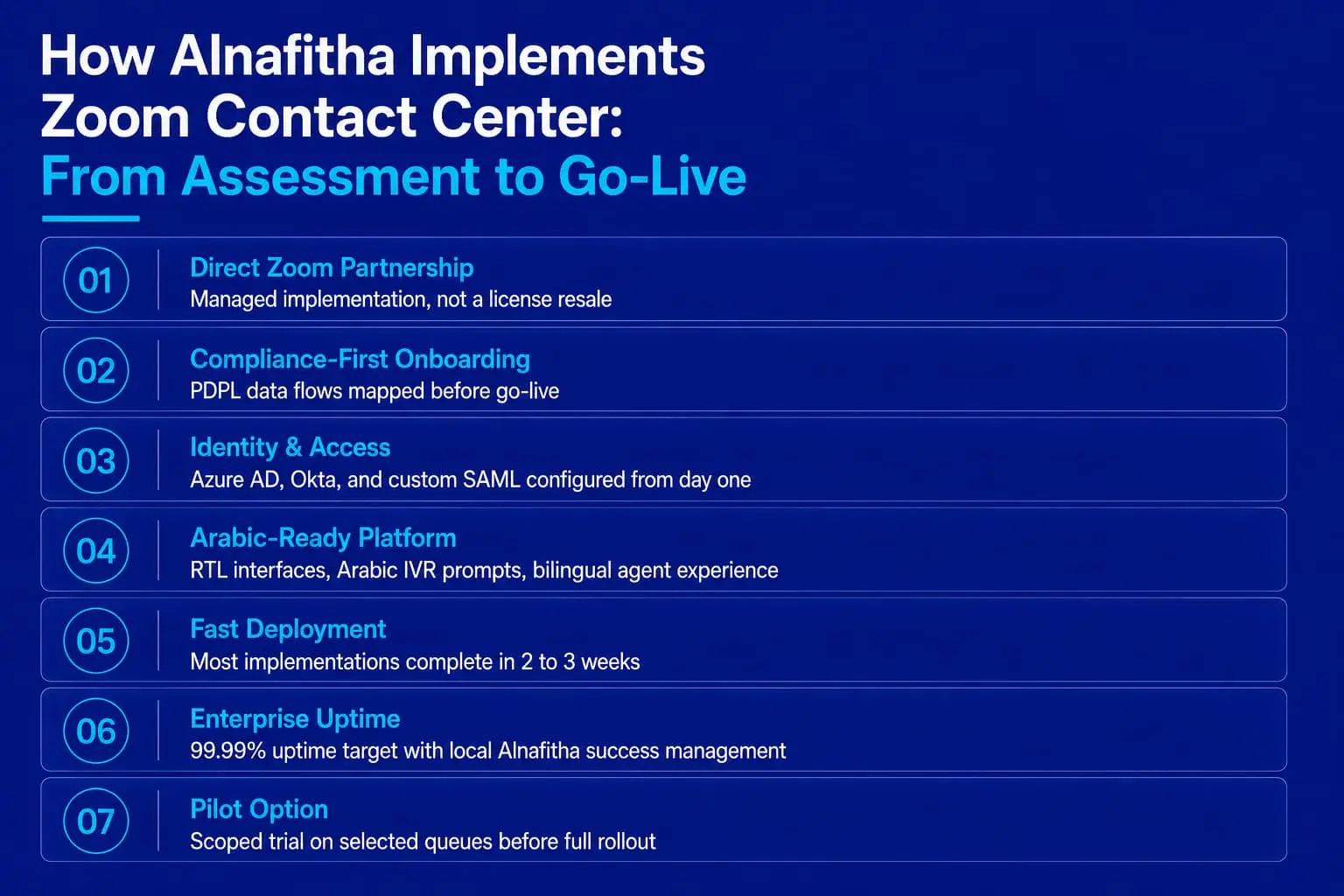
Alnafitha’s Modern Communications unit holds a direct Zoom partnership and delivers Zoom Contact Center as a managed implementation – not just a license resale. That distinction matters in practice.
The deployment process begins with an assessment of current contact flows, integration requirements, and compliance obligations. Alnafitha maps PDPL data flows during onboarding, establishes consent and retention controls, and configures role-based access using Azure AD, Okta, or custom SAML identity providers. The platform supports Arabic and English interfaces, including right-to-left layouts and Arabic IVR prompts – a requirement that generic international deployments often treat as an afterthought.
Most Zoom Contact Center deployments through Alnafitha complete in two to three weeks. The platform carries a 99.99% uptime target backed by Zoom’s enterprise support and Alnafitha’s local success management.
For organizations not ready to commit to a full rollout, Alnafitha can run a scoped pilot on selected queues and channels to validate KPIs before a phased transition.
Learn more about cloud-based contact center solutions from Alnafitha or explore the full Zoom Contact Center offering built specifically for the Saudi market.
The Decision Point
For organizations currently running aging on-premise contact center infrastructure, the question is not whether to move – it is how to move without disrupting service delivery and without creating compliance exposure in the process. Zoom Contact Center, deployed through Alnafitha, addresses both concerns with a structured implementation path, verified local data residency, and a platform built to meet the specific regulatory and operational requirements of Saudi enterprise operations.
If you are evaluating a cloud contact center transition for your Saudi operations, speak with an Alnafitha consultant today.
Frequently Asked Questions
What is a cloud contact center? A cloud contact center is a customer interaction platform delivered as a service over the internet, replacing on-premise hardware with a managed cloud environment. It handles voice, digital channels, routing, analytics, and integrations through a single subscription-based system.
How does a cloud contact center work? Agents log in through a web or desktop application. Inbound and outbound interactions across voice, chat, email, and social media are routed through the cloud platform based on rules, agent skills, and AI-assisted intent detection. All interaction data is stored in the provider’s cloud environment – in the case of Zoom Contact Center in Saudi Arabia, within local KSA data centers.
What are the security and compliance standards for cloud contact centers in Saudi Arabia? Organizations must align with three primary frameworks: the CST Cloud Computing Regulatory Framework (data center registration and disclosure), NCA ECC-2:2024 (data classification, cloud security controls, third-party contractual obligations), and PDPL (consent, retention, and data handling requirements for personal data collected through customer interactions).
Which cloud contact center solutions are best for businesses in Saudi Arabia? The most suitable solution depends on data residency requirements, integration needs, and scale. For enterprise operations in the Kingdom, Zoom Contact Center – delivered through Alnafitha – addresses all three regulatory frameworks with verified KSA data residency, CRM integrations, and Arabic language support.
How do I migrate from an on-premise contact center to a cloud-based one? A structured migration starts with an assessment of current call flows, integrations, and compliance obligations. Alnafitha runs this assessment as part of its Zoom Contact Center implementation process, followed by a phased rollout that minimizes service disruption and validates performance before full cutover.
What are the key benefits of moving to a cloud-based contact center? The primary operational benefits are elastic scaling, consolidated omnichannel management, built-in AI routing and analytics, and elimination of hardware refresh cycles. The financial benefit is conversion from unpredictable capital expenditure to a manageable per-agent subscription model.
How to integrate a cloud contact center with existing CRM systems? Zoom Contact Center provides native connectors for Salesforce, Microsoft Dynamics 365, ServiceNow, Zendesk, Freshdesk, and ManageEngine, as well as REST APIs for custom integrations. Alnafitha handles integration configuration as part of the standard deployment.