

Brief Takeaway
Keeping a legacy PBX on life support is not a neutral financial decision. Maintenance contracts, vendor lock-in, and compliance gaps add up to costs most IT budgets never isolate and for Saudi enterprises already using Microsoft Teams calling for meetings and chat, the case for consolidating voice on the same platform is stronger than ever.
- Keeping a legacy PBX on life support is not a neutral financial decision. Maintenance contracts, vendor lock-in, and compliance gaps add up to costs most IT budgets never isolate.
- Saudi enterprises face specific regulatory pressure around call recording, data residency, and communication modernisation tied directly to SAMA requirements and Vision 2030 timelines.
- Microsoft Teams calling replaces your phone system entirely, bringing voice, meetings, call recording, auto attendants, and compliance controls into the same platform your teams already use daily.
- Organisations that complete this migration consistently report telephony cost reductions between 30% and 60% within two years.
The Conversation Happening in Every Saudi IT Department Right Now
The trigger is rarely dramatic. It is a maintenance renewal quote higher than last year. A hardware failure on a system whose vendor stopped shipping replacement parts. A compliance audit question about call recording that the existing PBX cannot answer without an expensive third-party add-on.
Whatever starts it, the conversation ends in the same place: someone needs to calculate what staying actually costs versus what Microsoft Teams calling would deliver. This guide is built for that conversation, grounded in what Saudi IT leaders and operations managers are actively searching for and asking about in 2026.
What Your PBX Bill Hides: The Real Cost vs. Microsoft Teams Calling
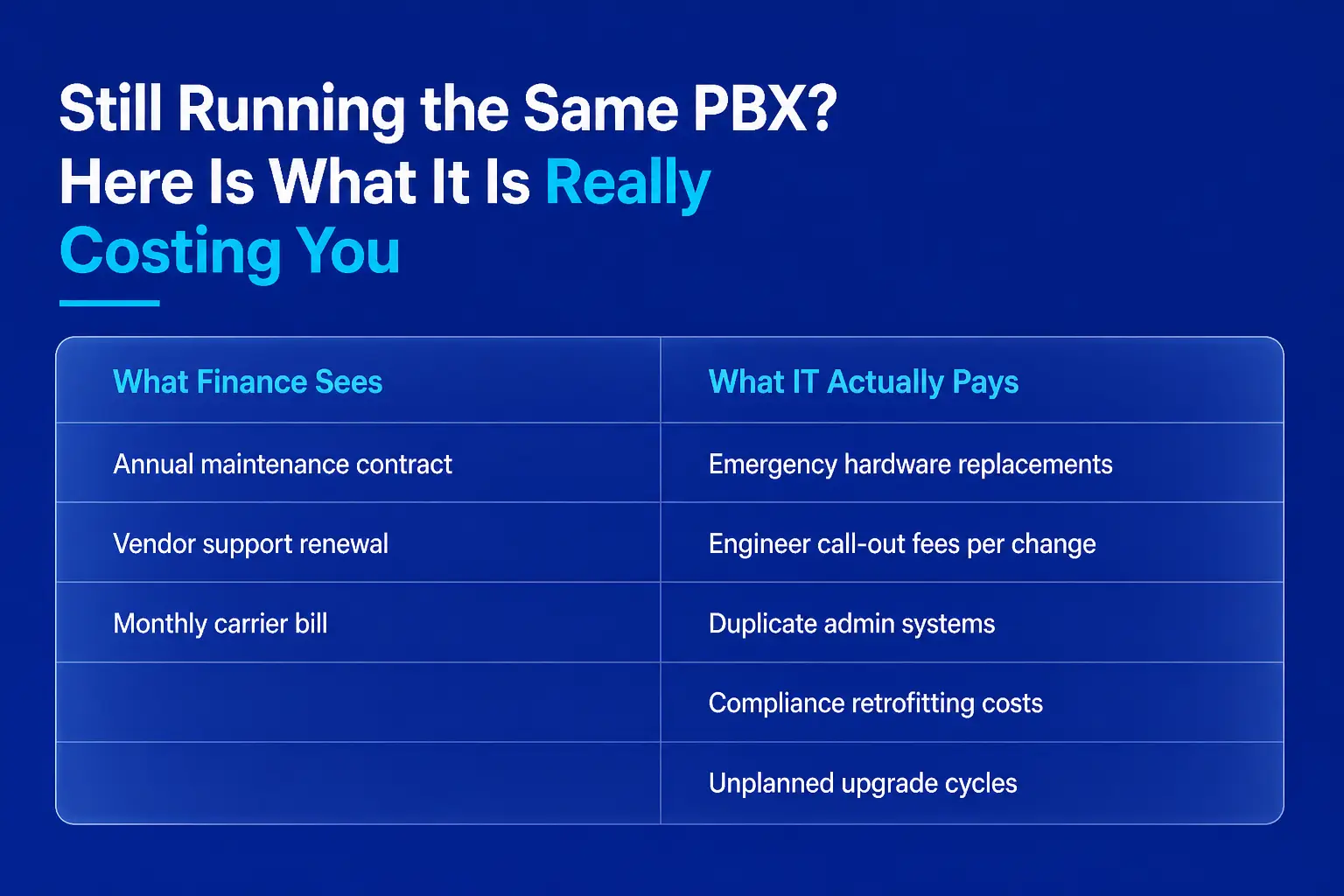
The maintenance contract is the number finance sees. The real total cost of ownership lives in the line items that never appear on a single invoice.
Hardware fragility and forced upgrades. On-premises PBX infrastructure ages on a fixed timeline regardless of whether your usage justifies a refresh. Cisco Unified Communications Manager 12.5 reached end of life in August 2025. Organisations still running older versions face shrinking vendor support windows, which means either expensive extended support contracts or unplanned upgrade cycles.
Every change requires a vendor engineer. Adding a user, adjusting call routing, setting up a new hunt group, or enabling a call queue requires a certified technician in most legacy environments. What should take an IT admin an hour takes days and carries a service charge each time.
Parallel infrastructure with no shared value. Your teams are already on Microsoft Teams for meetings and chat. Your voice calls run on a separate system with separate administration, separate reporting, and separate support. That duplication represents real budget and real IT overhead with no return on either side.
Compliance gaps with price tags attached. SAMA-regulated organisations that cannot demonstrate structured call recording and data retention risk both regulatory exposure and the cost of retrofitting compliance capability onto infrastructure that was not built for it.
Organisations that move to Microsoft Teams calling and consolidate their vendor landscape report cost reductions of 30% to 60% within 24 months. That reflects what happens when organisations stop paying for phone closets, extended support contracts, and parallel admin systems all at once.
The Business Case for Microsoft Teams Calling in the Saudi Market
Two forces are compressing the decision timeline for Saudi enterprises specifically.
SAMA compliance and call recording obligations. Financial institutions regulated by the Saudi Central Bank are required to maintain auditable records of business communications, support anti-money laundering transaction monitoring, and store data within the Kingdom. Legacy PBX systems handling call recording through bolt-on integrations create audit complexity. Microsoft Teams calling supports policy-based call recording natively, with data residency in KSA when deployed through locally hosted SBCs, giving compliance teams a cleaner and more defensible architecture.
Vision 2030 and operational modernisation. Entities aligned to Vision 2030 transformation programmes are expected to modernise internal operations in parallel with external digital service delivery. Communication infrastructure is not peripheral to that mandate. Running a legacy phone system in a department that interfaces with business partners, government entities, or citizens is a visible operational gap, and an avoidable one.
The end of legacy carrier infrastructure. PSTN infrastructure built on copper lines is being phased out across the GCC. Organisations that remain on traditional PRI trunks will face forced migration eventually. Moving proactively, on a planned timeline, is materially less disruptive than responding to infrastructure changes imposed externally.
Microsoft Teams Calling Features Saudi IT Leaders Ask About Most
Based on what IT directors and operations managers in Saudi Arabia are actively researching, these are the capabilities that drive the decision.

Cloud-Based Calling for Remote and Hybrid Teams
Microsoft Teams calling lets users make and receive external calls from any device, anywhere, using the Teams app. For Saudi organisations managing distributed teams across multiple cities or hybrid operating models, this eliminates the dependency on being physically present in an office to access the phone system.
Call Recording and Transcription for Compliance
Microsoft Teams calling supports policy-based recording with per-user or per-group rules, searchable transcripts, and retention controls aligned to compliance requirements. For financial institutions, this is a direct answer to SAMA record-keeping obligations without a separate recording platform layered on top.
International Calling for Saudi Enterprises
Through Direct Routing or Operator Connect, Microsoft Teams calling connects to PSTN carriers with international reach. Saudi organisations with regional offices, multinational client relationships, or global vendor networks manage all calling from one platform with consistent quality and centralised administration.
Auto Attendant and Call Queue Configuration
Microsoft Teams calling includes auto attendants and call queues that IT admins configure directly through the Teams Admin Center, with no vendor engineer required. Changes to IVR flows, business hours routing, or queue assignments take minutes, not service requests.
Softphone Integration with Existing Enterprise IT Infrastructure
Organisations that still have certified SIP devices, analog phones, or specialised hardware integrate them through certified SBCs and analog gateways. Migration does not require replacing every endpoint on day one, which makes phased rollouts practical for large Saudi enterprises with multiple sites.
Security for Business Calls
Microsoft Teams calling runs on Microsoft 365’s security infrastructure, with encrypted communications, conditional access policies, and full integration with Microsoft Defender. For IT teams managing compliance under SAMA’s Cybersecurity Framework and NCA ECC controls, this alignment reduces the scope of what needs to be separately secured and audited.
Alnafitha’s Microsoft Teams and modern workplace practice covers deployment, configuration, and ongoing support across all these capability areas for Saudi enterprise environments.
From Legacy PBX to Microsoft Teams Calling: A Structured Migration Plan
The concern that delays most migrations is not budget. It is complexity: not knowing what the existing PBX actually handles, uncertainty about number portability, and the risk of disrupting live operations during cutover.
These concerns have structured answers.
A migration starts with a full inventory covering every extension, hunt group, IVR flow, fax line, and analog device currently on the PBX. Each gets mapped to a Teams equivalent or a hybrid holding configuration during transition. Existing phone numbers port to Teams through Direct Routing or Microsoft Calling Plans. Legacy hardware integrates through certified gateways during the transition period.
The migration runs in parallel. Microsoft Teams calling and the legacy PBX operate simultaneously during phased rollout. A department or site cuts over while the rest of the organisation remains on the old system. There is no single high-risk cutover moment.
Alnafitha’s IP telephony and contact centre team delivers this migration planning as part of the deployment engagement, including SBC configuration, compliance recording setup, carrier connectivity for KSA numbers, and user adoption support.
How Alnafitha Delivers Microsoft Teams Calling at Enterprise Grade
As a Microsoft Solutions Partner with active enterprise deployments across banking, government, manufacturing, and professional services in Saudi Arabia, Alnafitha brings local market experience that matters in this specific context.
KSA PSTN connectivity requires CITC-licensed carriers and locally hosted SBCs. Compliance recording for SAMA-regulated clients requires configurations that are tested and auditable from day one. Number portability for organisations with multiple sites and legacy DDI blocks requires migration planning, not just licence provisioning.
Alnafitha’s Microsoft Teams calling deployments are scoped and executed with these requirements built in from the start, not retrofitted after go-live.
The Cost of Waiting Is Not Zero
Every quarter on a legacy PBX is another quarter of rising maintenance, unresolved compliance gaps, and IT capacity spent on infrastructure your organisation has already outgrown. The Saudi enterprise market is moving. Microsoft Teams calling is the present-tense replacement for a phone system that was not built for how your organisation actually operates today.
If you are ready to scope the migration for your environment, the conversation starts here.
Talk to Alnafitha’s Microsoft Teams calling specialists
Frequently Asked Questions
- How do I set up Microsoft Teams calling for a remote or hybrid team in Saudi Arabia?
Microsoft Teams calling is configured through the Teams Admin Center. Users receive a Teams Phone licence and a phone number assigned via Microsoft Calling Plans or Direct Routing. With Direct Routing, your IT team connects Teams to a KSA-licensed SIP carrier through a certified SBC, giving remote users full PSTN calling capability from any device without VPN or on-premises hardware dependency. Setup for a mid-size organisation typically takes two to four weeks from scoping to first live calls.
- Which corporate calling services support call recording and transcription, and does Microsoft Teams calling qualify?
Yes. Microsoft Teams calling supports policy-based call recording natively, with options for compliance recording through certified third-party partners. Recordings are stored in Microsoft 365 with configurable retention policies. Transcription is available through Teams Premium and integrates with Microsoft 365 Copilot for post-call summaries and searchable records. For SAMA-regulated organisations, this covers both the recording obligation and the audit trail requirement.
- What are the licensing requirements for enterprise voice features in Microsoft Teams calling?
Licensing depends on your current Microsoft 365 subscription. E3 customers add a Teams Phone Standard licence per user. E5 customers may already have Teams Phone included depending on their tenant configuration. All users then need a PSTN connectivity option: either a Microsoft Calling Plan or Direct Routing through a certified carrier. A pre-migration licence audit is the right starting point to confirm what is already in place and what needs to be added.
- Can I integrate a softphone with my existing enterprise IT infrastructure using Microsoft Teams calling?
Yes. Microsoft Teams calling integrates with certified SIP devices through SBCs, and with analog phones and common area devices through analog gateways. Existing hardware does not need to be replaced before migration begins. Devices that cannot be integrated natively can remain operational on a hybrid trunk during transition, giving IT teams full control over the pace of endpoint refresh.
- How does Microsoft Teams calling handle international calls for Saudi organisations?
Through Direct Routing, Microsoft Teams calling connects to any PSTN carrier with international reach, including carriers that provide coverage across the GCC and globally. Organisations consolidate international calling onto a single platform, with centralised reporting and consistent call quality controls. For Saudi organisations with regional offices or multinational client relationships, this eliminates the need for separate international calling contracts managed by location.