

Cloud Phone System Migration: Brief Takeaways
- A cloud phone system built on Microsoft Teams Phone replaces legacy PBX hardware, but the migration carries technical dependencies that rarely appear in the first quote: Session Border Controllers, network readiness, SIP trunk compatibility, and licensing tiers.
- In Saudi Arabia, every voice service that touches the public network must route through a CST-licensed carrier (STC, Mobily, or Zain), which directly shapes how you design Direct Routing.
- PDPL now carries active enforcement, with fines reaching SAR 5 million per breach, so teams must plan call recording and data residency into the architecture, not added later.
- The largest hidden costs are network remediation, SBC redundancy, and user adoption, not the per-user license fee.
- Alnafitha IT designs and delivers compliant Teams Phone deployments for Saudi enterprises, handling carrier coordination, SBC configuration, and change management end to end.
Why Saudi Enterprises Are Moving Off Legacy PBX
Across Riyadh, Jeddah, and Dammam, the trigger for replacing a traditional phone system is rarely dramatic. It is usually a maintenance renewal quote that arrives higher than last year, or a Vision 2030 modernization mandate that flags the on-premises PBX as a visible operational gap. A cloud phone system answers both pressures at once: it removes aging hardware, consolidates voice into the Microsoft 365 environment most organizations already run, and gives compliance teams a cleaner audit trail.
Microsoft Teams Phone has become the default destination for this shift. It turns Teams, already the daily hub for chat, meetings, and file collaboration, into a full business phone system with public switched telephone network (PSTN) connectivity. For an IT Director weighing options, the appeal is obvious. One platform, one identity model, one set of security controls. The catch is that moving from a PBX to a cloud phone system is a network and telephony project, not a software toggle, and the budget needs to reflect that.
The Cloud Phone System Costs That Do Not Appear in the First Quote
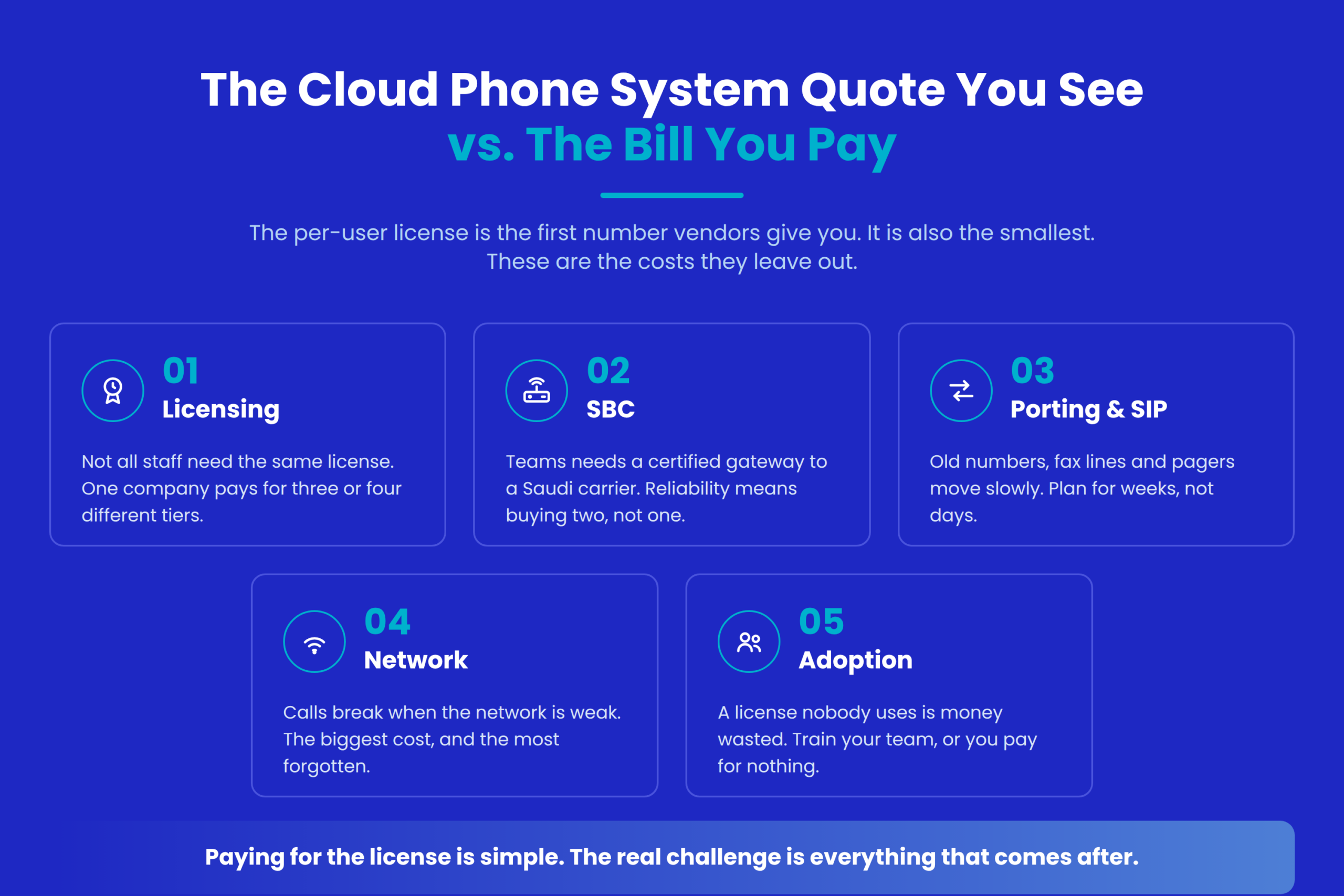
When vendors price a cloud phone system, they usually lead with the per-user license. That number is the floor, not the ceiling. Here is where Saudi IT teams consistently find unbudgeted spend.
Licensing tiers that depend on what you already own
If your users sit on Microsoft 365 E5, Teams Phone is already included. Users on E3 or Business plans need the Teams Phone Standard add-on, priced separately per user per month. Frontline staff can use a reduced-cost license, and AI calling features require Teams Premium or a Copilot license on top. The point for budgeting is simple: a single organization often spans three or four license profiles, and the blended cost looks nothing like the headline figure. Running a proper license audit before migration separates a clean forecast from a quarterly surprise.
Session Border Controllers and the Direct Routing dependency
This is the dependency most projects underestimate. To connect Teams Phone to a Saudi carrier through Direct Routing, you need a Microsoft-certified Session Border Controller (SBC). The SBC is the secure gateway that sits between Teams and the PSTN, translating protocols, managing call routing, and protecting against toll fraud and denial-of-service attacks. If you want resilience, and any enterprise running voice as a primary system does, you deploy redundant SBCs with automatic failover, which doubles that line item. Direct Routing also keeps your existing carrier relationship intact and supports hybrid setups where some sites stay on legacy PBX during a phased cutover, but the SBC layer is non-negotiable for that flexibility.
SIP trunk compatibility and number porting
Vendors built legacy systems around SIP trunks and analog devices that do not always map cleanly to a cloud phone system. Overhead pagers, door phones, fax lines, and contact center integrations frequently need an analog gateway or a migration trunk to survive the move. Number porting itself runs on the carrier’s timeline, typically a multi-week process, and porting errors can take communications offline if the cutover is not sequenced carefully. Mapping every number, shared line, and analog endpoint before go-live is what separates a smooth migration from a help-desk crisis.
Network Readiness: The Quiet Cloud Phone System Budget Killer
Why Voice Needs a Ready Network
Voice is unforgiving of network problems that data tolerates. A cloud phone system needs consistent sub-150ms latency and sub-1% packet loss to the PSTN connection point. Many Teams Phone rollouts disappoint not because of the platform but because no one assessed the network for voice.
What a Readiness Assessment Covers
A full readiness assessment covers bandwidth at every site, QoS configuration to prioritize voice traffic, firewall rules for Teams calling, and failover paths under peak load. You must identify sites with marginal circuits before cutover, not after the first user complains that the new system sounds worse than the old PBX. This remediation covers new circuits, QoS rollout, and sometimes SD-WAN. It often becomes the single largest cost in the project, and initial proposals most often omit it.
User adoption
A cloud phone system only delivers ROI when people actually use it. Staff comfortable with desk phones need structured onboarding to move their calling habits into Teams. Skipping change management is how organizations end up paying for licenses that sit idle while employees keep using their mobiles for business calls.
The Saudi Compliance Layer: CST and PDPL
Two regulatory realities shape every Teams Phone deployment in the Kingdom, and ignoring either one creates real exposure.
Telecommunications licensing. Voice services in Saudi Arabia fall under the Communications, Space and Technology Commission (CST), the body formerly known as CITC. Any voice traffic that interconnects with the Saudi PSTN must route through a CST-licensed operator, in practice STC, Mobily, or Zain. This is why a global “calling plan” cannot simply be switched on in the Kingdom the way it can elsewhere. Direct Routing through a licensed local carrier is the architecture that keeps a cloud phone system compliant, and designing that carrier relationship correctly is a core part of the migration.
Personal data protection. The Personal Data Protection Law (PDPL), enforced by the Saudi Data and Artificial Intelligence Authority (SDAIA), is now fully operative. Voice recordings are personal data under the law, and the regulator has moved into active enforcement, issuing dozens of decisions and applying fines that reach SAR 5 million per breach, with repeat or intentional violations carrying heavier penalties.
Many organizations record calls for finance rules, quality assurance, or dispute resolution. For them, call recording needs a lawful basis, proper consent, and careful attention to where the organization stores recordings. Deploying through locally hosted SBCs supports data residency inside the Kingdom and gives compliance teams a defensible architecture rather than a bolt-on workaround.
To understand how these data obligations connect to your wider Microsoft estate, our analysis of Microsoft 365 E5 security and compliance consolidation shows how recording, retention, and identity controls fit into one platform.
How Alnafitha IT Delivers a Cloud Phone System in the Kingdom
Knowing the hidden costs is one thing. Sequencing a migration so they do not derail the project is another, and it is where an experienced local partner earns its place.
Alnafitha IT has worked in the Saudi enterprise market for more than three decades and runs a dedicated modern communications and Microsoft Teams practice covering the full lifecycle: network and voice readiness assessment, license optimization, SBC design and configuration, carrier coordination with CST-licensed operators, phased number porting, and the user adoption programs that protect your investment. Because the team works across the Microsoft stack daily, the phone system is deployed as part of a coherent compliance and security posture, not as an isolated voice project. The result is a cloud phone system that meets enterprise reliability expectations, satisfies PDPL and CST requirements, and lands without the budget shocks that catch unprepared teams.
Conclusion
A cloud phone system on Microsoft Teams Phone is one of the highest-value moves a Saudi enterprise can make, but only when the full picture is on the table before contracts are signed. The license fee is the easy part. The SBCs, the network remediation, the SIP trunk and porting work, and the CST and PDPL compliance layer are where projects succeed or stall. Plan for them deliberately, with a partner who has delivered the same migration across the Kingdom, and the move pays back in lower cost, tighter compliance, and a communications platform your people will actually use.
Ready to scope your migration with accurate numbers from the start? Talk to Alnafitha’s communications team for a readiness assessment built for Saudi compliance requirements.
Frequently Asked Questions
What is a cloud phone system?
A cloud phone system delivers business calling over the internet instead of through on-premises PBX hardware. With Microsoft Teams Phone, calls run inside the same Teams application your organization already uses for chat and meetings, and external calls reach the public network through a licensed carrier connection.
How does a cloud phone system work in Saudi Arabia?
Internal calls travel over your network, while external calls connect to the PSTN through a CST-licensed operator such as STC, Mobily, or Zain. With Direct Routing, a certified Session Border Controller links Teams Phone to that carrier, keeping the service compliant with Saudi telecommunications regulations.
How much does a cloud phone system cost?
Costs fall into several layers: the Teams Phone license per user, which varies by Microsoft 365 plan, plus carrier calling charges, SBC infrastructure, network readiness work, and migration services. The per-user license is usually the smallest part. An accurate estimate requires a license audit and a network assessment specific to your sites.
Is a cloud phone system cheaper than a traditional PBX?
Over a two to three year horizon, most organizations reduce telephony spend significantly by retiring PBX maintenance, consolidating into Microsoft 365, and removing separate phone hardware. The savings depend on how much network remediation the migration requires upfront.
Do I need to keep my old PBX after moving to Teams Phone?
Not permanently. Direct Routing supports a hybrid model where the legacy PBX and analog devices coexist with Teams Phone during a phased migration, which is useful for sites with pagers, fax lines, or specialized equipment. Many organizations retire the PBX fully once those endpoints are migrated or replaced.
How does a cloud phone system handle call recording under PDPL?
Recordings are treated as personal data under PDPL, so they require a lawful basis, proper consent handling, and controlled storage. Deploying through locally hosted infrastructure supports data residency inside the Kingdom and helps satisfy SDAIA requirements, which is essential given active enforcement and substantial fines.
Which cloud phone system is best for small business in Saudi Arabia?
For organizations already on Microsoft 365, Teams Phone is usually the strongest fit because it adds calling to a platform staff already use, avoiding a separate system. The right connectivity model, Direct Routing through a local carrier, depends on call volume, compliance needs, and existing infrastructure, which a short assessment can clarify.