

Choosing a unified communications provider in Saudi Arabia is no longer a feature comparison. For IT and operations leaders in the Kingdom, it is a governance decision shaped by data residency and PDPL enforcement. This guide walks through what matters, and how to reach a decision you can act on.
Quick takeaways
- A unified communications provider consolidates chat, voice, video, and meetings into one governed platform, replacing the scattered mix of tools most Saudi enterprises still run today.
- For organizations in the Kingdom, two factors now outrank features on the shortlist: local data residency and demonstrable PDPL alignment. Both are enforcement realities in 2026, not future concerns.
- Zoom Workplace pairs a mature communications stack with two data centers inside Saudi Arabia, giving IT and operations leaders a way to consolidate tools without exporting sensitive data.
- Alnafitha IT, a Zoom Platinum Partner and Strategic Sponsor of the Zoom KSA data center launch, delivers deployment, migration, and PDPL-aware configuration locally, so the platform lands inside your governance model rather than beside it.
What a unified communications provider actually does
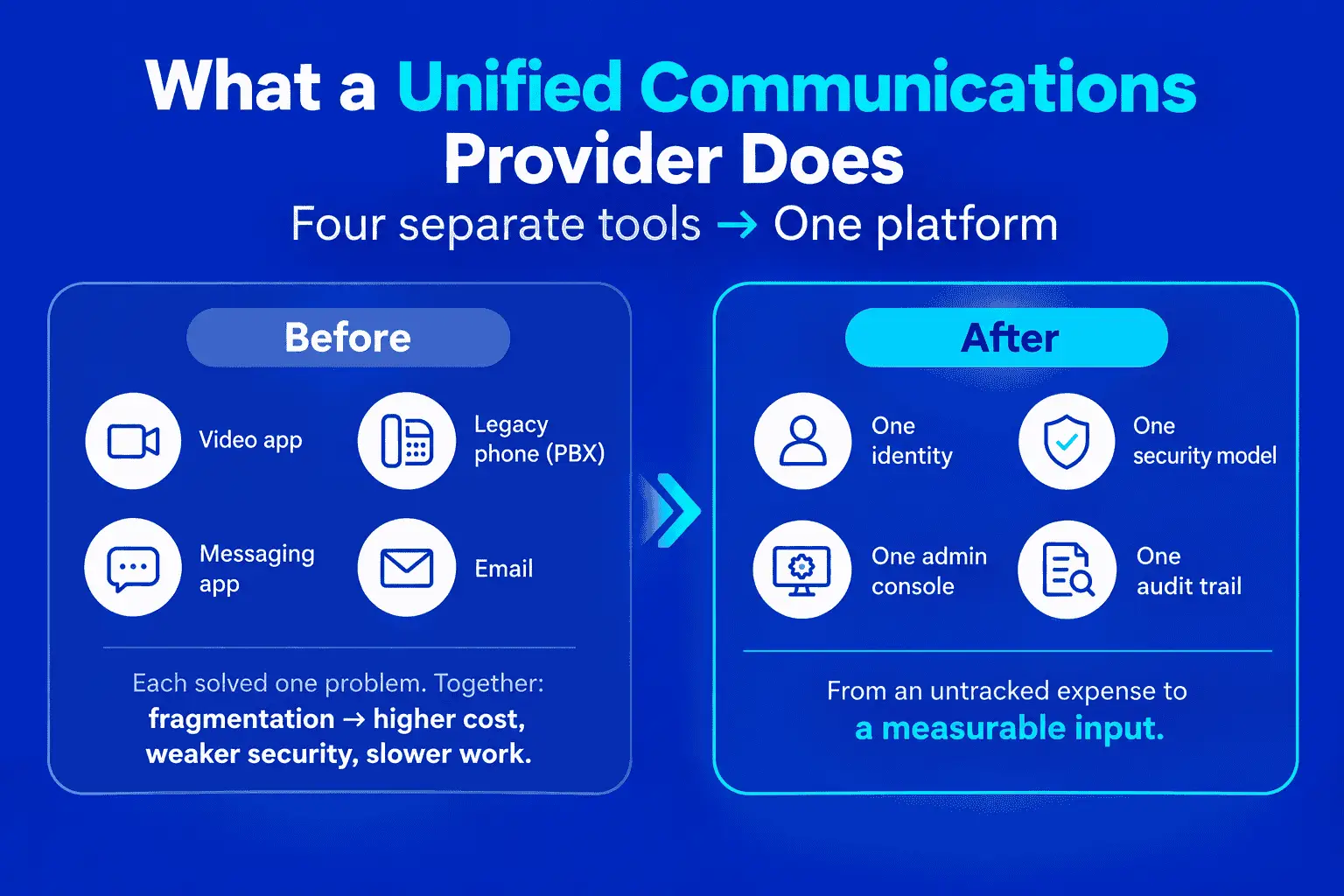
A unified communications provider delivers voice, video, meetings, team chat, and often contact center capability through a single platform, under one administration layer and one security model. That definition matters because the phrase gets used loosely. A provider is not a bundle of separate apps invoiced together. It is a consolidated system where a message, a call, and a meeting share the same identity, the same policy controls, and the same audit trail.
Most Saudi enterprises did not arrive at their current communications setup by design. They accumulated it: a video tool from the shift to hybrid work, a legacy PBX for voice, a messaging app one department preferred, and email sitting apart from all of it. Each solved a problem in isolation. Together they created a new one, namely fragmentation that raises cost, weakens security, and slows the organization down.
That is the specific problem a unified communications provider is built to solve, and it is why the category has moved from a convenience to a governance priority for IT and operations leads across the Kingdom. Consolidation reduces the vendors and admin consoles your team manages, a single security model closes the gaps between disconnected tools, and one platform produces one set of usage data that turns communication from an untracked expense into a measurable input.
Why Disconnected Communication Tools Are a Governance Risk
Tool sprawl looks like an inconvenience and behaves like a risk. When communication is spread across four or five disconnected applications, three problems compound quietly.
Cost is the visible one. Separate licenses, overlapping features, and parallel support contracts inflate spend, and the redundancy stays hidden until someone maps every tool against every user. Consolidation reverses it directly: fewer contracts, a lower total cost of ownership, and a clear line of sight into what communication actually costs per user.
Security is the serious one. Every additional platform is another identity store, another set of access policies, and another place where data lives outside your central controls. A message in one app, a recording in another, and a call log in a third mean your sensitive data has no single boundary. For a security or operations lead, that is a widening attack surface and a compliance question waiting to be asked during an audit.
Governance is the strategic one. You cannot apply a consistent retention policy, a uniform access rule, or a single data-handling standard across tools that were never designed to share one. Consolidating onto a single unified communications provider is what makes governance enforceable rather than aspirational, because policy applies once and covers everything.
Data residency: the criterion that reshapes your unified communications provider shortlist
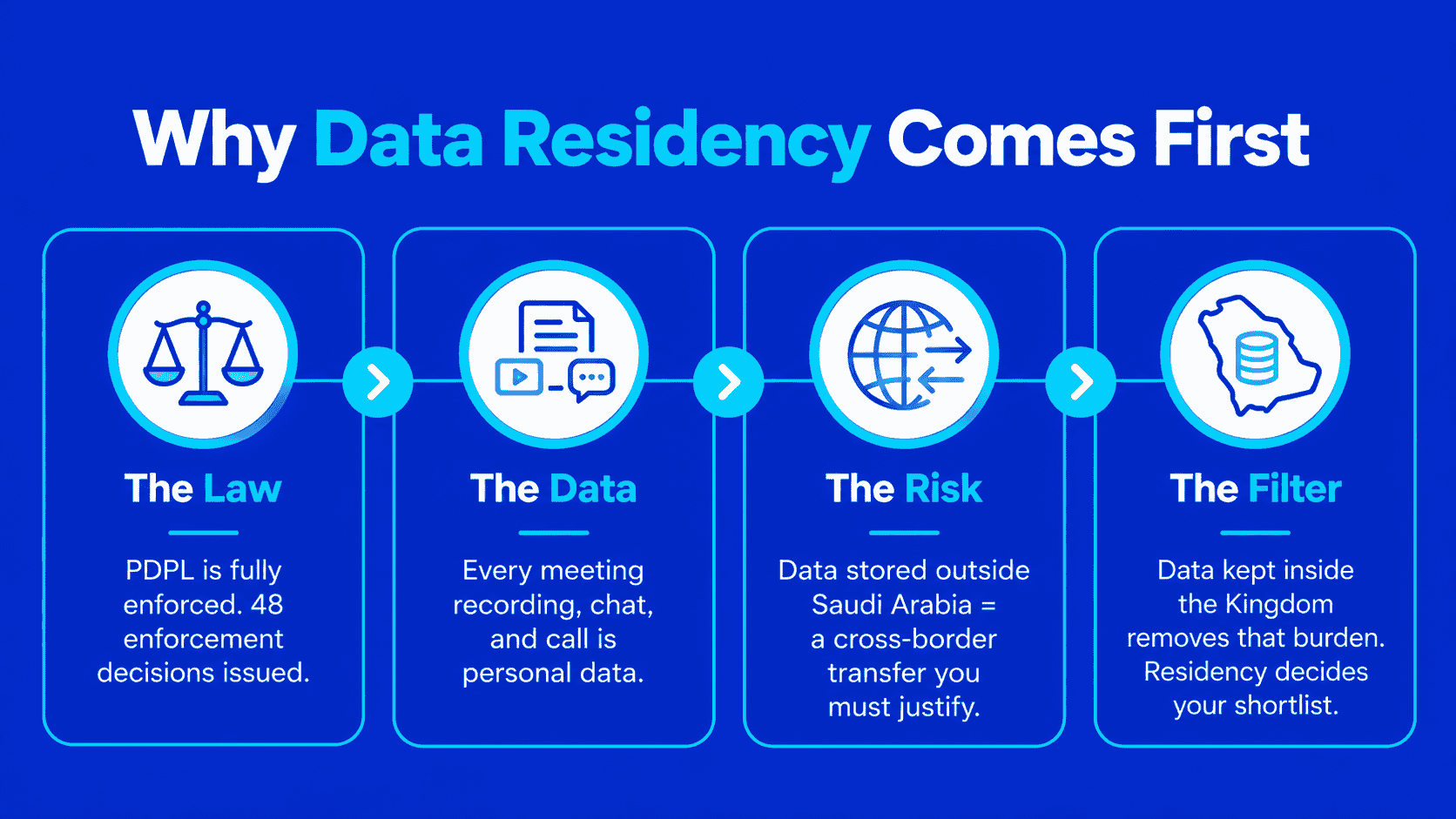
Here is the direct answer for any Saudi enterprise evaluating providers: data residency should sit at the top of your criteria, not the bottom. In 2026, where your communication data physically lives is a compliance decision with legal weight, and it narrows the field of viable providers faster than any feature comparison.
The reason is the Personal Data Protection Law. The PDPL entered into force on 14 September 2023, and its one-year grace period expired on 14 September 2024. Full enforcement has been active since that date. This is not a transitional phase.
The Saudi Data and Artificial Intelligence Authority (SDAIA), the law’s competent authority, reported 48 cumulative enforcement decisions covering violations that include processing personal data without a valid legal basis, unauthorized disclosure, and failure to implement adequate technical safeguards. The law also regulates cross-border transfers, requiring that data leaving the Kingdom meet defined protection standards.
Translate that into a communications context. Every meeting recording, every chat log, and every call detail record is personal data under the PDPL. A provider that stores this data outside Saudi Arabia turns each of those artifacts into a cross-border transfer that your team must justify and document. A provider that keeps the data inside the Kingdom removes that burden at the architectural level. This is why residency reshapes the shortlist: it converts a compliance obligation into a procurement filter.
How Zoom Workplace fits the Saudi enterprise brief
Zoom Workplace consolidates video meetings, team chat, phone, whiteboard, mail, and calendar into one platform, with an AI assistant built into the experience rather than sold as a separate product. That consolidation is the core answer to tool sprawl, and it is worth looking at what each capability delivers in practice rather than as a feature list.
The platform’s phone system replaces legacy PBX infrastructure with cloud voice, which removes the hardware and the parallel contract. Team chat keeps conversations, files, and decisions connected to the meetings they came from, so context stops getting lost between apps.
Zoom AI Companion, included at no extra cost on paid plans, produces meeting summaries, action items, and drafted content, which turns the record of a conversation into usable output instead of a file nobody reopens. For a leadership audience, the value is not any single feature. It is that these capabilities share one identity model, one admin console, and one security boundary, which is precisely what the fragmented alternative cannot offer.
On security, Zoom carries the certifications that enterprise procurement teams look for, including ISO/IEC 27001, SOC 2 Type II, ISO 27017, and ISO 27018, with AES-256 encryption on calls and optional end-to-end encryption across plan tiers. These are the third-party attestations that turn a vendor claim into audited evidence during due diligence.
The Arabic question deserves a precise answer rather than a marketing one, because IT leaders will test it. Zoom’s core interface localization to Arabic remains limited, and that is a fair thing to verify against your own users’ needs.
Where Zoom has moved decisively is AI-driven language support: Zoom AI Companion supports Arabic, including Gulf Arabic, for live captions and real-time translation, and the Translator and Summarizer capabilities released in May 2026 include Arabic among their output languages. For a bilingual Saudi workplace running meetings across Arabic and English, that translation layer is often the capability that matters more than menu localization.
The residency piece: Zoom’s Saudi data centers
This is where the platform meets the compliance requirement head-on. Zoom now operates two data centers inside Saudi Arabia. The first, established in 2023 in collaboration with Aramco, already serves customers with local data residency requirements. The second launched in June 2026, hosted at center3, a Saudi-headquartered carrier-neutral data center operator, and it expands capacity for enterprises, government entities, and critical national infrastructure organizations.
The practical effect is what matters to your governance model. Local hosting means video, audio, and chat data can remain stored inside the Kingdom’s borders, which addresses the cross-border transfer question at the infrastructure layer rather than through contractual promises.
It also delivers lower latency, so the residency benefit does not come at the cost of call quality. For a Saudi enterprise, this combination of local presence and enterprise-grade certification is what separates a provider that can genuinely meet the brief from one that can only meet part of it.
Why your unified communications provider needs a local partner
A platform is a capability. A deployment is an outcome. The gap between the two is where a unified communications provider succeeds or stalls, which makes the implementation partner as consequential as the platform itself.
Alnafitha IT, founded in 1993, is a Zoom Platinum Partner and served as a Strategic Sponsor of the Zoom KSA data center launch ceremony held under the sponsorship of the Ministry of Communications and Information Technology. That positioning reflects direct familiarity with the exact infrastructure your data residency strategy depends on.
In delivery terms, Alnafitha handles the assessment of your current communications estate, the migration off legacy voice and scattered tools, and the configuration of the platform to align with PDPL obligations, retention rules, and your existing identity and access model.
The team also delivers Zoom Contact Center locally in Saudi Arabia for organizations extending unified communications into customer-facing operations, with Arabic and English support and hosting inside the Kingdom. The value of a local partner is that the platform arrives inside your governance framework, configured for your regulatory environment, rather than as a generic deployment you then have to bring into compliance yourself.
Making the decision
For an IT or operations lead in Saudi Arabia, the evaluation reduces to a clear sequence. Confirm that the provider consolidates your fragmented tools into one governed platform. Verify that it can keep your communication data resident inside the Kingdom.
Check that its security certifications will survive audit. Establish that a capable local partner can deploy it inside your compliance model. Zoom Workplace, delivered through Alnafitha IT, is built to answer all four, which is what moves this from a shortlist consideration to a decision you can act on.
If you are ready to map your current communications estate against a consolidated, PDPL-aligned platform, contact Alnafitha’s team to scope a deployment built around your governance requirements and your users.
Frequently asked questions
What is a unified communications provider? A unified communications provider delivers voice, video, meetings, and team chat through a single platform under one administration and security model. Rather than running separate apps for calls, messaging, and video, your organization operates one integrated system where identity, policy, and audit controls apply consistently across every channel.
How much does unified communications cost in Saudi Arabia? Cost depends on user count, the feature tier you select, and whether you add capabilities like contact center or webinars. The more useful figure for a Saudi enterprise is total cost of ownership, because consolidating several standalone tools into one provider typically reduces the combined spend on licenses, support contracts, and administration. A local partner can model your specific TCO against your current estate before you commit.
Does Zoom meet Saudi PDPL requirements? Zoom provides the architectural elements that support PDPL compliance, most importantly local data residency through its two Saudi data centers and enterprise security certifications including ISO 27001 and SOC 2 Type II. Compliance itself is a shared responsibility: the provider supplies compliant infrastructure, and your organization must configure retention, consent, and access controls correctly. This is where PDPL-aware deployment through a local partner matters.
Where is Zoom’s data stored for Saudi customers? Zoom operates two data centers inside Saudi Arabia, the first established in 2023 and a second launched in 2026 at center3 in Riyadh. Local hosting allows video, audio, and chat data to remain stored within the Kingdom, which directly addresses PDPL cross-border transfer requirements for organizations that configure their accounts for local residency.
Does Zoom support Arabic? Zoom’s AI Companion supports Arabic, including Gulf Arabic, for live captions and real-time translation, and its translation features released in 2026 include Arabic among supported output languages. Core interface localization to Arabic remains more limited, so bilingual organizations should evaluate the translation and captioning capabilities against their specific use case, which is often where the practical value sits for Arabic-English workplaces.
What is the difference between unified communications and UCaaS? Unified communications describes the integration of communication channels into one experience. UCaaS, unified communications as a service, is that capability delivered from the cloud on a subscription basis rather than run on hardware you own and maintain. Zoom Workplace is a UCaaS platform, which is what allows it to deliver cloud voice, video, and chat from local data centers without on-premises infrastructure.
Why work with a local partner instead of buying direct? A local partner handles assessment, migration, and configuration against your specific regulatory and identity requirements. For Saudi enterprises, this means the platform is deployed in alignment with PDPL obligations and your governance model from day one, rather than deployed generically and brought into compliance afterward. A partner with direct experience of the local Zoom infrastructure, such as Alnafitha IT, closes the gap between platform capability and compliant outcome.