

Cybersecurity for Banking in KSA: What SAMA-Regulated Institutions Need to Get Right
Cybersecurity for banking in Saudi Arabia carries mandatory SAMA requirements and real penalties. Here is what regulated institutions need to get right.
Brief Takeaway
- Saudi banks and fintech companies operate under the mandatory SAMA Cybersecurity Framework, which requires controls across governance, identity, operations, and third-party risk with audits that carry real penalties.
- SAMA rejects 60% of self-assessments for incompleteness, and organizations relying on manual processes cannot surpass Maturity Level 2.
- Identity and access management, SIEM, and endpoint security are the three control areas where most Saudi financial institutions have visible gaps.
- ManageEngine’s BFSI-focused solutions (AD360, PAM360, Log360, and Endpoint Central) map directly to SAMA CSF requirements and can be implemented and supported in-Kingdom by Alnafitha IT.
- Cybersecurity for banking is not a one-time project. SAMA updates its framework periodically, and 2026 revisions targeting cloud and AI environments are in progress.
Introduction
Saudi Arabia’s financial sector is moving faster than most of its peers. More than 75% of transactions across the Kingdom are now conducted digitally, and the number of licensed fintech companies has grown to over 216. Banks are expanding cloud infrastructure, launching open banking APIs, and onboarding digital-only products at a pace that was unthinkable five years ago.
The security risk profile has grown at the same pace. According to IBM’s Cost of a Data Breach Report, the average cost of a breach in the financial sector reached $4.88 million in 2024. In 2025, 45% of financial organizations globally experienced AI-powered cyberattacks. For Saudi institutions, the stakes are compounded by regulatory accountability: the SAMA Cybersecurity Framework is mandatory, enforced through periodic supervisory reviews and onsite inspections, and non-compliance carries financial penalties of up to SAR 5 million per breach.
Cybersecurity for banking in Saudi Arabia is not simply a technology challenge. It is a governance, compliance, and operational continuity challenge, and the institutions that manage it well do so by building the right control infrastructure before the next audit cycle begins.
Why Cybersecurity for Banking in Saudi Arabia Is More Demanding Than Most Markets
The SAMA Cybersecurity Framework (CSF), published in 2017 and updated periodically, applies to every entity regulated by the Saudi Central Bank. That includes commercial banks, insurance companies, fintech startups, payment service providers, credit bureaus, and microfinance institutions. For fintech companies, proof of cybersecurity compliance is now required before a full operating license is granted.
The framework organizes requirements into four core domains: Governance, Risk Management, Operations, and Third-Party Security. Controls are assessed on a maturity model from Level 0 to Level 5. SAMA does not accept minimum implementation as sufficient. It expects continuous measurement, documentation, and improvement.
Three realities make compliance harder in practice than it looks on paper:
Saudi Arabia faces a 47% cybersecurity skills gap. Compliance teams at most banks consist of two to three full-time staff managing more than 47 controls simultaneously, with no dedicated IAM engineers or SIEM specialists. Talent competition from Aramco, NEOM, and large government entities extends hiring timelines to six to nine months for experienced hires.
Manual processes cannot scale. Manual access reviews consume four weeks every quarter. Excel-based asset inventories are outdated by the time they are completed. Organizations without centralized logging cannot satisfy SAMA Control 1.3.14 and remain capped at Maturity Level 2 regardless of other investments.
The regulatory environment is not static. SAMA updates its framework annually, and 2026 revisions are expected to add controls specifically targeting cloud deployments and AI-driven operations. An institution that achieves compliance today may face a new assessment gap within twelve months if its tooling cannot adapt.
Cybersecurity for Banking: The Control Gaps That Appear Most in SAMA Audits
Based on patterns across the SAMA-regulated sector, three technical areas consistently account for audit findings and remediation cycles.
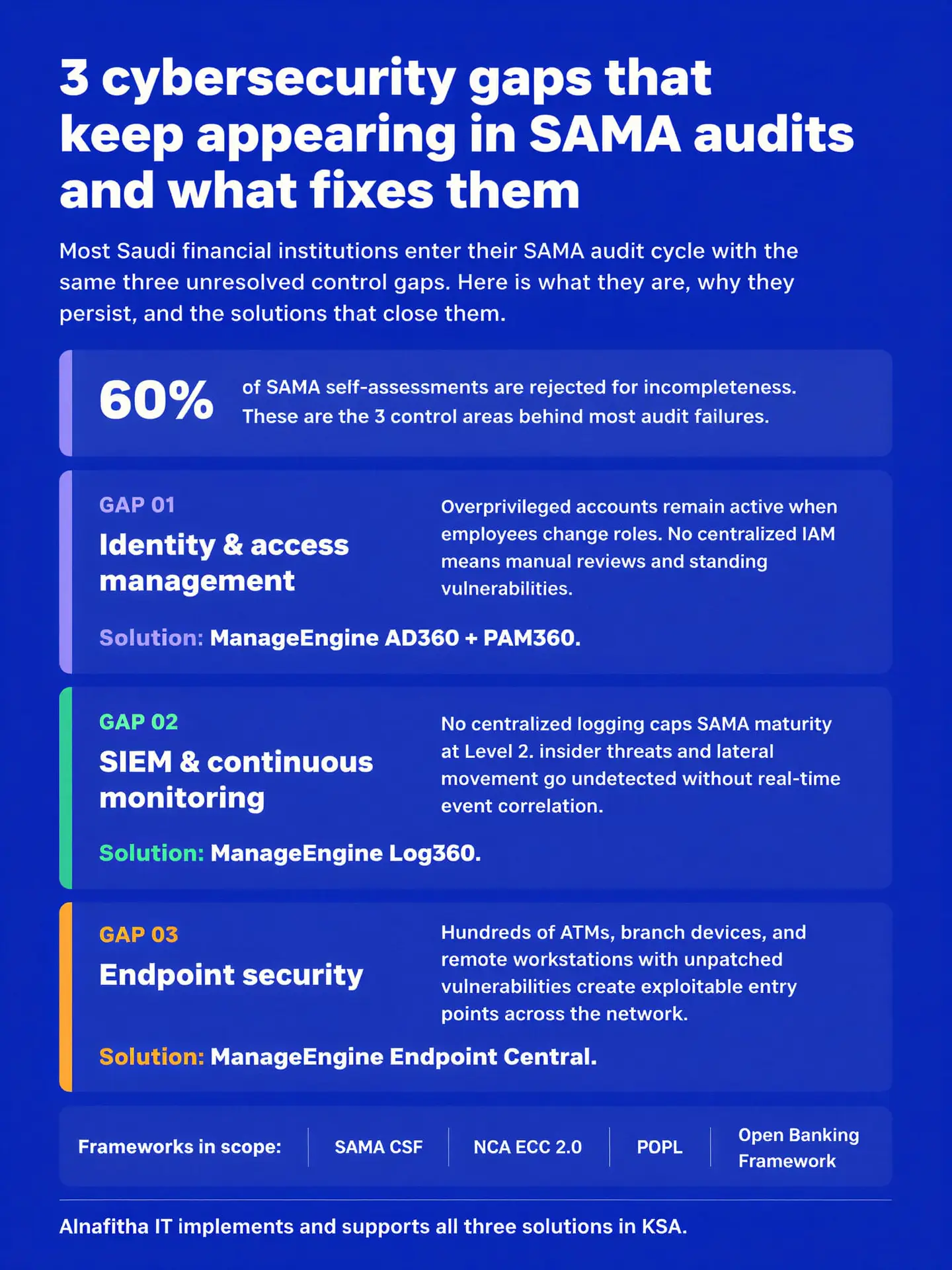
Identity and Access Management: The First Priority in Cybersecurity for Banking
Overprivileged accounts are the most exploited entry point in financial environments. When a bank employee changes roles, retains access from a previous position, and that access is never reviewed or revoked, the result is a standing vulnerability that exists at every point of that employee’s tenure.
ManageEngine AD360, available through Alnafitha IT, provides unified identity lifecycle management with automated provisioning and de-provisioning, adaptive MFA across all banking channels, and role-based access control. PAM360 extends this to privileged accounts, specifically the administrative credentials that, when compromised, give attackers the broadest possible footprint inside a financial network. Together, they address SAMA’s access governance requirements in a way that manual processes simply cannot.
For Saudi CISOs and IT Directors evaluating cybersecurity for banking, identity is the highest-priority control domain. It directly satisfies SAMA CSF Control 1.3.14, maps to the NCA ECC 2.0 identity requirements, and addresses the PDPL’s requirements around authorized access to personal financial data.
SIEM and Continuous Monitoring
Saudi financial institutions without a SIEM solution cannot demonstrate the continuous monitoring that SAMA demands. They cannot detect insider threats, anomalous transaction patterns, or lateral movement by an external attacker. They also cannot produce the audit-ready event logs that SAMA inspectors expect to review.
ManageEngine Log360, implemented and supported by Alnafitha IT, is a unified SIEM platform with integrated User and Entity Behavior Analytics (UEBA), Data Loss Prevention, and Cloud Access Security Broker capabilities. It collects and correlates log data from servers, endpoints, ATMs, firewalls, and cloud infrastructure. For fintech companies operating open banking APIs, Log360 provides the API telemetry and SIEM integration that SAMA’s Open Banking Framework requires.
The practical benefit for a Saudi bank’s security team is not just compliance coverage. SIEM gives analysts the context to respond to incidents in hours rather than days. IBM’s research shows that organizations with mature security automation programs saved an average of $1.9 million per breach compared to those without.
Endpoint Security Across Distributed Environments
A Saudi commercial bank with multiple branches, remote staff, and third-party vendor access has hundreds or thousands of endpoints that represent potential attack surfaces. Patch gaps on a single ATM terminal or an unmanaged device connecting to the core banking network are enough to create an exploitable vulnerability.
ManageEngine Endpoint Central gives IT teams centralized visibility and control over all endpoints, covering patch application, configuration enforcement, vulnerability scanning, and device management across branch locations from a single console. For banks navigating SAMA’s third-party security requirements, this level of endpoint governance extends naturally to vendor-managed devices and contractor workstations.
Cybersecurity for Banking and the Open Banking Frontier
Saudi Arabia’s Open Banking Framework has been live since 2022. It requires financial institutions and licensed fintech providers to implement OAuth-based authentication, consent lifecycle controls, API rate limiting, and SIEM integration for API logging. These are not optional features. They are conditions of continued licensing.
API vulnerabilities and supply chain attacks are the highest-impact threat vectors for the Saudi fintech sector in 2025 and 2026, according to security research from PT Security. An open banking integration that lacks proper logging and anomaly detection does not just create security exposure. It creates a compliance failure that SAMA’s supervisory reviews will identify.
The ManageEngine stack deployed by Alnafitha IT covers the logging, identity, and monitoring requirements that open banking security demands. This is increasingly relevant as Saudi banks bring more third-party providers into their API ecosystems and the attack surface for credential abuse and data exfiltration widens.
How Alnafitha IT Strengthens Cybersecurity for Banking in Saudi Arabia
Alnafitha IT has worked with financial institutions, public sector organizations, and enterprises across Saudi Arabia since 1993. For cybersecurity for banking engagements, the approach moves through assessment, configuration, and deployment, not just licensing. Alnafitha’s team conducts an initial review of the organization’s current security posture and compliance gaps, maps those gaps to the SAMA CSF domains, and implements the relevant ManageEngine solutions with configurations aligned to SAMA, NCA ECC 2.0, and PDPL requirements.
The solutions are supported in-Kingdom. For a Saudi CISO managing a compliance timeline, the ability to reach a local team that understands the regulatory context is a material operational advantage.
Conclusion
Cybersecurity for banking in Saudi Arabia has moved well past the stage where general-purpose security tools are sufficient. The SAMA Cybersecurity Framework demands measurable maturity across identity, monitoring, endpoint governance, and third-party risk. Annual framework updates, pending 2026 revisions for cloud and AI controls, and the live Open Banking Framework mean the compliance baseline is not a fixed target.
Saudi banks, fintech companies, and insurance institutions that invest in the right control infrastructure now will enter the next SAMA audit cycle with documented evidence rather than remediation timelines. The technology to achieve this exists. The question is whether the implementation is in place before the next assessment begins.
Ready to map your institution’s current security posture against SAMA requirements? Contact the Alnafitha IT team to discuss a cybersecurity assessment for your organization.
Frequently Asked Questions
What is the SAMA Cybersecurity Framework and who does it apply to? The SAMA Cybersecurity Framework is a mandatory set of cybersecurity controls issued by the Saudi Central Bank. It applies to all SAMA-regulated entities, including commercial banks, fintech companies, insurance firms, payment service providers, and credit bureaus operating in Saudi Arabia. Non-compliance can result in financial penalties of up to SAR 5 million per breach.
How do banks in Saudi Arabia manage cybersecurity risks under SAMA? Saudi banks are required to implement controls across four SAMA CSF domains: Governance, Risk Management, Operations, and Third-Party Security. In practice, this involves deploying identity and access management systems, SIEM platforms for continuous event monitoring, endpoint security across all devices, and formal third-party risk assessment programs. SAMA conducts periodic self-assessment cycles and onsite inspections to verify compliance.
What cybersecurity standards should banks follow in Saudi Arabia? The primary mandatory standard is the SAMA Cybersecurity Framework. In addition, Saudi financial institutions are expected to align with the NCA Essential Cybersecurity Controls (ECC 2.0), which became binding for private sector organizations in January 2026, and with the Personal Data Protection Law (PDPL) for any processing of customer financial data.
How do you implement multi-factor authentication in banking environments? MFA implementation in a banking context requires an identity management platform that supports adaptive MFA, meaning the authentication step adjusts based on user role, access location, and risk level. ManageEngine AD360 provides this capability, with support for hardware tokens, authenticator apps, and biometric verification. SAMA’s February 2026 directive also made MFA mandatory for all Microsoft 365 administrative portals, which affects most Saudi bank IT environments.
What are the cybersecurity requirements for open banking in Saudi Arabia? SAMA’s Open Banking Framework requires licensed providers to implement OAuth-based authentication and token management, API logging with SIEM integration, consent lifecycle controls, rate limiting, and formally documented security testing. A SIEM solution that captures API telemetry and flags anomalous access patterns is a direct technical requirement for maintaining open banking compliance.
Why do so many Saudi banks fail their SAMA self-assessments? SAMA rejects approximately 60% of self-assessments for incompleteness. The most common reasons are the absence of centralized logging (which caps maturity at Level 2), manual access review processes that cannot produce the required documentation frequency, and Excel-based asset inventories that are not updated in real time. Organizations with automated IAM and SIEM platforms consistently produce cleaner assessments because the compliance evidence is generated continuously.