

Saudi Arabia’s cybersecurity threat environment is not theoretical, and for IT teams relying on Endpoint Central to manage remote devices, the urgency is well understood. In 2024 alone, the Kingdom ranked among the top three most targeted countries in the Middle East for ransomware attacks, with IT teams across banking, government contracting, healthcare, and energy watching incidents climb quarter over quarter. The attack vector in the majority of these cases was not a sophisticated zero-day exploit. It was an unpatched, poorly managed endpoint sitting outside the corporate perimeter, connected through a home network or a shared office space, invisible to the tools that were supposed to protect it.
This is the reality that Saudi IT security teams and network administrators are working in today. Remote and hybrid work has permanently expanded the attack surface, and most organizations are managing that expansion with tools and processes that were built for a world where every device was inside the building.
ManageEngine Endpoint Central changes that equation entirely.
The Four Threats Endpoint Central Was Built to Address in Saudi Environments
Before getting into how Endpoint Central addresses these problems, it is worth being specific about what those problems actually look like in practice across Saudi organizations.
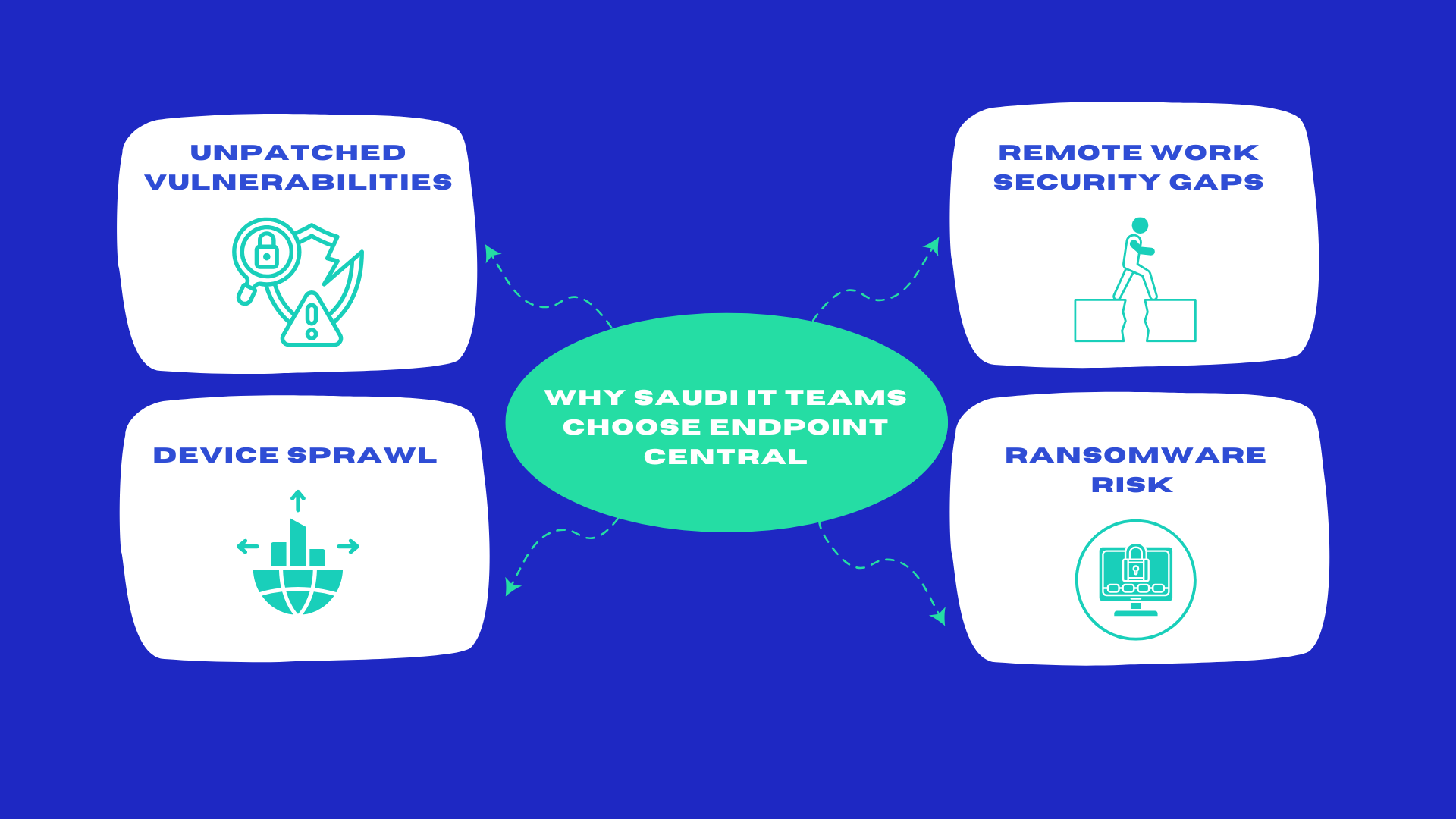
Unpatched vulnerabilities accumulate faster than most IT teams can manually address them. A typical enterprise environment runs hundreds of third-party applications alongside its operating systems. Every one of those applications releases security updates on its own schedule. Without automated patch management, the gap between a patch being released and that patch being deployed across your endpoint estate can stretch to weeks or months. Attackers know the CVE databases as well as your security team does. They move faster.
Device sprawl is the direct result of remote work scaling without proper governance. Employees access corporate systems from personal laptops, tablets, and mobile devices. Branch offices add endpoints that were never formally enrolled into management systems. Over time, no one has an accurate count of what is connected to the environment, let alone whether those devices are compliant.
Remote work security gaps appear because traditional endpoint tools rely on the device being on the corporate network to enforce policy, receive updates, and report status. The moment a device leaves the building, it falls into a gray zone where enforcement becomes inconsistent and visibility disappears.
Ransomware risk ties all three together. Ransomware operators target unpatched systems on remote networks precisely because those systems are the least monitored. One successful entry point is enough to move laterally across an organization’s entire infrastructure.
NCA ECC Controls 2-1, 2-3, and 2-10: What Saudi Organizations Must Comply With
For Saudi organizations subject to the National Cybersecurity Authority’s Essential Cybersecurity Controls framework, remote endpoint security is not a preference. It is a regulatory obligation with audit consequences.
ECC Control 2-1 requires organizations to maintain a complete, current inventory of all technology assets. Hardware, software, applications, servers, and devices all need to be catalogued with information on asset criticality, ownership, classification, and location. An organization that cannot account for every endpoint in its environment, including remote devices, cannot satisfy this control. Audit findings in this area carry real weight during NCA reviews.
ECC Control 2-10 mandates systematic vulnerability assessment and remediation. This goes beyond running a scan once a quarter. The control requires identifying vulnerabilities, prioritizing them by severity and business impact, and remediating them within timeframes that reflect the risk they carry. Documentation of this process has to be audit-ready at any point.
Endpoint Central was built to satisfy exactly these requirements. Its asset discovery, centralized inventory management, continuous vulnerability scanning, and automated patch deployment map directly onto what ECC 2-1 and 2-10 are asking for. The compliance reporting module generates documentation that security teams can submit to auditors without spending days assembling evidence from multiple disconnected systems.
How Endpoint Central Covers Your Entire Remote Endpoint Estate
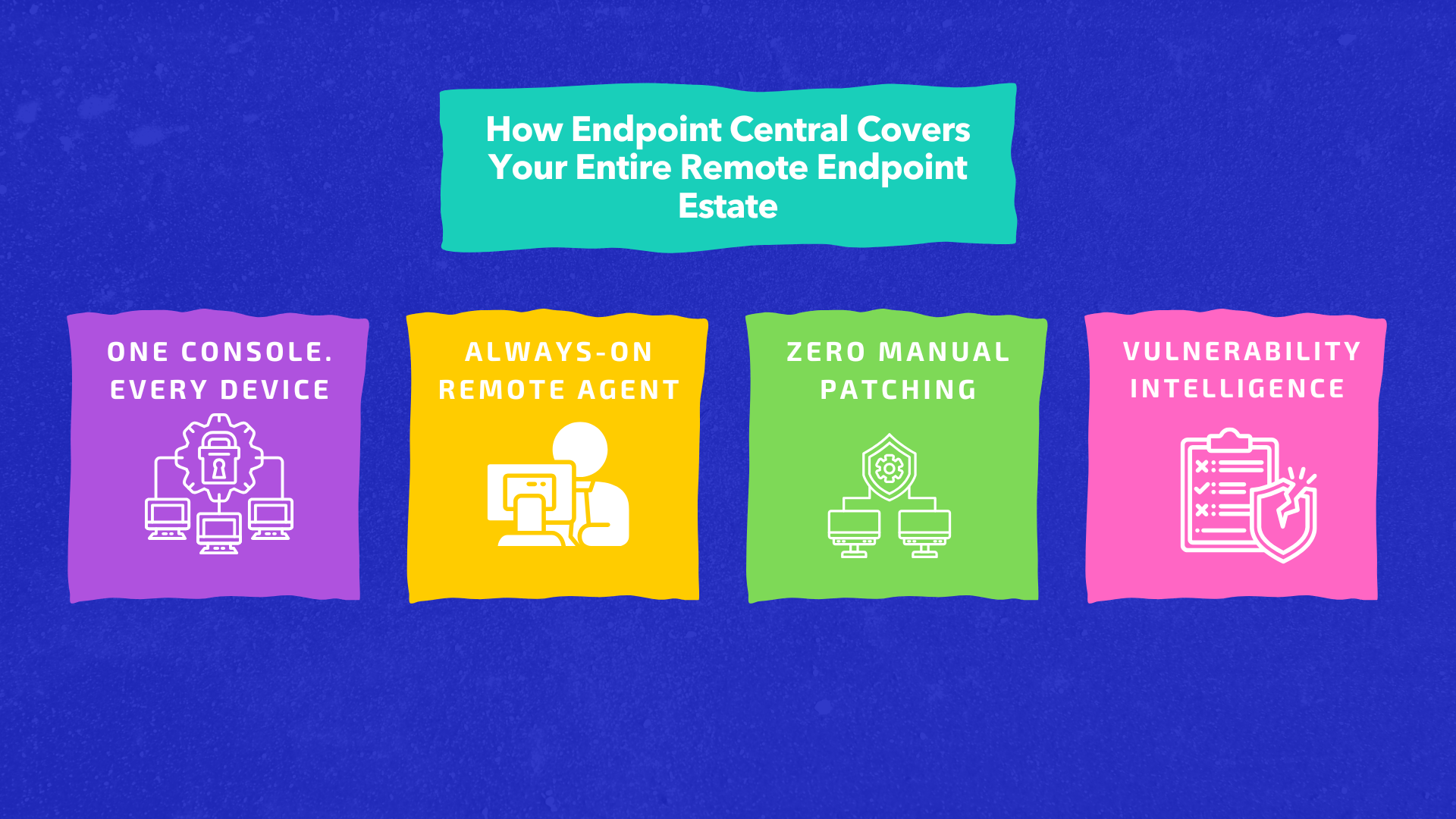
Endpoint Central is a unified endpoint management and security platform that handles Windows, macOS, Linux, iOS, and Android from a single console. For Saudi IT teams managing employees across Riyadh, Jeddah, Dammam, and distributed remote locations, this cross-platform coverage is not a nice-to-have. It is a baseline requirement.
The platform’s remote endpoint agent maintains a persistent connection regardless of whether the device is on the corporate network. This means patch deployment, policy enforcement, configuration management, and vulnerability scanning continue operating normally for a device working from a home network in Khobar or a hotel connection in Dubai. The gap that legacy tools leave open simply does not exist with Endpoint Central.
Patch management within Endpoint Central covers operating system updates and over 850 third-party applications. The process is fully automated: the platform detects missing patches, tests them in a staging environment, and deploys them on a schedule the IT team controls. High-severity CVEs can be pushed immediately without waiting for a maintenance window. The result is a patch cycle measured in hours rather than weeks.
The vulnerability management module provides continuous scanning with CVSS-based severity scoring. When a new vulnerability is published that affects assets in your environment, the platform surfaces it with context, priority, and remediation guidance. Security teams get actionable intelligence rather than raw scan data.
Software control, device configuration management, and remote troubleshooting capabilities round out the platform. IT administrators can run diagnostics, deploy applications, and enforce security baselines on remote devices without disrupting the end user and without requiring the device to be physically brought into the office.
Patch Manager Plus: ManageEngine’s Dedicated Patching Solution for High-Volume Endpoint Environments
For organizations where patch management is the primary operational challenge, ManageEngine Patch Manager Plus works either alongside Endpoint Central or as a focused standalone solution. It covers OS-level patching for Windows, macOS, and Linux, plus third-party application updates at enterprise scale.
The practical value for Saudi organizations is straightforward. IT teams dealing with hundreds or thousands of endpoints across multiple locations cannot manually track the patch status of every application on every device. Patch Manager Plus automates that tracking, that testing, and that deployment. It also generates compliance reports that align with NCA ECC requirements, which means audit preparation becomes a matter of exporting a report rather than a week-long data gathering exercise.
Why Alnafitha IT Delivers Endpoint Central at a Different Level
Purchasing a software license and deploying it effectively across a Saudi enterprise environment are two very different things. Alnafitha IT has been working with organizations across the Kingdom since 1993. The team understands NCA ECC compliance requirements, the Arabic language operational context, the infrastructure realities of Saudi enterprises across different industries, and the specific challenges that come with managing distributed endpoint estates in this market.
When a government entity or a major financial institution needs Endpoint Central deployed across thousands of endpoints in a way that satisfies both day-to-day operational requirements and NCA audit scrutiny, they need a partner who has done this before in this specific regulatory environment. Alnafitha’s implementation approach covers infrastructure assessment, deployment architecture design, agent rollout across distributed sites, policy configuration aligned with ECC controls, and ongoing local support.
For organizations that have tried to stand up endpoint management tools independently and run into complexity that stalled the project, this structured delivery approach is what closes the gap between a tool that is installed and a solution that actually protects the organization.
You can review the full scope of IT management and cybersecurity solutions Alnafitha delivers for Saudi organizations on their website.
From Unmanaged Devices to Full Control: Running Endpoint Central Across Your Organization
The starting point for any Endpoint Central deployment is visibility. The platform’s automatic asset discovery maps every managed and unmanaged device in the environment, building the centralized inventory that satisfies ECC 2-1 and gives the security team a working baseline for everything that follows.
From that inventory, patch prioritization, vulnerability remediation, software control, and configuration hardening all operate on a continuous automated basis. New devices that join the network are enrolled, scanned, and brought into compliance with the security baseline before they can become a liability.
This matters most for ransomware risk. The most common entry point for ransomware attacks in Saudi Arabia is an unpatched vulnerability on an endpoint that was not properly tracked. Remove the unpatched vulnerability through automated patch management. Remove the invisible device through proper enrollment and agent deployment. The attack path narrows considerably.
ManageEngine’s own documentation on Endpoint Central’s vulnerability management capabilities provides detailed technical context on how the platform addresses specific threat scenarios.
For organizations building NCA compliance programs, the ECC Implementation Guide published by the National Cybersecurity Authority is the authoritative reference for understanding what each control requires in practice.
Every Dispersed Endpoint Is a Risk Endpoint Central Can Close Today
Every unpatched endpoint in a Saudi organization’s environment carries risk that compounds with time. Every remote device that sits outside proper management is a gap in NCA ECC compliance posture. The organizations that have moved from reactive endpoint management to automated, continuous control with Endpoint Central consistently report faster patch cycles, fewer incidents, and far less effort in preparing for regulatory audits.
The conversation about what proper Endpoint Central deployment looks like for your specific environment starts with one call.
Connect with the Alnafitha IT team today and get a clear picture of what full remote endpoint security looks like in practice across your organization.