

If you work in cybersecurity for a Saudi bank or financial institution, you already know the pressure. Regulators are tightening requirements, cyber threats are growing more sophisticated, and one compromised admin credential can bring your entire operation to a halt. That’s exactly why PAM – Privileged Access Management has moved from a “nice to have” to an absolute requirement for any financial organization operating under the Saudi Arabian Monetary Authority (SAMA) framework.
Industry data is clear: roughly 80% of security breaches involve compromised privileged credentials. For banks, insurance companies, and fintech firms regulated by SAMA, this is not a theoretical risk. It’s an operational reality that auditors will ask about, and one that attackers actively exploit. In this article, we break down why Privileged Access Management deserves top priority on your 2026 security roadmap, how it directly supports SAMA compliance, and what a practical PAM deployment looks like through a solution like ManageEngine PAM360.
The Real Cost of Ignoring PAM in Saudi Financial Services
Saudi Arabia consistently ranks among the most targeted countries for cyberattacks in the Middle East. Financial institutions, in particular, sit at the top of the target list because of the sheer value of the data they handle, customer banking details, transaction records, personal identification, and interbank communications. Without an advanced Privileged Access Management strategy, every privileged account in your environment is essentially an open invitation for attackers.
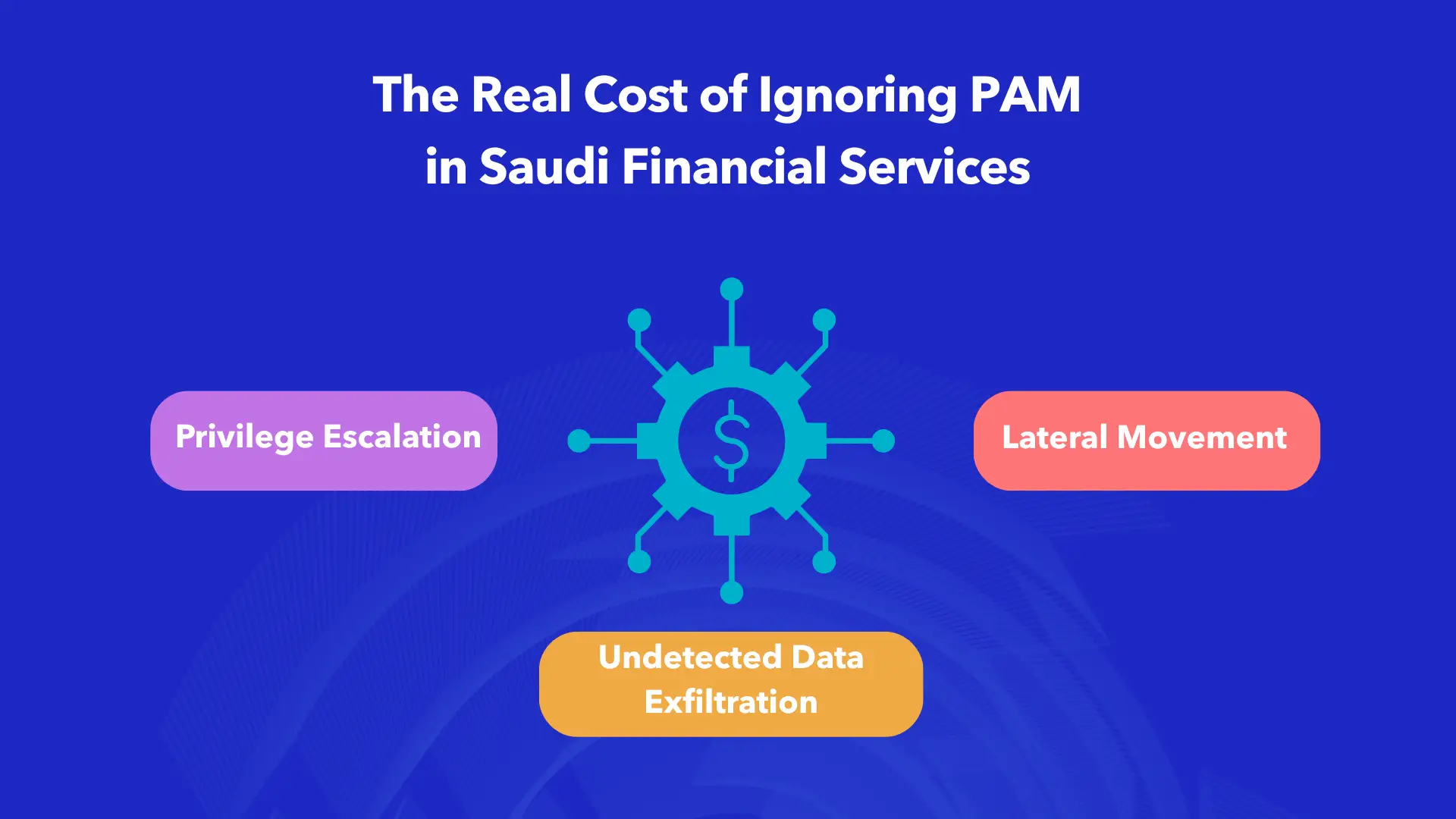
Think about the privileged accounts across your organization: domain administrators who control Active Directory, database admins with access to core banking systems, IT operations staff managing cloud infrastructure, and third-party vendors connecting remotely for maintenance. Each one of these accounts, if compromised, gives an attacker the keys to move laterally, escalate privileges, and extract data, often without triggering a single alert. PAM exists specifically to close this gap by controlling, monitoring, and auditing every privileged session.
How PAM Directly Supports SAMA Cybersecurity Compliance
The SAMA Cybersecurity Framework is not optional, it’s mandatory for every financial institution regulated by SAMA. Within this framework, Section 3.3.5 on Identity and Access Management explicitly requires organizations to enforce strict controls over who can access information systems and under what conditions. Privileged accounts are front and center in this requirement.
Here’s what SAMA specifically expects and how Privileged Access Management addresses each requirement. Access to information systems must follow the “need-to-have” and “need-to-know” principles. PAM enforces this through role-based access controls and just-in-time privilege elevation, meaning users only get admin access when they need it and only for the duration required. Organizations must maintain detailed audit trails of all access requests, approvals, and revocations. A proper PAM solution records every privileged session, including video-level session recording, giving your audit team exactly what they need when SAMA assessors come knocking. Multi-factor authentication must be enforced for privileged accounts and remote access. PAM360 integrates MFA directly into privileged session workflows, adding that critical second layer without disrupting operations.
For a deeper look at what SAMA auditors evaluate and how to prepare, Alnafitha IT has published a detailed SAMA Cybersecurity Audits compliance guide that walks through the full framework.
Four Critical PAM Pain Points Saudi Banks Cannot Afford to Ignore
1. Privileged Credential Theft
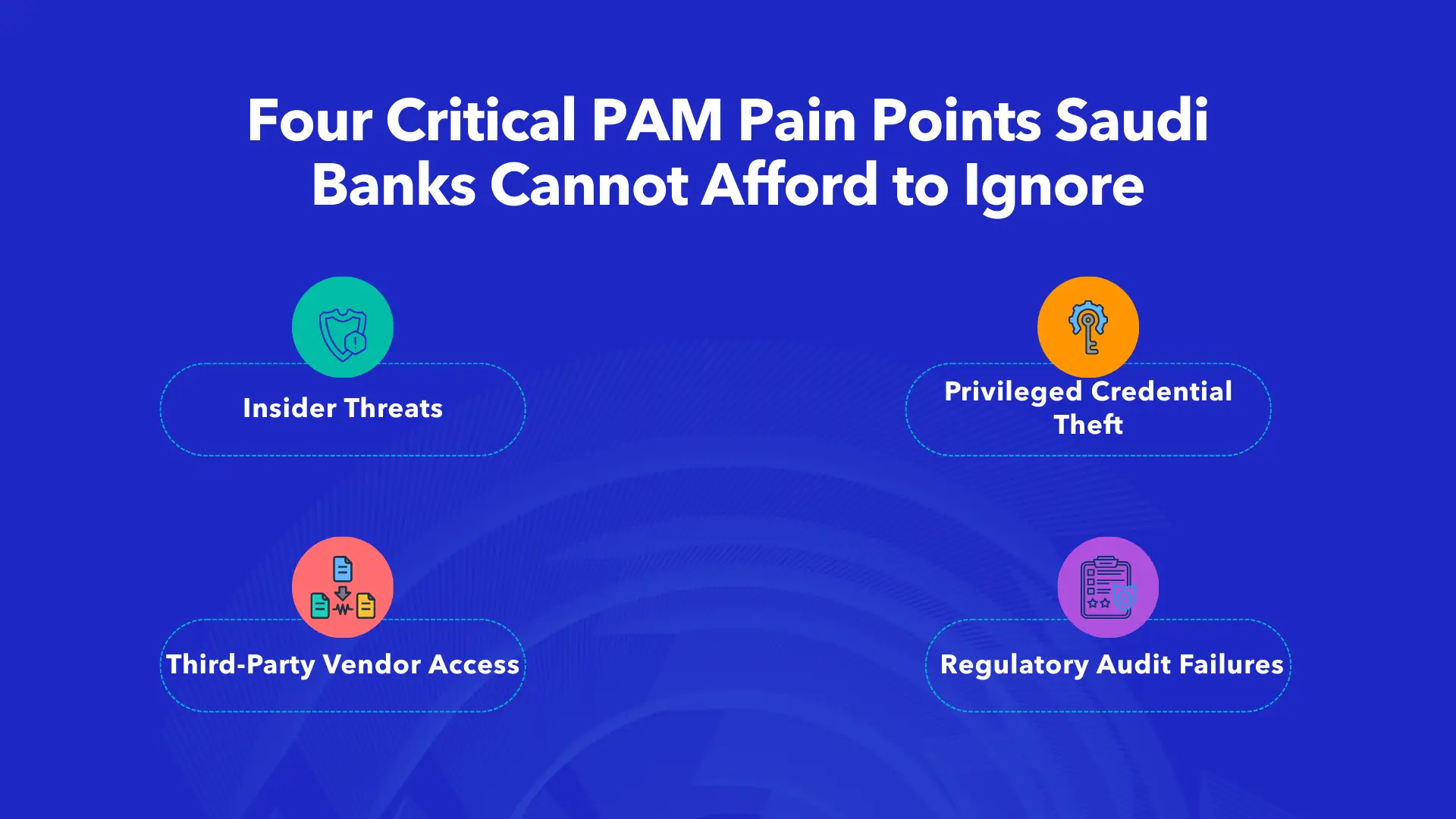
Stolen admin credentials are the number one method attackers use to breach financial networks. Once an attacker has a domain admin password or a service account credential, they can access core banking applications, modify transaction records, and exfiltrate sensitive customer data. Privileged Access Management eliminates this risk by storing all privileged credentials in an encrypted vault, rotating passwords automatically, and ensuring that users never see or handle the actual credentials. With PAM360’s credential injection technology, admins launch sessions through the PAM platform without the password ever being exposed.
2. Regulatory Audit Failures
Failing a SAMA audit is not just embarrassing, it carries financial penalties and reputational damage that can take years to recover from. One of the most common audit findings is the lack of proper controls over privileged access. Auditors want to see who accessed what system, when, why, and whether that access was approved. Without Privileged Access Management, generating these reports means manually piecing together logs from dozens of systems. With a centralized PAM solution, every privileged action is logged, recorded, and reportable from a single console. Alnafitha IT’s Risk and Compliance solutions can help you build a complete compliance posture around this.
3. Insider Threats
Not every threat comes from outside your network. Employees, contractors, and even senior IT staff with unchecked privileged access represent a significant insider risk. Whether it’s intentional data theft or an accidental misconfiguration, the result can be catastrophic. PAM mitigates insider threats by enforcing the principle of least privilege, every user gets exactly the access they need, nothing more. Session monitoring detects anomalous behavior in real time, and just-in-time access ensures that standing privileges are eliminated entirely.
4. Third-Party Vendor Access
Saudi financial institutions rely heavily on external technology vendors for system maintenance, updates, and support. Every vendor connection is a potential entry point that must be secured and monitored. PAM provides secure, time-bound remote access for vendors without exposing your internal credentials. Sessions are recorded, access is automatically revoked after the maintenance window, and every action is tied to a specific vendor identity. This level of control is exactly what SAMA expects when it comes to third-party security management.
Why PAM360 is the Right PAM Solution for Saudi Financial Institutions
Not all Privileged Access Management solutions are created equal, and choosing the wrong one can create more headaches than it solves. ManageEngine PAM360 stands out as a practical, enterprise-grade PAM platform specifically designed for organizations that need comprehensive privileged access governance without the complexity of over-engineered alternatives.
PAM360 delivers automated discovery and onboarding of privileged accounts across Windows, Linux, cloud, and Active Directory environments. It provides an encrypted credential vault with automated password rotation that eliminates static, shared passwords. You get secure remote session management with real-time recording for complete audit trails. The solution includes just-in-time privilege elevation that replaces permanent admin rights with temporary, task-based access. Its AI-powered behavioral analytics detect unusual privileged activity before it becomes a breach. It offers out-of-the-box compliance reporting aligned with SAMA, ISO 27001, PCI-DSS, and NCA requirements.
As an authorized ManageEngine partner, Alnafitha IT delivers PAM360 with full local deployment support, configuration aligned to your specific environment, and ongoing managed services through our IT support programs. Our team understands the specific requirements of SAMA-regulated environments and configures PAM360 to meet those requirements from day one.
How to Start Your PAM Journey in 2026
Implementing Privileged Access Management does not have to be a multi-year project. A phased approach works best for most financial institutions. Start by discovering and inventorying all privileged accounts in your environment, this step alone often reveals dozens of forgotten service accounts and shared credentials that represent immediate risk. Next, vault and rotate the most critical credentials, starting with domain admin and core banking system accounts. Then, roll out session management and monitoring for all privileged access, and finally, implement just-in-time access to eliminate standing privileges entirely.
Alnafitha IT’s cybersecurity team has guided dozens of Saudi organizations through this exact process. Whether you are starting from scratch or upgrading an existing identity and access management setup, we’ll help you build a PAM strategy that satisfies regulators, protects your infrastructure, and actually works for your operations team.
PAM is Not a Luxury, It’s a Compliance and Security Requirement
In 2026, running a Saudi financial institution without proper Privileged Access Management controls is like leaving the vault door open and hoping no one walks in. SAMA’s cybersecurity framework makes PAM a regulatory mandate. The threat landscape makes it a practical necessity. And the cost of a breach, financial penalties, reputational damage, and operational disruption, makes it a business imperative.
The question is not whether your organization needs PAM. The question is how quickly you can get it in place. With PAM360 and Alnafitha IT as your implementation partner, the answer is faster than you think.
| Secure Your Privileged Access Now
Talk to Alnafitha IT’s cybersecurity experts about deploying PAM360 in your financial institution. Get a tailored assessment of your privileged access risks and a clear roadmap to SAMA compliance. |