

Quick Takeaway: Ransomware groups are actively scanning for unpatched endpoints across Saudi Arabia’s enterprise sector. Manual patching cycles cannot keep pace with today’s disclosure-to-exploit timelines. ManageEngine Endpoint Central, delivered by Alnafitha IT’s ITM Solutions team, gives IT managers, security engineers, and SOC analysts a unified platform to automate patch management across Windows, macOS, Linux, and mobile devices, closing compliance gaps under NCA ECC 2.0 and SAMA CSF before auditors or attackers get there first.
The Patch Management Problem Is Not a Knowledge Problem
Every IT manager in Saudi Arabia knows that unpatched endpoints are dangerous. The challenge is not awareness; it is execution at scale. An organization running 500 endpoints across Riyadh headquarters, branch offices in Jeddah and Dammam, and remote workers connecting from outside the corporate perimeter faces a structural problem that spreadsheets and manual ticket workflows cannot solve.
The numbers make the stakes clear. In 2025, ransomware incidents in Saudi Arabia rose sharply, with groups including KillSecurity, Everest Ransom, and Qilin actively targeting government institutions, financial services, healthcare, and transportation. Globally, vulnerability exploitation, meaning attackers leveraging known, unpatched flaws, accounted for 32% of ransomware entry points in 2025, ranking it as the single most common initial access vector ahead of phishing and credential theft.
The window between public vulnerability disclosure and active exploitation has collapsed. What once gave security teams weeks to respond now gives them days, sometimes hours. Organizations that rely on manual patch management are not slow; they are systematically exposed.
What NCA ECC 2.0 and SAMA CSF Require from Your Patch Management
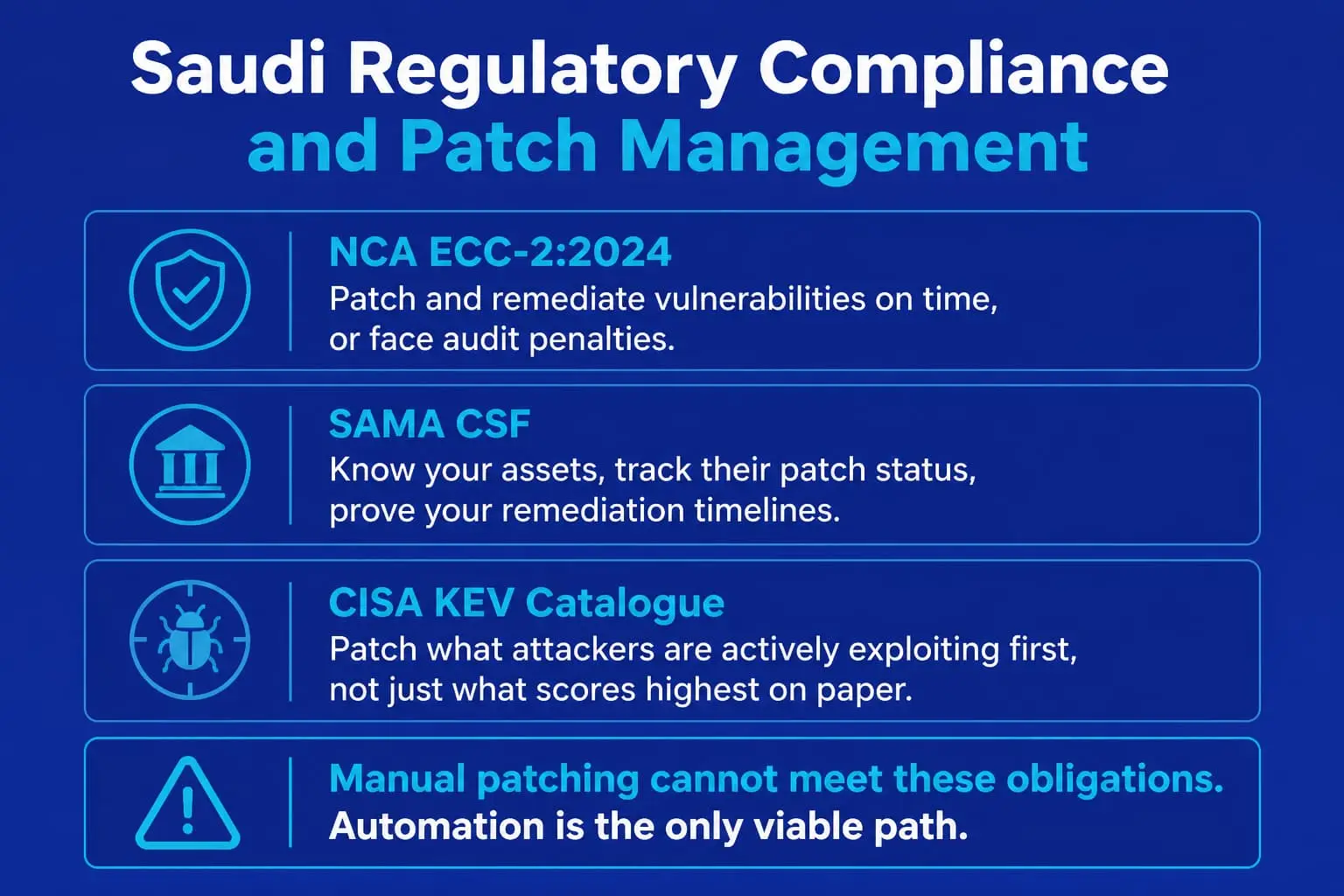
Saudi regulators have translated this threat reality into enforceable obligations.
The National Cybersecurity Authority’s updated ECC-2:2024 framework expanded from 59 to 110 controls and now applies to a broader range of entities, including government bodies, critical infrastructure operators, and financial institutions. Control 2-5 under the Cybersecurity Defense domain mandates structured vulnerability management, which includes the identification, prioritization, and timely remediation of vulnerabilities across information assets. Control 3-3 governs endpoint protection and directly addresses the security posture of managed devices across the organization. Non-compliance carries reputational consequences and regulatory penalties, and the NCA is increasingly active in audit enforcement.
The SAMA Cybersecurity Framework reinforces these requirements through its Asset Management and Vulnerability Remediation domains. Regulated financial entities such as banks, insurance providers, and fintech operators are expected to maintain continuous visibility into asset patch status and demonstrate remediation timelines against known vulnerabilities.
Organizations that want a practical prioritization reference can use the CISA Known Exploited Vulnerabilities (KEV) catalogue, which lists vulnerabilities actively exploited in the wild. Using KEV as a patching priority signal means security teams focus their remediation efforts where the active threat risk is highest, not simply where CVSS scores are highest on paper.
Meeting these obligations through manual processes is not viable for any enterprise managing more than a few dozen endpoints. The only practical path to sustained compliance is automation.
How ManageEngine Endpoint Central Automates Patch Management
ManageEngine Endpoint Central, the unified endpoint management platform, is built to automate the full patch management lifecycle, from vulnerability scanning through patch testing, approval, deployment, and compliance reporting, across Windows, macOS, Linux, and mobile devices, from a single console.
The platform continuously synchronizes its vulnerability database with Zoho Corp’s central patch repository, which is constantly updated as new patches are released by vendors. When a new patch is discovered and verified, it becomes available to the Endpoint Central server within the client’s environment within hours, not days. Automated patch deployment configurations can then push approved patches to endpoints across LAN, WAN, and DMZ environments without requiring an IT technician to visit each machine.
For enterprises operating in distributed environments, which describes most large Saudi organizations with branch offices, remote workers, or multi-site operations, this centralized model eliminates the coverage inconsistency that manual approaches inevitably produce. Remote offices do not get skipped. Branch endpoints do not fall two patch cycles behind. The compliance dashboard reflects the real state of the entire estate, not just the headquarters floor.
Patch management in Endpoint Central also handles third-party applications, covering over 850 applications beyond operating systems. This matters because many of the most frequently exploited vulnerabilities affect third-party software such as browsers, PDF readers, and collaboration tools that sit outside the scope of native OS update mechanisms.
The test-and-approve workflow allows security teams to validate patches in a staging group before wider deployment, reducing the risk of a faulty patch causing production issues. Patches that fail testing can be declined. Patches that cause post-deployment problems can be rolled back. Administrators working under change management frameworks can schedule deployments during approved maintenance windows, with reboot policies that minimize disruption to end users.
For organizations managing air-gapped or isolated networks, a common requirement in government entities and critical infrastructure, Endpoint Central supports offline patch management by allowing patch export from connected environments and import into secured, offline systems.
The reporting layer is equally important for compliance teams. Built-in templates generate patch compliance reports that can be shared with auditors, leadership, and external regulators. Scheduled reports can be delivered automatically via email, giving IT managers a continuous picture of patch coverage without manual data gathering.
Why IT Managers and SOC Analysts Choose This Approach
The most common objection to automated patch management is the fear of unintended consequences, specifically a patch breaking a business-critical application. Endpoint Central addresses this directly through its test-before-deploy model and granular deployment targeting. Administrators can define which systems receive which patch configurations, apply exclusions for specific applications or endpoint groups, and maintain rollback capability if a deployment causes instability.
For SOC analysts, the value is in the reduction of time-to-remediation. When a new CVE is published and added to the CISA KEV catalogue, the analyst can immediately identify which endpoints in the estate are affected and initiate a targeted patch deployment, without waiting for the next scheduled maintenance window or coordinating with a field technician.
For IT managers reporting to leadership on regulatory posture, the compliance dashboard provides the documentation trail that NCA ECC audits require: evidence that vulnerabilities were identified, prioritized, and remediated within defined timeframes.
How Alnafitha IT Delivers Patch Management Differently
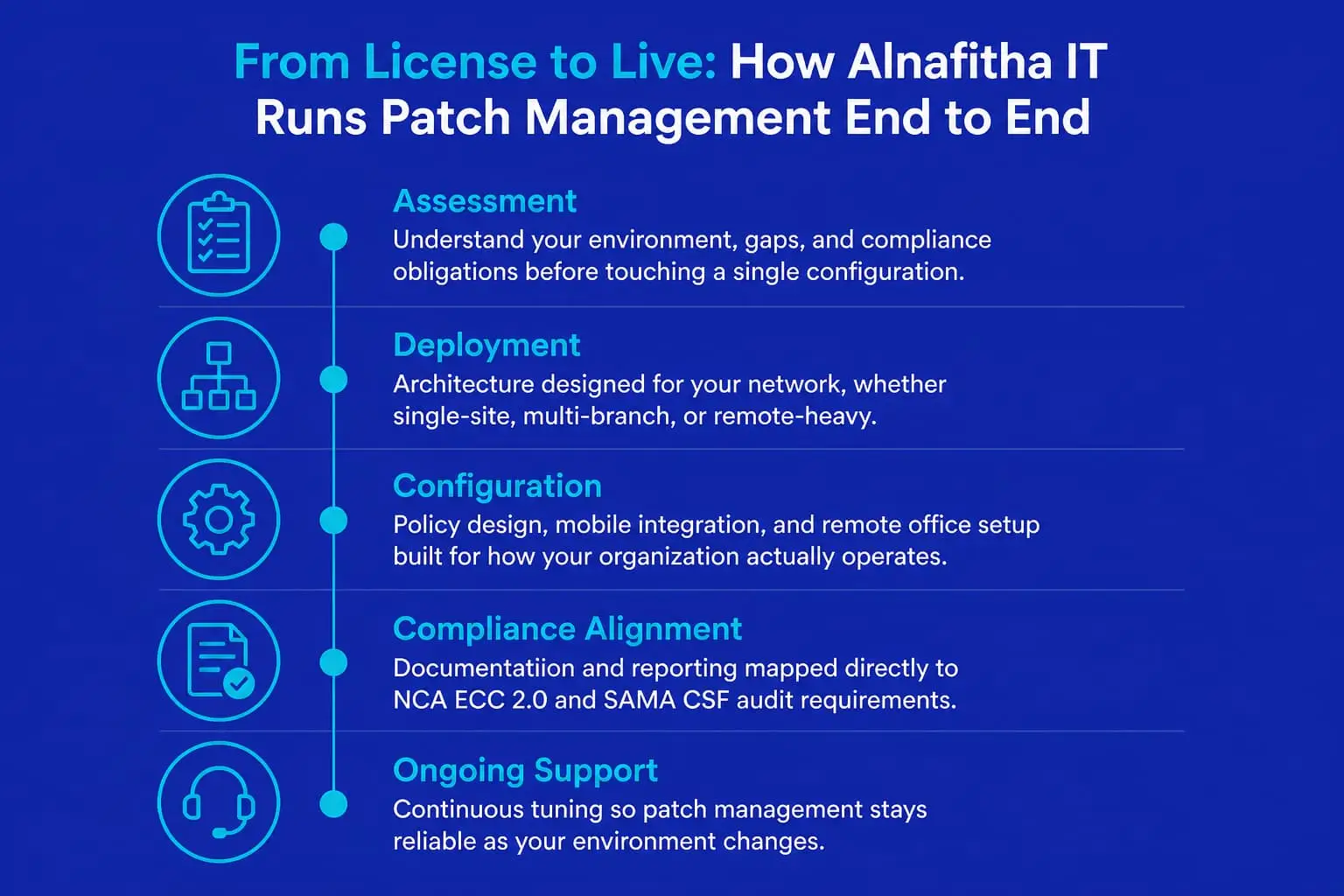
Alnafitha IT has been a ManageEngine Platinum Partner for years, with an ITM Solutions team that has implemented endpoint management across diverse sectors of the Saudi market, including government entities, financial institutions, healthcare organizations, and industrial enterprises. The difference between purchasing a license and operating a functioning patch management program is implementation depth, integration with existing infrastructure, and ongoing tuning.
Alnafitha’s team brings direct experience with ManageEngine’s full product stack, including the specific configuration decisions that determine whether automated patch management runs reliably or generates noise. That includes deployment policy design, remote office architecture, mobile device integration, and alignment with the compliance documentation requirements of NCA ECC 2.0 and SAMA CSF.
For organizations that need endpoint security and patch management to work together as a coherent program rather than a collection of disconnected tools, Alnafitha’s approach covers the full scope, from initial assessment through deployment, training, and ongoing support.
The Cost of Waiting
Saudi enterprises often defer patch management investment because the risk feels abstract until an incident occurs. Ransomware groups do not operate on that logic. They scan continuously for exposed endpoints running known-vulnerable software, and they move fast once they find an entry point. The CISA KEV catalogue grows weekly, and each new entry represents a vulnerability that attackers are actively leveraging against real organizations.
The patch management gap is measurable and closable. The technology to close it is available, proven, and deployable in weeks, not months.
Ready to assess your current patch compliance posture and close the gaps before they become incidents? Talk to the Alnafitha ITM Solutions team today.
Frequently Asked Questions
What is patch management and why does it matter for Saudi enterprises? Patch management is the process of identifying, testing, and applying software updates, known as patches, to operating systems, applications, and firmware across an organization’s endpoints. For Saudi enterprises operating under NCA ECC 2.0 and SAMA CSF, it is both a security requirement and a compliance obligation. Unpatched endpoints represent the most common initial access vector for ransomware attacks.
Which systems does ManageEngine Endpoint Central support for patch management? Endpoint Central supports automated patch management across Windows, macOS, Linux, including major distributions such as Ubuntu, CentOS, Debian, and Red Hat Enterprise Linux, and mobile devices. It also covers over 850 third-party applications, making it one of the broadest patch management platforms available.
How does patch management help with NCA ECC 2.0 compliance? NCA ECC 2.0 Control 2-5 requires structured vulnerability management, including timely identification and remediation of vulnerabilities across information assets. Control 3-3 addresses endpoint protection. Endpoint Central’s automated scanning, remediation, and reporting capabilities directly support evidence collection for both controls during NCA audits.
What is the CISA Known Exploited Vulnerabilities catalogue and how should organizations use it? The CISA KEV catalogue is a continuously updated reference of vulnerabilities confirmed as actively exploited in real-world attacks. Security teams use it to prioritize patch management efforts, ensuring that vulnerabilities with known active exploits are remediated before less-urgent issues, regardless of CVSS score.
How does Alnafitha IT support the implementation of ManageEngine Endpoint Central? As a ManageEngine Platinum Partner, Alnafitha IT’s ITM Solutions team provides end-to-end support, from environment assessment and deployment architecture through configuration, user training, and ongoing management. The team has direct experience with the regulatory and operational requirements of the Saudi enterprise market, including NCA ECC 2.0 and SAMA CSF alignment.
Can Endpoint Central manage patches for remote and branch office endpoints? Yes. Endpoint Central is designed to manage endpoints across LAN, WAN, and DMZ environments from a single console, including remote workers and distributed branch offices. It also supports patch management for air-gapped and isolated networks, which is particularly relevant for government and critical infrastructure organizations in Saudi Arabia.
What is the difference between automated and manual patch management? Manual patch management requires IT teams to identify missing patches, download them, test them, and deploy them to each endpoint, a process that is slow, inconsistent, and impossible to scale across large distributed environments. Automated patch management handles the entire lifecycle from detection to deployment, ensuring that all endpoints receive patches within defined timelines and that compliance documentation is generated automatically.