

Key Takeaways
- Most Saudi enterprises run IT, HR, and facilities on separate systems, creating delays, compliance gaps, and poor employee experience.
- ManageEngine ServiceDesk Plus extends ITIL-proven service management to every department, not just IT, through a single unified platform.
- NCA ECC Control 2-13 requires structured cybersecurity incident management with documented classification, escalation, and NCA reporting. ServiceDesk Plus delivers the workflows and audit trails to meet it.
- Alnafitha IT deploys and configures ServiceDesk Plus for Saudi enterprises, with deep experience across government, financial, energy, and healthcare sectors.
When Your IT Helpdesk Hits Its Capacity limits
Most organizations in Saudi Arabia built their first IT helpdesk to handle support tickets. It works well enough at the start. Then the business scales: Vision 2030 transformation programs expand digital infrastructure, headcount grows, HR processes multiply, and NCA compliance audits arrive with hard questions. Suddenly, three departments are managing requests through three disconnected tools, SLA breaches go unreported, and auditors are asking for incident classification records that do not exist.
This is precisely where ManageEngine ServiceDesk Plus changes the situation. Not by being a slightly better ticketing tool, but by becoming the operational backbone that connects IT, HR, and operations under one governed, ITIL-aligned platform. If your organization is at the stage where the IT helpdesk has become a bottleneck rather than an enabler, this is the upgrade conversation worth having.
The Real Cost of an Isolated IT Helpdesk in Saudi Enterprises
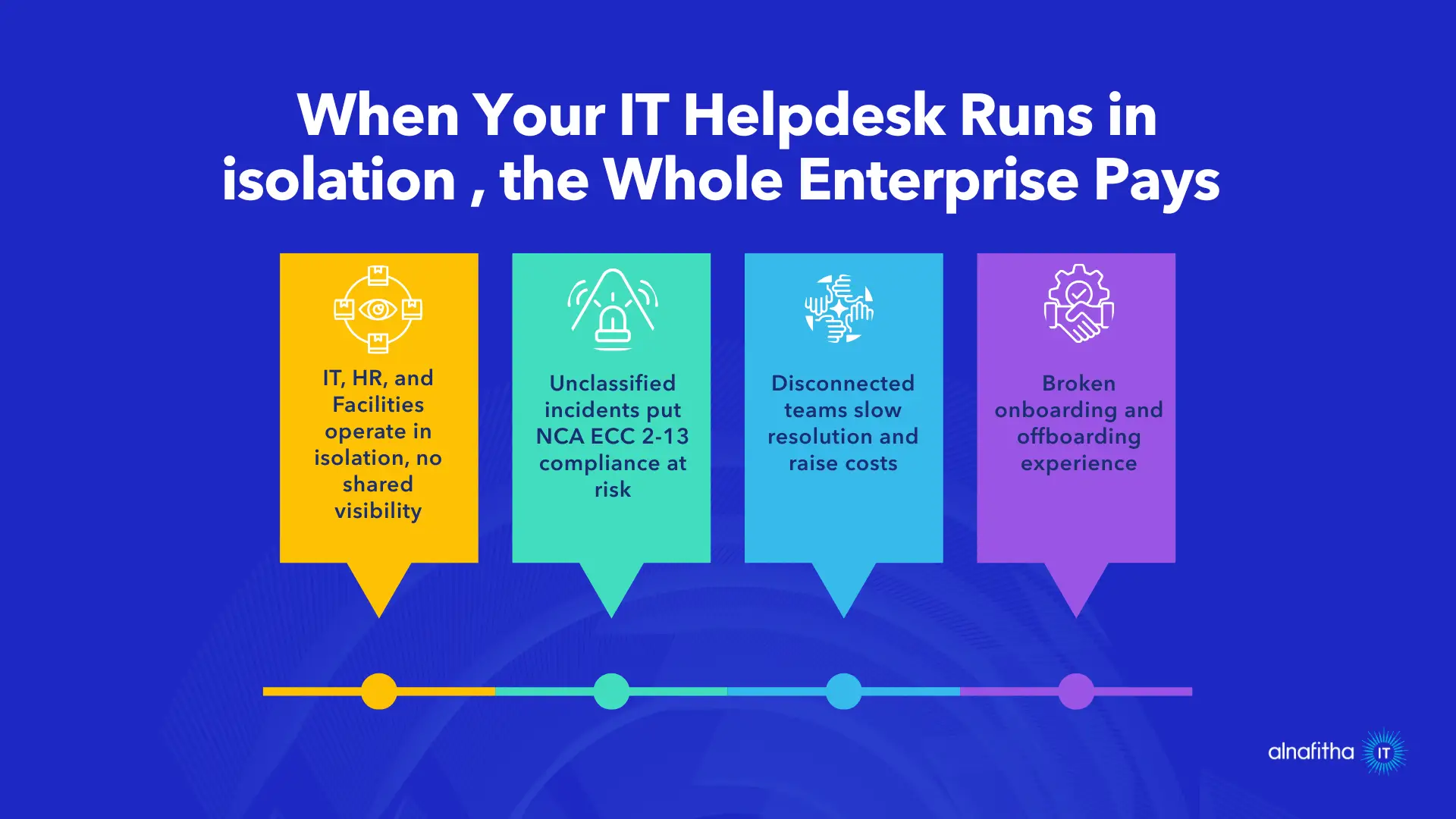
Saudi enterprises running digital transformation programs are operating at a scale that basic IT helpdesk tools cannot support. The issue is not simply ticket volume. It is fragmentation. IT manages incidents through one platform. HR handles onboarding through email threads. Facilities track maintenance requests in shared spreadsheets. The result: employees contact three separate teams through three different channels, requests fall through the gaps, and leadership has no consolidated view of service performance.
In a regulated market like Saudi Arabia, that fragmentation carries direct compliance risk. NCA ECC Control 2-13 (Cybersecurity Incident and Threat Management) requires organizations to define incident response plans, classify cybersecurity incidents by severity, establish documented escalation procedures, and report significant incidents to the National Cybersecurity Authority. An informal or fragmented IT helpdesk cannot satisfy these requirements. You need a structured, auditable platform with clearly defined workflows and a complete incident record.
Beyond compliance, the operational cost is significant. Research across enterprise IT environments consistently shows that organizations without a unified service management platform spend more on manual coordination, face slower mean time to resolution, and deliver a measurably worse employee experience during onboarding and offboarding. In a country where talent acquisition and retention are strategic national priorities, that gap has real business consequences.
What ManageEngine ServiceDesk Plus Actually Changes

ManageEngine ServiceDesk Plus is recognized in the 2025 Gartner Magic Quadrant for AI Applications in ITSM, and named a Strong Performer in the Forrester Wave for ESM Platforms in Q4 2025. More than 100,000 organizations in 185 countries use the platform, including a significant and growing base across the GCC.
What separates ServiceDesk Plus from a conventional IT helpdesk is its native Enterprise Service Management (ESM) capability. IT departments get full ITIL-aligned incident, problem, change, and release management. More importantly, any non-IT department (HR, facilities, legal, finance) can have its own dedicated service desk instance up and running in under 60 seconds. Each instance carries its own ticket categories, SLA definitions, automation workflows, and reporting dashboards. Yet employees interact with all departments through a single unified portal, with no need to know which backend system they are talking to.
The integration layer is equally important for Saudi enterprises. ServiceDesk Plus connects natively with Microsoft Entra ID, Zoho Directory, and most enterprise HRMS platforms. That means an HR onboarding request can automatically trigger IT provisioning, access rights assignment, and asset allocation. Each step is tracked and timestamped within a single automated workflow.
“With ServiceDesk Plus, we feel like the firm’s support and administration departments are working together to provide assistance for the first time.”
Network Administrator, Stark & Stark
Meeting NCA ECC Control 2-13 with a Structured IT Helpdesk
ECC Control 2-13 sits within Domain 2 (Cybersecurity Defense) of the NCA’s Essential Cybersecurity Controls framework. Its requirements are specific: organizations must implement documented cybersecurity incident response plans, establish escalation procedures, classify incidents according to severity, and share incident notifications and threat intelligence with NCA when required.
ServiceDesk Plus addresses this through its incident management module. Automated classification rules categorize tickets by type and severity at the point of entry. Escalation workflows fire based on predefined SLA thresholds, routing critical incidents to designated senior technicians or security teams without manual intervention. Every IT helpdesk ticket carries a full audit trail covering timestamps, assignment history, resolution notes, and SLA status, generating the documented evidence that NCA audits require.
For organizations running a more advanced security stack, ServiceDesk Plus integrates directly with ManageEngine’s Log360 SIEM and EventLog Analyzer. Security incidents flagged at the infrastructure level can automatically generate classified tickets in the IT helpdesk, triggering the exact response procedures your cybersecurity team has defined. When a compliance review asks for evidence of incident management maturity under ECC 2-13, you are not scrambling to reconstruct records. They are already there.
ServiceDesk Plus also supports the asset management and CMDB requirements that are referenced across multiple ECC controls, giving security teams visibility into the IT assets involved in any given incident. This visibility is critical for root cause analysis and regulatory reporting.
Deploying IT Helpdesk Infrastructure That Scales with Saudi Business
Understanding what a platform can do and configuring it correctly for a Saudi enterprise are two different disciplines. Saudi organizations have specific requirements: Arabic-language support for end users, compliance with NCA frameworks, integration with locally common HR and ERP systems, and the operational patterns of government, financial, energy, and healthcare clients that make up much of the Kingdom’s enterprise base.
ServiceDesk Plus supports both on-premises deployment and cloud hosting, giving organizations with data residency requirements or sensitive infrastructure the flexibility to choose the right model. The platform is available in 29 languages, including full Arabic support, which is a practical necessity for enterprise-wide adoption in Saudi Arabia.
For mid-sized and large enterprises, the average deployment timeline is approximately 12 weeks. The implementation covers workflow configuration, SLA design, department service desk setup, directory integration, user training. Each element is configured to match the organization’s specific service delivery model.
Alnafitha IT has been deploying ManageEngine solutions across Saudi Arabia and the wider region since 1993. As an authorized ManageEngine partner, Alnafitha brings direct implementation experience across government agencies, financial institutions, energy companies, and healthcare organizations, each with distinct regulatory requirements and operational structures. The team handles full-cycle deployment: scoping, configuration, SLA design, integration, and post-launch support, with the capability to adapt the platform as NCA compliance requirements evolve.
Ready to move beyond a basic IT helpdesk and build enterprise service management that meets Saudi compliance requirements? Talk to Alnafitha IT about deploying ManageEngine ServiceDesk Plus for your organization.
Talk to Our IT Helpdesk Specialists
The IT Helpdesk That Does More Than IT
Running a fragmented set of tools across IT, HR, and operations is not a cost-saving strategy. It is an operational and compliance risk. It costs response time, employee experience, and standing in regulatory audits. ManageEngine ServiceDesk Plus transforms your IT helpdesk into an enterprise service management platform that is built for the scale, governance, and regulatory environment Saudi organizations operate in today.
The organizations choosing to make that shift now are building the operational foundation that Vision 2030 transformation programs require. Those that delay are compounding the fragmentation. If your IT helpdesk is already at the ceiling, ServiceDesk Plus is the logical next step, and Alnafitha IT is the right partner to get there.
Frequently Asked Questions About IT Helpdesk and ServiceDesk Plus in Saudi Arabia
What is the difference between an IT helpdesk and enterprise service management?
An IT helpdesk handles technology support requests for end users: password resets, device issues, software access. Enterprise service management (ESM) extends the same structured approach to every department in the organization, including HR, facilities, finance, and legal. ManageEngine ServiceDesk Plus supports both within a single platform, meaning your IT helpdesk becomes the operational foundation for the entire enterprise rather than a standalone support function.
How does ManageEngine ServiceDesk Plus support NCA ECC compliance in Saudi Arabia?
NCA ECC Control 2-13 requires organizations to implement documented cybersecurity incident management with defined response plans, incident classification, escalation procedures, and NCA reporting mechanisms. ServiceDesk Plus provides the structured incident management workflows, automated escalation rules, and timestamped audit trails necessary to satisfy these requirements. When integrated with ManageEngine’s SIEM tools, the platform can automatically generate classified IT helpdesk tickets from infrastructure-level security alerts, improving both response speed and documentation accuracy.
Does ServiceDesk Plus support Arabic-language interfaces for Saudi users?
Yes. ServiceDesk Plus is available in 29 languages, including full Arabic language support for both the end-user self-service portal and the technician interface. This is a practical requirement for enterprise-wide IT helpdesk adoption in Saudi Arabia, where a significant portion of the workforce interacts with systems in Arabic.
How long does it take to deploy ServiceDesk Plus for a large Saudi enterprise?
For a large enterprise deployment, the average implementation timeline is approximately 12 weeks. This covers workflow configuration, SLA design, department service desk setup, directory integration with tools such as Microsoft Entra ID, and user training. Alnafitha IT manages the full deployment process for Saudi organizations, tailoring the configuration to each client’s regulatory requirements and operational structure.
Which departments beyond IT can use ServiceDesk Plus in a Saudi enterprise?
Any department that manages employee requests or service delivery can operate on ServiceDesk Plus. Common deployments in Saudi enterprises include HR (onboarding, offboarding, leave requests), facilities (maintenance, room bookings, asset tracking), finance (procurement, reimbursements), and legal (contract reviews, compliance requests). Each department runs its own dedicated IT helpdesk-style instance while sharing a unified employee portal, eliminating the need for multiple disconnected tools across the organization.