

Saudi regulators no longer treat privileged access as an internal IT detail. Under the National Cybersecurity Authority (NCA) Essential Cybersecurity Controls, version ECC-2:2024, the way your organization governs administrator accounts is now a measurable, auditable control. For a CISO or security architect preparing for an assessment, the question has shifted from whether you manage privileged access to whether you can prove it. This guide explains how a privileged access management program built on ManageEngine PAM360, and delivered by Alnafitha IT, helps you close the gaps that auditors look for before they find them.
Key Takeaways
- ECC-2:2024 control 2-2-3 directly addresses privileged accounts, requiring multi-factor authentication, least privilege, and segregation of duties for administrative access.
- The most common audit findings are uncontrolled admin account sprawl, shared credentials, missing session recordings, and broken audit trails.
- ManageEngine PAM360 maps directly to these requirements through credential vaulting, just-in-time elevation, session recording, and audit-ready reporting.
- Compliance is not a one-time project. A managed privileged access management program keeps controls effective between assessment cycles.
Why Privileged Access Management Sits at the Center of ECC-2:2024
The ECC-2:2024 framework defines 110 controls across four cybersecurity domains, and it applies to government bodies, critical national infrastructure, and a wide range of regulated entities operating in the Kingdom. Within the Cybersecurity Defence domain, the Identity and Access Management subdomain (2-2) is where privileged access management is most visible. Control 2-2-3 sets out the cybersecurity requirements for identity and access management, including multi-factor authentication for remote and privileged accounts and user authorization built on the principles of need-to-know, need-to-use, least privilege, and segregation of duties.
The 2024 revision raised the bar. Where the earlier ECC-1:2018 asked for multi-factor authentication mainly for remote access, ECC-2:2024 explicitly extends that expectation to privileged accounts and ties the choice of authentication factors to an impact assessment. In practical terms, an auditor reviewing your environment will expect to see that every domain administrator, database owner, and cloud root account is governed, monitored, and recoverable as evidence. This is precisely the gap that privileged access management is designed to close.
For organizations in the financial sector, the same controls echo through the SAMA Cyber Security Framework. Its Identity and Access Management requirement (control 3.3.5) restricts access to information assets on a need-to-have and need-to-know basis and expects privileged and remote access to be tightly controlled and monitored. A privileged access management platform satisfies both regulators with one consistent set of controls, which matters for banks, fintechs, and insurers that answer to NCA and SAMA at the same time.
Four Privileged Access Management Gaps That Break NCA ECC Audits
When an assessment goes wrong, it usually traces back to the same four weaknesses. Each one is a finding an auditor can document, and each one has a direct answer in a well-run privileged access management program.
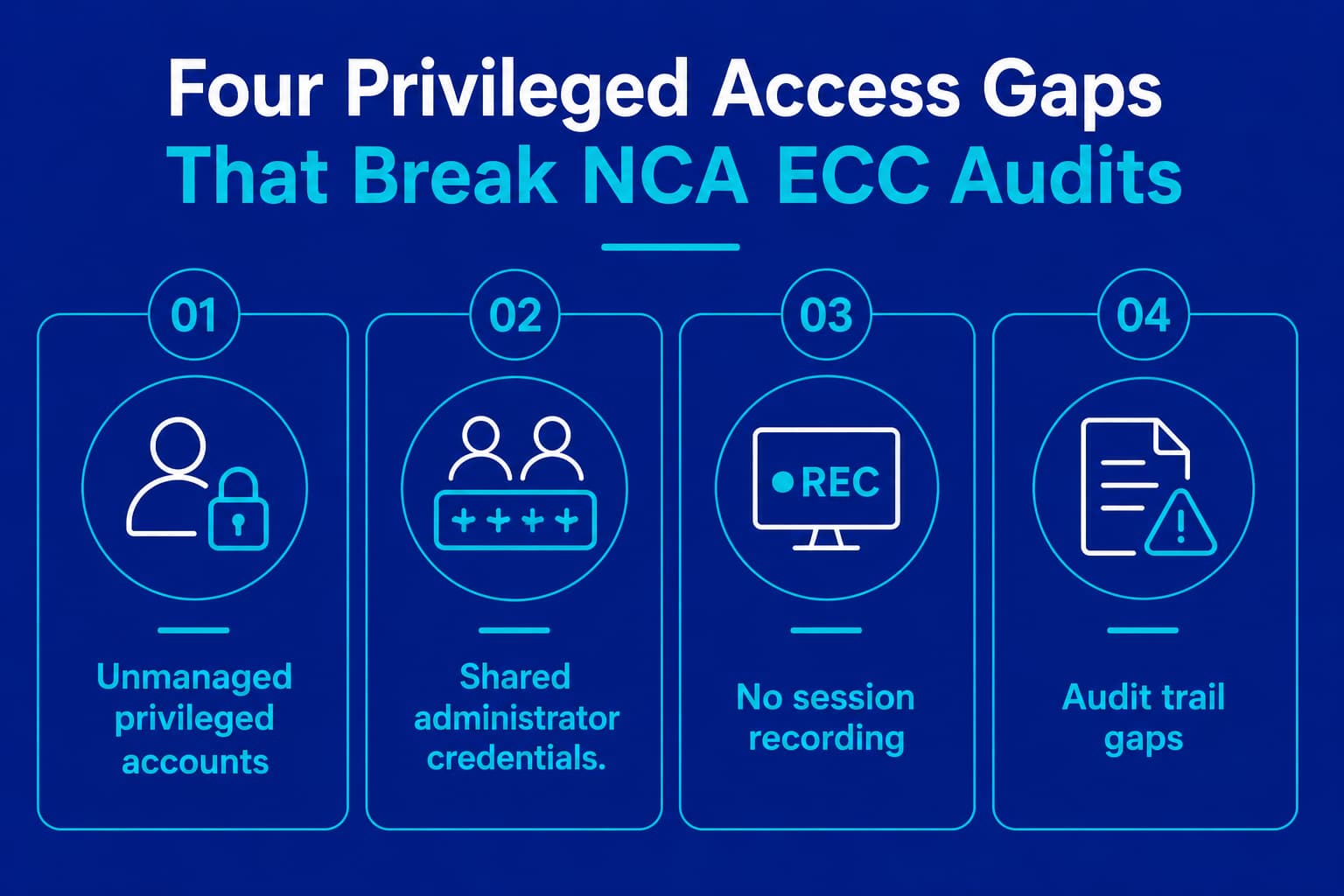
- Unmanaged privileged accounts. Most enterprises do not know how many privileged accounts they hold. Service accounts, local administrators, legacy domain accounts, and cloud entitlements accumulate quietly across on-premises and hybrid estates. You cannot govern what you cannot see, and an unknown admin account is the first thing an attacker looks for and the first thing an auditor flags.
- Shared administrator credentials. When several engineers use one shared admin password, accountability disappears. If a misconfiguration or a breach occurs, no log can tell you which individual performed the action. Under ECC-2:2024, that breaks both the least privilege and the segregation of duties expectations in a single step.
- No session recording. Auditors increasingly ask to see what privileged users actually did inside critical systems, not just that they logged in. Without session recording, you can confirm access happened but cannot reconstruct the activity, which leaves an evidentiary hole during forensic review or incident investigation.
- Audit trail gaps. Fragmented or incomplete logs are one of the most common reasons an organization fails to demonstrate continuous compliance. If privileged events are scattered across systems, or retention is inconsistent, you cannot produce the unbroken trail an assessment requires.
How ManageEngine PAM360 Delivers Privileged Access Management for ECC 2.0
ManageEngine PAM360 is a unified privileged access management platform that secures, controls, monitors, and audits administrative access across an entire IT estate from one console. It is trusted by more than 5,000 organizations and government agencies, which gives Saudi security teams a proven foundation rather than an experiment.
| Audit gap | PAM360 capability | ECC-2:2024 alignment |
| Account sprawl | Automated discovery and onboarding of accounts into an encrypted vault | 2-2 Identity and Access Management, asset visibility |
| Shared credentials | Centralized credential vaulting with role-, attribute-, and policy-based access | 2-2-3 least privilege and segregation of duties |
| Standing privilege | Just-in-time elevation with time-bound, purpose-specific access | 2-2-3 least privilege, need-to-use |
| No session record | Session recording, shadowing, and termination of live sessions | Privileged activity monitoring and audit |
| Audit trail gaps | Context-rich logs and built-in compliance reports | Audit, logging, and continuous evidence |
| Anomalous use | AI and ML driven privileged user behavior analytics | Threat detection on privileged activity |
Beyond the headline controls, PAM360 also manages SSH keys and SSL/TLS certificates, secures non-human identities across DevOps pipelines, and enforces endpoint privilege management by removing unnecessary local admin rights. For a security architect, that breadth means privileged access management becomes a single governance layer rather than a patchwork of point tools.
Why Alnafitha IT Is the Right Privileged Access Partner in Saudi Arabia
Buying a license is not the same as passing an audit. The difference is implementation, and that is where a local partner with deep regulatory context matters. Alnafitha IT is a Saudi company founded in 1993 and recognized as the face of ManageEngine in the Kingdom, with more than 7,000 organizations served across government, finance, and enterprise sectors. That track record means the team has implemented privileged access controls against the exact frameworks your auditor will use.
Alnafitha approaches privileged access management as a structured engagement rather than a software install. The work starts with an assessment of your current privileged accounts and access pathways, moves through licensing and configuration mapped to your ECC and SAMA obligations, and concludes with deployment, knowledge transfer, and ongoing support. You can explore the relevant capability through the Identity and Access Management practice, and align the wider program through Alnafitha’s Risk and Compliance services, which connect technical controls to the governance evidence an assessment demands.
Because Alnafitha also runs the IT management side of ManageEngine, the privileged access layer integrates naturally with your service desk, SIEM, and analytics, so privileged events are correlated rather than siloed. That integration is what turns scattered logs into the unbroken audit trail regulators expect.
A Practical Path to Audit Readiness
If you are preparing for an assessment, the sequence below reflects how mature Saudi security teams approach privileged access management without disrupting operations.
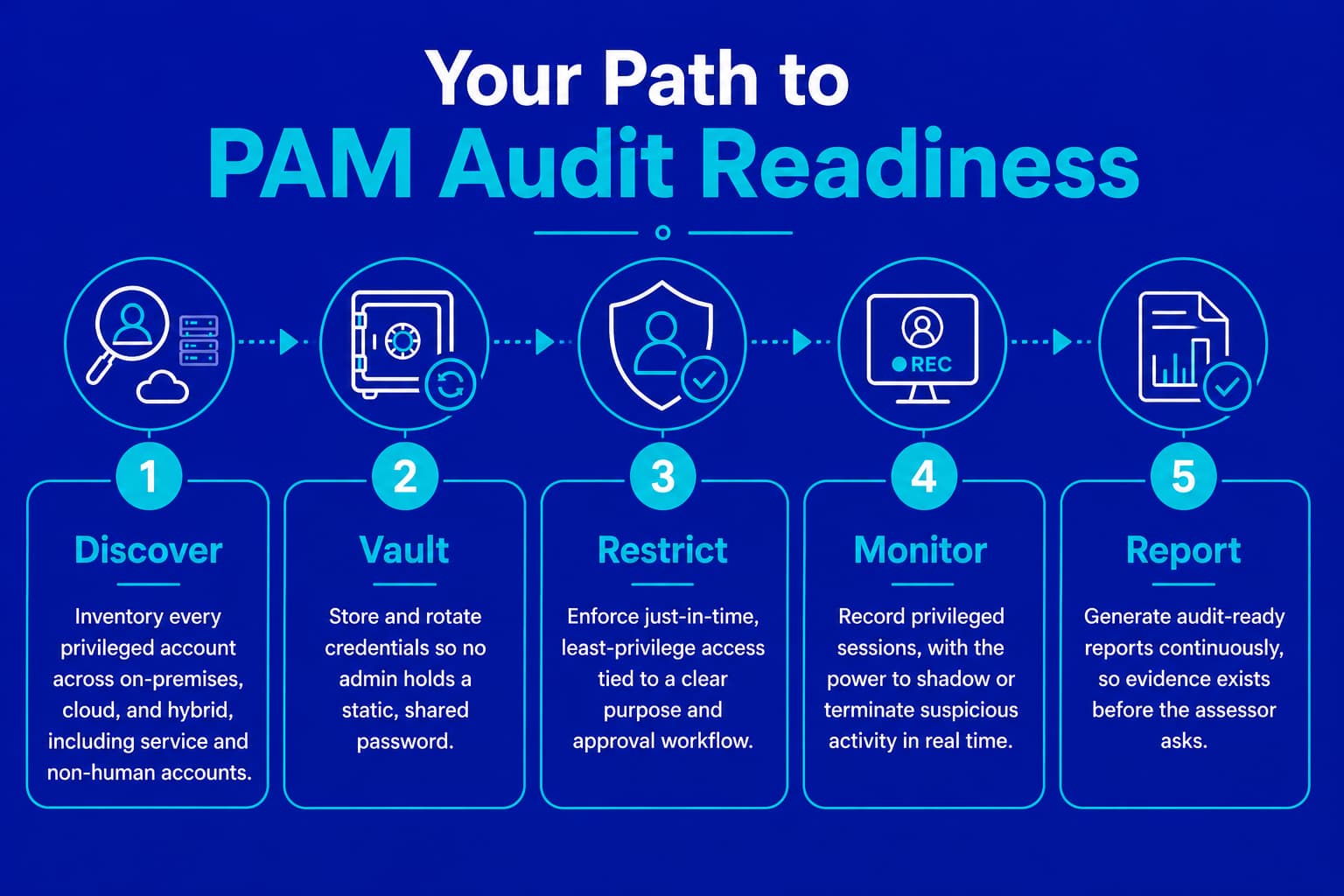
- Discover and inventory every privileged account across on-premises, cloud, and hybrid systems, including service and non-human accounts.
- Vault and rotate credentials so no administrator holds a static, shared password.
- Enforce just-in-time, least-privilege access tied to a clear business purpose and an approval workflow.
- Record and monitor privileged sessions, with the ability to shadow or terminate suspicious activity in real time.
- Generate audit-ready reports continuously, so evidence exists before the assessor asks for it.
Reputable analysts and standards bodies reinforce why this matters. Industry surveys have repeatedly shown that privileged access management lags behind other security technologies in adoption, even though privileged credentials are among the most exploited attack vectors. You can read a neutral overview of the discipline and its zero trust foundations on Wikipedia’s privileged access management entry, and review the official control text directly in the NCA Essential Cybersecurity Controls publication.
Close the Gaps Before the Auditor Opens Them
An ECC-2:2024 assessment is not a test you cram for the night before. The organizations that pass with confidence are the ones that treated privileged access management as continuous governance, with discovery, vaulting, just-in-time access, session recording, and reporting working together every day. ManageEngine PAM360 provides the platform, and Alnafitha IT provides the local expertise to implement it against the precise controls your regulator applies.
If your next audit is on the horizon and you are not certain your privileged accounts would withstand scrutiny, the time to act is now. Talk to Alnafitha’s privileged access specialists to scope an assessment and build an audit-ready privileged access management program for your organization.
Frequently Asked Questions
What is the difference between PAM and IAM? Identity and access management governs the identities and access rights of your general user population, while privileged access management focuses specifically on high-risk administrative accounts that can change systems, reach sensitive data, or disable controls. PAM is effectively a specialized, tightly controlled layer that sits on top of your broader IAM program.
Does NCA ECC require a privileged access management solution? ECC-2:2024 does not name a specific product, but control 2-2-3 requires multi-factor authentication for privileged accounts, least privilege, and segregation of duties. In practice these requirements are very difficult to demonstrate at scale without a dedicated privileged access management platform that can prove the controls are enforced and continuously logged.
How does PAM360 help with audit evidence? PAM360 captures privileged operations as context-rich logs and provides built-in compliance reports, session recordings, and dashboards. That means the evidence an assessor needs, who accessed what, when, and what they did, is generated automatically rather than reconstructed manually before each assessment.
Can one platform cover both NCA ECC and SAMA requirements? Yes. The privileged access expectations in NCA ECC-2:2024 (control 2-2-3) and SAMA CSF (control 3.3.5) overlap substantially around least privilege, multi-factor authentication, and monitored privileged access. A single privileged access management deployment, configured correctly, can satisfy both frameworks, which is valuable for financial organizations regulated by both.
How long does a privileged access management implementation take? Timelines depend on the size of your estate and the number of privileged accounts, but a structured engagement typically moves from discovery and assessment, through configuration aligned to your compliance obligations, to phased deployment. Working with an experienced local partner such as Alnafitha IT shortens the path to audit readiness by mapping the rollout to the controls from day one.