
Reactive ticketing quietly caps how fast an IT organization can grow. Here is how Saudi enterprises move to structured ITSM with ServiceDesk Plus: measurable SLAs, auditable workflows, and one console for Riyadh, Jeddah, and Dammam.
Brief takeaways
Manual ticketing has no SLA clock, no audit trail, and no visibility once a company operates across multiple branches. That gap becomes a compliance liability under NCA ECC-2:2024.
ServiceDesk Plus is an ITIL-certified platform (14 practices, PeopleCert) that unifies incident, problem, change, asset, and request management on one console, on-premises or cloud.
A ManageEngine data center now operates inside the Kingdom, so Saudi organizations can meet data-residency expectations without leaving the cloud.
Alnafitha IT, recognized as the face of ManageEngine in Saudi Arabia, sequences the rollout so SLAs, sites, and reporting are configured to your ITIL maturity, not a generic template.
An IT manager in a growing Saudi enterprise can usually name the exact moment the model broke. A ticket arrives by email from the Dammam branch, a WhatsApp message escalates it, a phone call reopens it, and three days later nobody can say who owned it, when it was promised, or whether it was ever resolved. Multiply that across three cities and nine departments, and the service desk stops being a function. It becomes a guessing game.
The cost is not only frustration. When an auditor asks for evidence that IT incidents are logged, classified, and resolved within defined timelines, an inbox cannot answer. Under the National Cybersecurity Authority’s Essential Cybersecurity Controls, incident management and asset inventory are not best practices to aspire to. They are documented obligations, and manual ticketing produces none of the evidence a review requires.
The way out is not more effort inside the same broken model. It is a structured IT service management platform that makes response times measurable, ownership unambiguous, and compliance a byproduct of daily work. For a large share of Saudi organizations, that platform is ServiceDesk Plus.
Why reactive ticketing fails, and where ServiceDesk Plus takes over
Email-based support has no way to enforce a promise, track an asset, or prove what happened. Those three gaps turn from inconvenience into risk the instant a business spans multiple branches and regulated data.
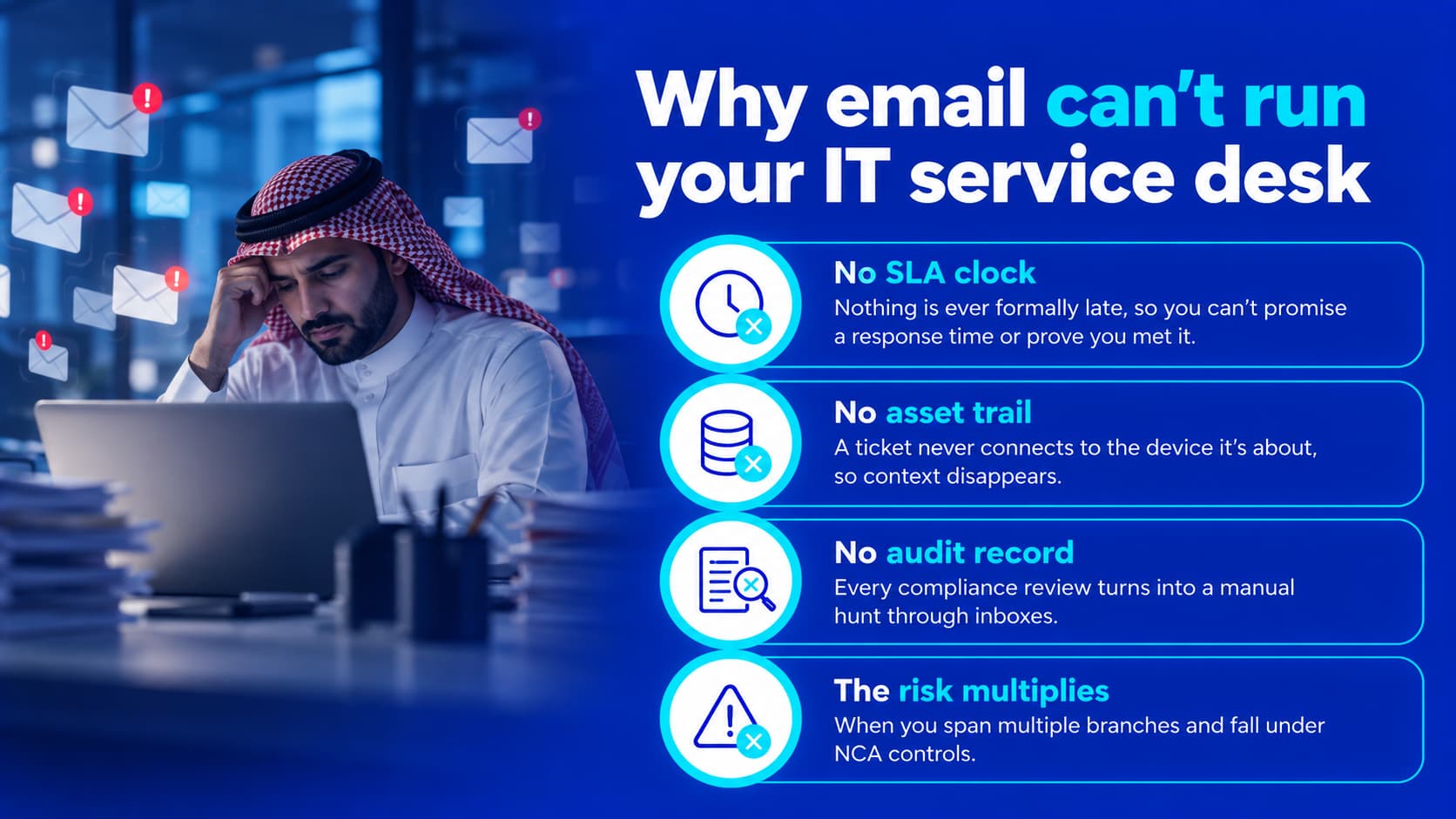
A single mailbox cannot start an SLA timer, so nothing is ever formally late. It cannot tie a request to the laptop or server it concerns, so asset context is lost. And it leaves no structured record, so every audit becomes an archaeology project. These are not workflow annoyances. They are the exact points where ServiceDesk Plus replaces improvisation with a system.
Saudi enterprises feel this sharpest because two things are happening at once: rapid Vision 2030 driven digital expansion, and a tightening regulatory floor. The NCA now expects baseline controls, including incident logging, from private companies, not only critical infrastructure operators. A service desk that cannot produce that evidence is a liability waiting for an audit date.
What ServiceDesk Plus actually gives an IT leader
ServiceDesk Plus is an AI-driven, ITIL-certified service management platform that unifies ticketing, asset management, and change control on one console, available on-premises or in the cloud.
ManageEngine’s platform holds ITIL certification from PeopleCert for 14 ITSM practices, covering incident, problem, change, release, service catalogue, and asset management. For an IT leader, certification is shorthand for a real outcome: best-practice workflows work out of the box, rather than being rebuilt by hand.
The value shows most clearly where the old model failed:
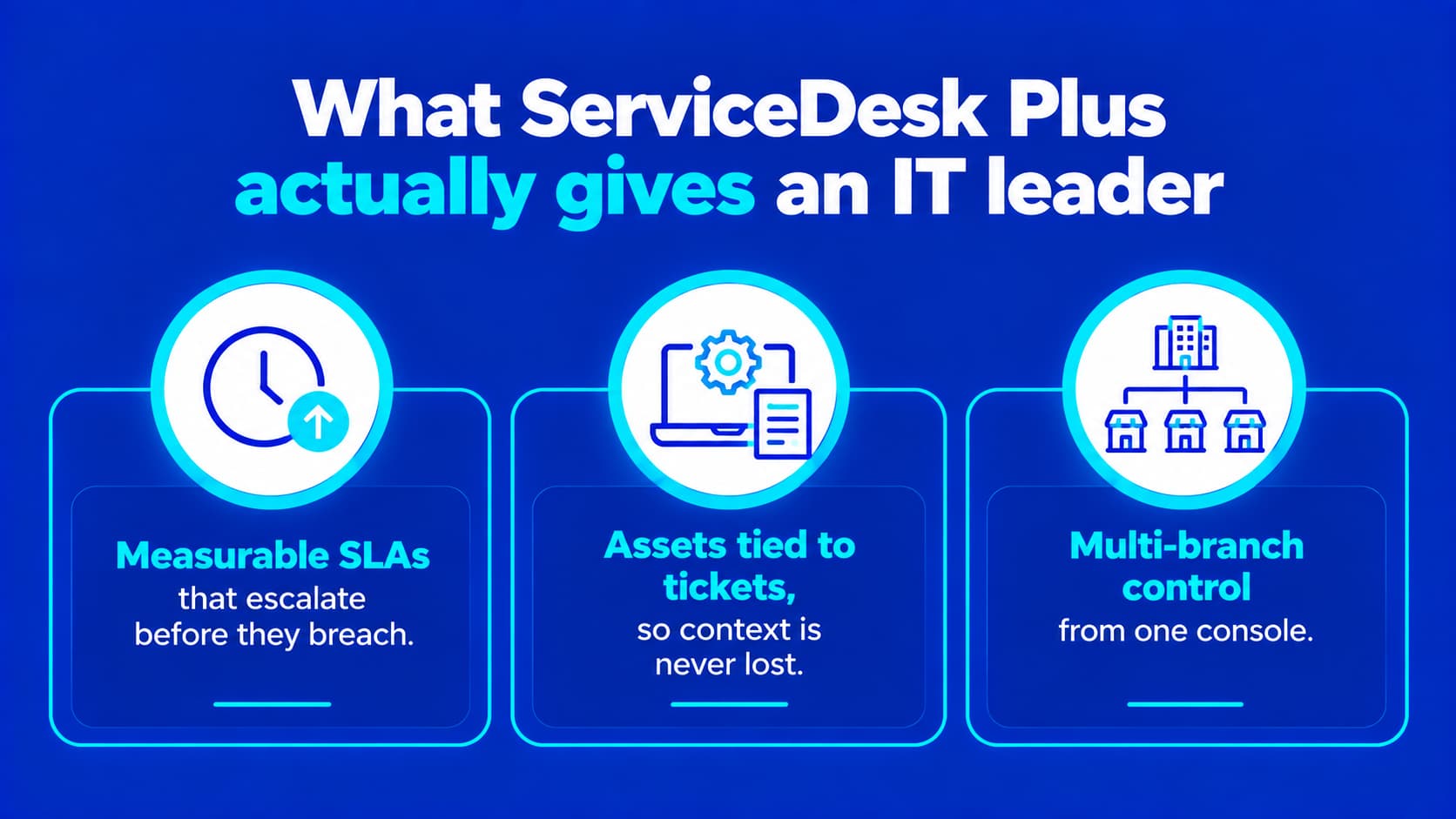
Measurable SLAs that escalate before they breach
Every request carries response and resolution targets, and the system escalates automatically as a deadline approaches. This is the difference between hoping a ticket was handled and reporting that 98% of them met their promised time. One ServiceDesk Plus customer, EnerSys, uses these automations to sustain 98.9% SLA compliance. The number is not the point; the ability to state it with confidence is.
Assets tied to tickets, so context is never lost
Because IT asset management lives on the same platform, a technician sees the device, its contracts, and its history the moment a ticket opens. That single link satisfies a quiet but demanding requirement: the NCA expects an accurate, maintained inventory of information assets. Here it is a byproduct of support, not a separate spreadsheet exercise.
Multi-branch control from one console
ServiceDesk Plus manages multiple sites with their own workflows, business hours, and approval chains, all governed centrally. Riyadh, Jeddah, and Dammam operate under one policy without forcing identical local processes. For a distributed Saudi enterprise, this is the feature that turns branch sprawl from a problem back into a structure.
ServiceDesk Plus in the Saudi context: data residency and compliance
A ManageEngine data center now operates in Saudi Arabia, and the platform maps directly onto NCA control families, so ServiceDesk Plus fits the Kingdom’s regulatory reality rather than working against it.
Data location is often the first question a Saudi CISO asks, and it now has a clean answer. Zoho’s Saudi entity holds CST Class B certification aligned with the NCA Cloud Cybersecurity Controls, allowing public and confidential data to be processed inside the Kingdom. Organizations that need cloud agility no longer have to trade away residency to get it. Those who require full control can still deploy on-premises.
The deeper fit is how the platform maps to the controls themselves:
| NCA ECC expectation | How ServiceDesk Plus supports it |
| Incident management | Structured logging, classification, and escalation with a complete, timestamped audit trail |
| Asset inventory | Maintained ITAM records linked to every request, change, and contract |
| Access and approval | Role-based permissions and multi-stage approval workflows on requests and changes |
| Reporting and evidence | Customizable reports that turn daily operations into audit-ready documentation |
This is why the platform is positioned less as a help desk and more as a compliance enabler. The same actions that resolve a ticket also produce the evidence an assessor asks for.
Choosing the right ServiceDesk Plus edition, then rolling it out in order
Match the edition to your ITIL maturity, then sequence the deployment so structure comes before scale. Getting the order right is what separates a live system from a stalled project.
ServiceDesk Plus comes in three editions. Standard covers the core help desk: ticketing, SLAs, and the self-service portal. Professional adds IT asset management. Enterprise delivers the full ITIL stack, including change, problem, project, and CMDB. Most multi-branch Saudi enterprises with compliance obligations land on Enterprise, because that is where change control and asset depth live.
Edition choice, though, is the easy part. The rollout is where value is won or lost, and it benefits from a partner who has done it inside the Kingdom. Alnafitha IT has been recognized by ManageEngine as the face of the vendor in Saudi Arabia, and delivers ServiceDesk Plus across sectors from healthcare to construction.
That experience shapes a deliberate sequence:
- Map current incident and request flows before configuring a single template, so the tool reflects how your teams actually work.
- Define SLAs and approval chains per site, then validate them against real branch operating hours.
- Pair ServiceDesk Plus with Endpoint Central so asset discovery and patching feed the same system that logs tickets.
- Train technicians and end users, then expand from IT to HR and facilities using the platform’s enterprise service management capability.
The proof is in the Kingdom’s own results. AlRawaf, a major Saudi construction firm, moved to centralized, automated IT service management in ninety days with ServiceDesk Plus. ARO Drilling used ManageEngine to unify operations and speed up service delivery. These are not aspirational references. They are the same journey, already completed by organizations that started exactly where many IT leaders are today.
See ServiceDesk Plus mapped to your environment
Book a working session with Alnafitha IT to see structured SLAs, multi-branch workflows, and NCA-aligned reporting configured for your organization.
Request a ServiceDesk Plus demo
Frequently asked questions
Is ServiceDesk Plus suitable for organizations that must keep data inside Saudi Arabia?
Yes. A ManageEngine data center operates within the Kingdom, and Zoho’s Saudi entity holds CST Class B certification aligned with the NCA Cloud Cybersecurity Controls, permitting processing of public and confidential data locally. Organizations needing complete control can also deploy ServiceDesk Plus on-premises.
How does ServiceDesk Plus help with NCA ECC compliance?
The platform produces the operational evidence the controls require. Incidents are logged, classified, and escalated with a full audit trail; assets are inventoried and linked to requests; approvals are role-based; and reporting converts daily activity into audit-ready documentation. Compliance becomes a byproduct of normal service desk work rather than a separate project.
Which edition does a multi-branch Saudi enterprise usually need?
Standard covers core help desk and SLAs, Professional adds IT asset management, and Enterprise delivers the full ITIL suite with change, problem, project, and CMDB. Multi-branch enterprises with compliance obligations typically choose Enterprise, because that is where change control and deeper asset management reside.
Can ServiceDesk Plus manage IT support across several cities from one system?
Yes. The platform supports multiple sites with custom workflows, business hours, and approval chains, all governed from a central console. This lets Riyadh, Jeddah, and Dammam run under one policy while respecting local operating differences.
Do we need a local partner, or can we deploy it ourselves?
The software can be self-deployed, but a partner who has implemented it inside the Kingdom shortens time to value and reduces configuration errors. Alnafitha IT, recognized as the face of ManageEngine in Saudi Arabia, aligns SLAs, sites, and reporting to your ITIL maturity and existing processes rather than a generic template.