

Most Azure security and Microsoft 365 Security breaches in Saudi enterprises do not come from sophisticated attacks. They come from misconfigured settings left untouched since deployment. Research published in 2025 found that 45 percent of large enterprises experienced a security or compliance incident in the past year caused directly by a misconfiguration. For IT managers and cloud administrators in Saudi Arabia, where PDPL is fully enforced and NCA’s Essential Cybersecurity Controls apply across sectors, this is not just a security problem. It is a regulatory and business risk that demands deliberate action.
Misconfigured Permissions: The Most Damaging Microsoft 365 Security Failure
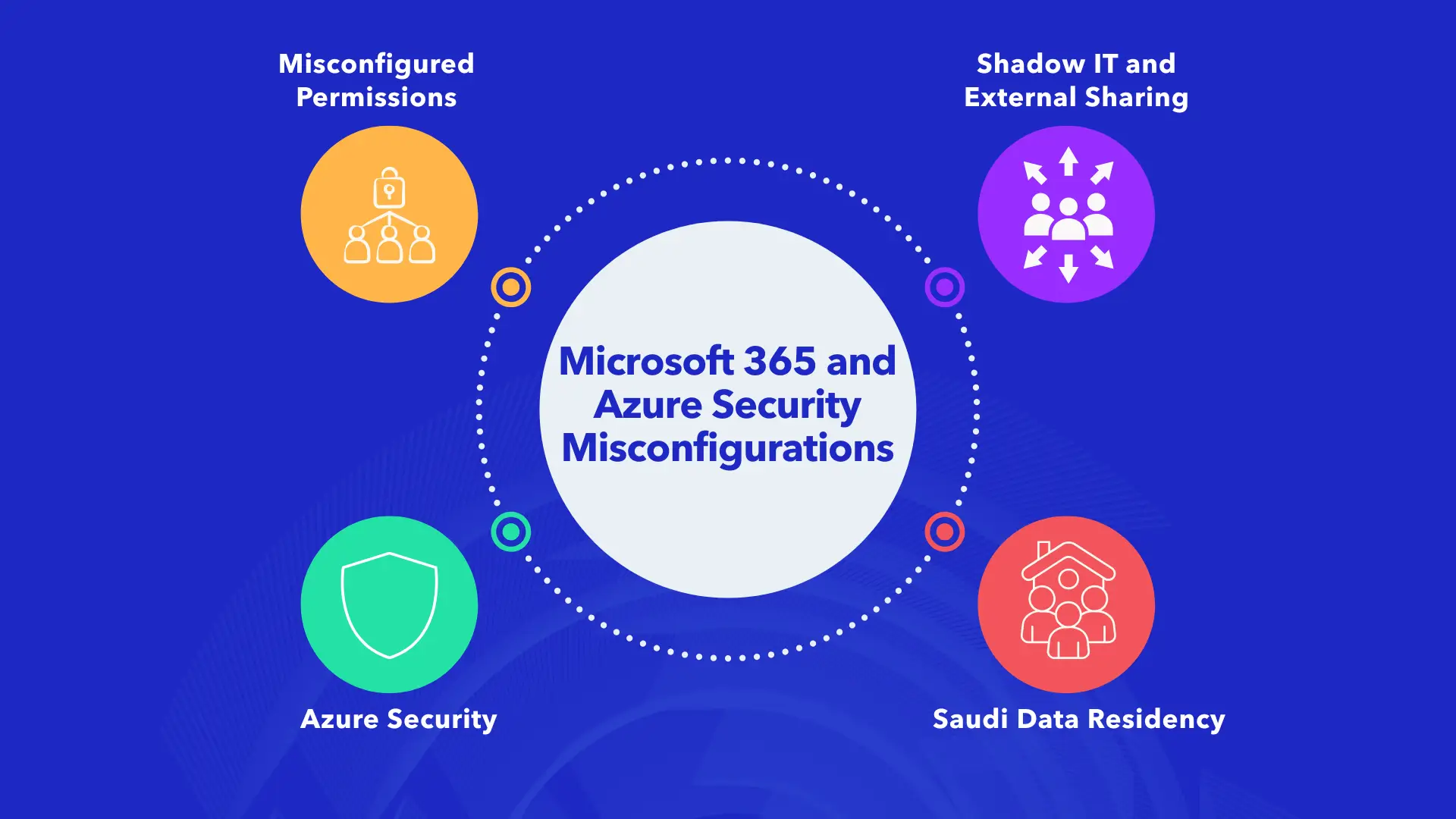
Excessive permissions are the most persistent failure point in Microsoft 365 security. Global Admin accounts used for day-to-day tasks, users with write access to SharePoint libraries they should never touch, and third-party applications with read-write access across the entire tenant are not edge cases. A 2025 industry report found that 51 percent of enterprise tenants have more than 250 Entra ID applications with read-write access, effectively recreating super-admin risk at scale.
Least-privilege enforcement is the fix. Global Admin accounts should be limited to two to four named individuals, restricted to administrative tasks only, and protected with Privileged Identity Management through Microsoft Entra ID Governance. Every third-party application integration should be scoped deliberately and audited on a regular schedule. Organizations that are not sure which Microsoft 365 security features their current licensing tier includes often find that the controls they need are already available and simply not activated.
Shadow IT and External Sharing: Where Data Leakage Actually Starts
Shadow IT in a cloud environment no longer means unauthorized hardware. It is a department using a personal OneDrive to share project files, a user creating a Teams channel with guest access on by default, or an employee forwarding emails to a personal account for convenience. Each behaviour creates a data leakage path that standard monitoring will miss.
Microsoft 365’s external sharing settings in SharePoint and OneDrive default to permissive states that most organizations never revisit after setup. Anonymous links, which allow anyone with a URL to access documents without authentication, are enabled by default in many tenants. For Saudi enterprises handling personal data subject to PDPL, this is a direct compliance liability. Anonymous sharing must be disabled, external sharing scoped to verified domains only, and Microsoft Defender for Cloud Apps deployed to give the IT team a real-time view of what data is leaving the environment.
Azure Security: Four Configurations That Cannot Be Left at Default
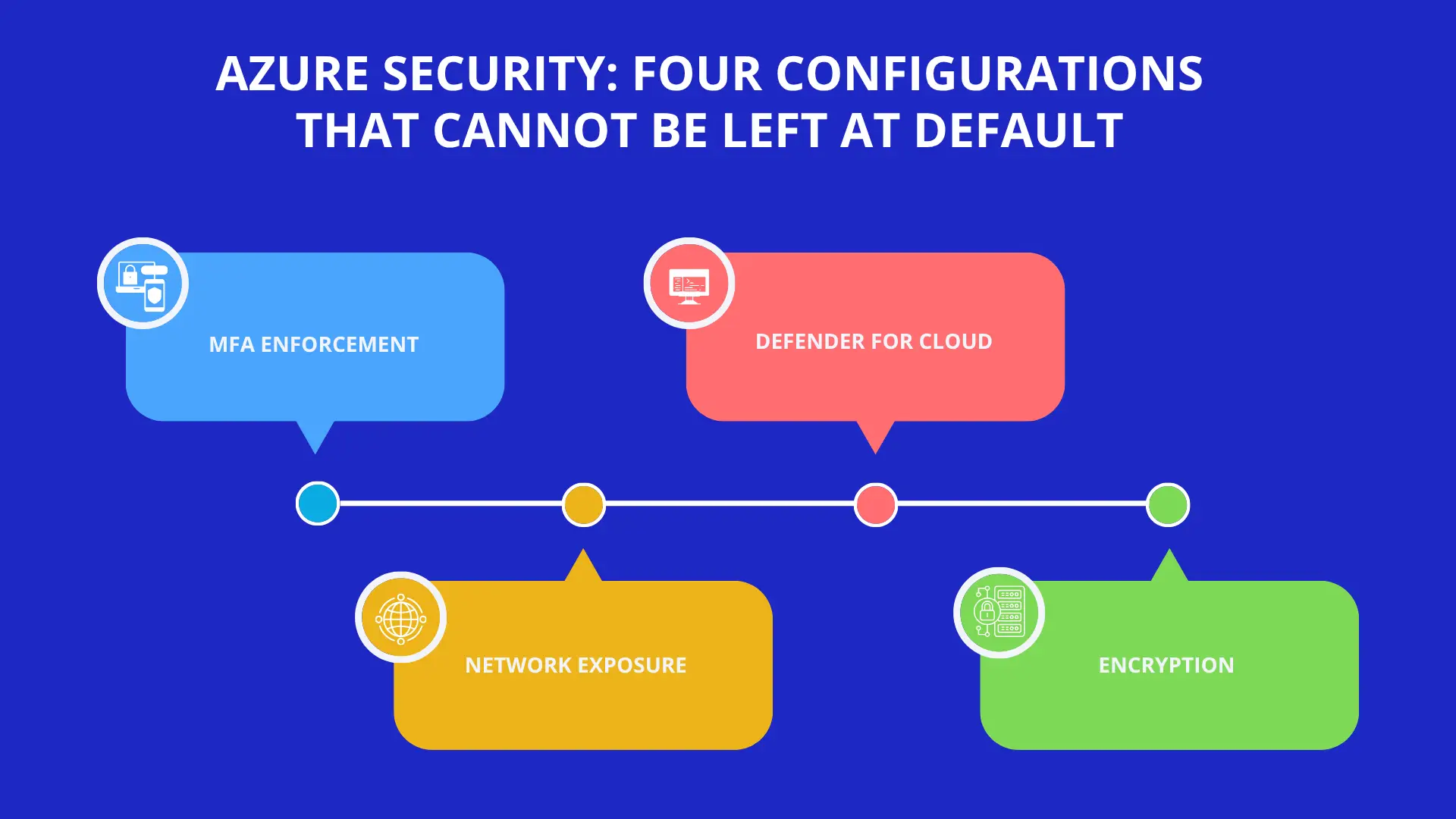
Azure security is built on a clear shared responsibility model: Microsoft secures the physical infrastructure and the platform layer, while identity, access policies, network configuration, data classification, and encryption key management belong to the customer. The following four areas are where Saudi enterprise environments consistently carry the most risk.
MFA enforcement is the starting point. As of 2025, MFA is mandatory for Microsoft 365 administrative accounts, but most credential attacks target regular user accounts. Enforcing MFA for all users through Conditional Access policies, not just Security Defaults, is the highest-impact control available and should be the first priority on any security remediation list.
Microsoft Defender for Cloud provides continuous posture assessment across Azure workloads. Its Secure Score feature gives a measurable view of where gaps exist and maps directly to several NCA ECC controls around monitoring, threat detection, and incident response. Having the tool enabled without acting on its findings adds no protection.
Network exposure accumulates silently. Storage accounts, databases, and APIs that do not require public access should sit behind private endpoints, with Network Security Groups configured to restrict traffic to known address ranges. This is a configuration decision, not an infrastructure project, and it closes one of the most common attack surfaces in cloud environments.
Encryption and key management must be explicit, not assumed. Both PDPL and NCA standards require encryption of personal data at rest and in transit, with key management retained within the organization or an approved jurisdiction. Azure Key Vault with customer-managed keys provides the right foundation, but only when configured as part of a deliberate data governance plan. Organizations working through data classification requirements will find that Azure Information Protection provides the tooling to label sensitive documents and enforce access policies wherever that data travels.
Saudi Data Residency: A Microsoft 365 and Azure Security Obligation
Saudi Arabia’s PDPL, in full enforcement since September 2024, requires personal data generated within the Kingdom to remain inside its borders by default. Cross-border transfers are permitted only under specific conditions, including explicit consent, documented risk assessments, and binding contracts using SDAIA-approved safeguards. Microsoft has confirmed an Azure Saudi Arabia East region launching in Q4 2026, which will provide in-country data residency for regulated workloads. Until then, Microsoft 365’s data residency controls must be configured deliberately to pin Exchange, SharePoint, and Teams workloads to appropriate geographic boundaries.
NCA’s Cloud Cybersecurity Controls and SAMA’s Cybersecurity Framework set mandatory requirements that overlap significantly with standard azure security best practices. A well-structured Azure Policy environment aligned to NCA ECC and SAMA CSF simultaneously satisfies both frameworks, which is a more efficient path than treating them as separate compliance efforts. For more detail on alignment requirements, Microsoft’s official Microsoft 365 security documentation and the NCA’s published Essential Cybersecurity Controls are the primary references.
Every Day Without Fixing Microsoft 365 and Azure Security Is Exposure
Saudi enterprises running Microsoft 365 and Azure for more than two years almost certainly carry configuration debt: settings that made sense at deployment, exceptions that were never revisited, and permissions that expanded without governance. With PDPL fully enforced and NCA compliance assessments increasing in frequency across sectors, resolving these gaps before an incident forces the issue is the practical and cost-effective path.
Alnafitha IT has been working with Saudi organizations across government, finance, and enterprise since 1993. As Microsoft Country Partner of the Year for Saudi Arabia, the team brings direct experience across both Microsoft 365 security and azure security, from configuration assessments and gap analysis through to ongoing posture management.
Ready to audit your Microsoft 365 security and Azure security posture? Talk to Alnafitha’s cloud security team today.