

Brief Takeaway: Wave 24 of Saudi Arabia’s ZATCA e-invoicing mandate brings the June 30, 2026 integration deadline to virtually every VAT-registered business in the Kingdom. If your current accounting system cannot push invoices to the Fatoora portal in real time, you are not compliant, and penalties are already defined. This article walks finance and IT teams through the exact requirements, the most common readiness gaps, and how Zoho Books, implemented by Alnafitha IT, covers all of them.
The Window Is Closing
Most finance managers in Saudi Arabia understand that ZATCA e-invoicing has been rolling out for a while. Phase 1 went live in December 2021 and required businesses to stop issuing paper and PDF invoices. That part is done. What many organizations still have not addressed is Phase 2: the integration phase, where your invoicing system must connect directly to ZATCA’s Fatoora platform and transmit every B2B invoice for clearance before it reaches the buyer.
ZATCA has expanded this obligation wave by wave, and Wave 24 now covers all businesses whose VAT-taxable revenues exceeded SAR 375,000 in 2022, 2023, or 2024, with a compliance deadline of June 30, 2026. That threshold is low enough that Phase 2 now applies to virtually every active VAT-registered company in the Kingdom. The question is no longer whether this affects your business. The question is whether your systems are ready.
What “Compliant” Actually Means Under ZATCA e-Invoicing Integration
A common mistake: assuming that generating a well-formatted digital invoice counts as compliance. It does not.
Under the integration phase of ZATCA e-invoicing, every standard tax invoice (B2B) must be submitted to and cleared by the Fatoora portal before it is sent to the buyer. Every simplified tax invoice (B2C) must be reported within 24 hours of issuance. The invoices must be structured in UBL 2.1 XML format, carry a UUID (Universally Unique Identifier), include a cryptographic stamp, and embed a QR code.
Your system also must not allow any tampering with invoices after they are issued. That means no manual edits, no deletions, and no workarounds. If your current ERP or accounting software cannot do all of this natively and connect to ZATCA’s Fatoora portal via API, it does not meet the mandate, regardless of how modern or expensive the system is.
The Compliance Checklist: Finance and IT Must Cover Both Sides
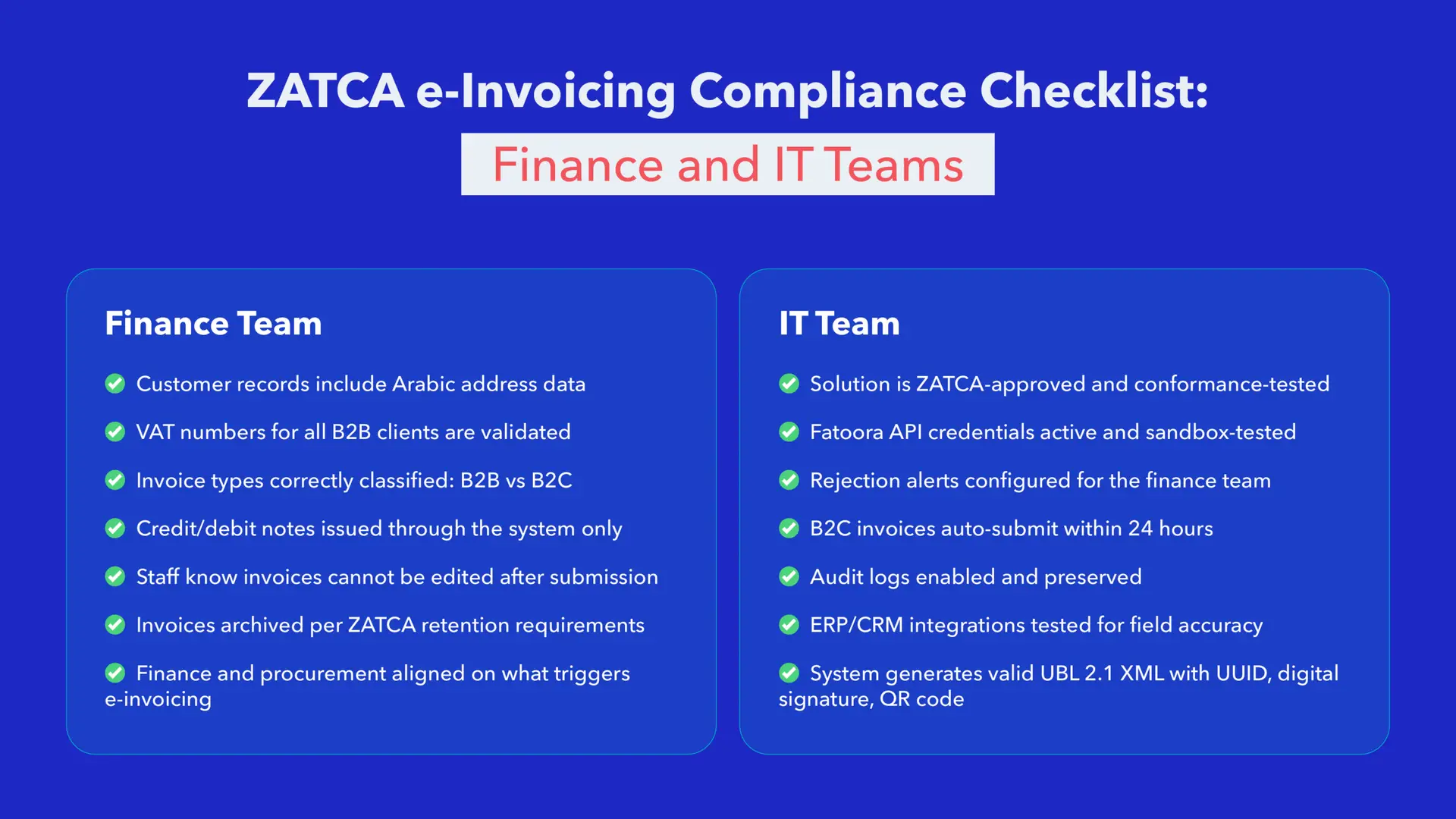
ZATCA e-invoicing integration is a shared responsibility. Finance teams own the data accuracy and process discipline; IT teams own the technical configuration and integration uptime. Both sides need to confirm readiness before your wave deadline.
Finance Team Checklist
- All customer records include Arabic-language address data (mandatory for ZATCA-compliant invoices)
- VAT registration numbers for all B2B customers are captured and validated in the system
- Invoice types are correctly classified: standard tax invoices for B2B transactions above SAR 1,000, simplified tax invoices for B2C
- Credit notes and debit notes are issued through the compliant system, not as manual corrections
- Staff understand that invoices cannot be edited or deleted after submission to Fatoora
- Archived invoice records are stored securely for the minimum required period under ZATCA regulations
- Finance and procurement are aligned on which transactions trigger e-invoice obligations
IT Team Checklist
- The e-invoicing solution is ZATCA-approved and has passed ZATCA’s conformance testing
- Fatoora API credentials are active and the integration has been tested end-to-end in ZATCA’s sandbox environment
- The system generates valid UBL 2.1 XML with all mandatory fields: UUID, digital signature, cryptographic stamp, hash value, and QR code
- Rejection handling is configured so that the finance team is notified immediately if a push to Fatoora fails
- B2C invoices are set to auto-submit within the 24-hour reporting window
- System audit logs are enabled and preserved for compliance verification
- Any ERP or CRM integrations feeding invoice data into the accounting platform have been tested for field accuracy and format compliance
The most common gap across KSA businesses right now is not awareness. It is alignment. Finance teams often assume IT has handled the technical integration. IT teams often assume Finance has validated the data structure. Neither team confirms it end-to-end until an invoice fails clearance.
Why Zoho Books Is the Right Platform for ZATCA e-Invoicing Compliance
Zoho Books is a fully ZATCA Phase 2 approved accounting platform. It handles the entire e-invoicing workflow natively: invoice creation with all required fields, automatic XML generation in UBL 2.1 format, UUID assignment, cryptographic stamping, QR code embedding, and direct push to the Fatoora portal via ZATCA’s API.
For B2B invoices, Zoho Books requires Fatoora submission before the invoice can be sent to the buyer, which mirrors ZATCA’s requirement exactly. For simplified B2C invoices, auto-push can be configured to run within the mandatory 24-hour window. If a push fails, the system flags the error with a reason code so the finance team can correct and retry without missing the compliance window.
Beyond the technical requirements, Zoho Books is a cloud-based platform hosted locally in Saudi Arabia’s data centers, which means your financial data stays within the Kingdom and your system updates automatically as ZATCA regulations evolve. You do not need to manage patches or re-certify your integration each time ZATCA issues updated technical specifications.
For businesses that need more than just accounting, Zoho Finance Plus integrates Zoho Books with expense management, inventory, payroll, and subscription billing in one unified platform. All modules share the same data layer, which eliminates the reconciliation problems that arise when invoicing data has to be manually transferred between disconnected systems.
Where Alnafitha IT Comes In
Implementing a ZATCA-compliant system is not a plug-and-play task. The configuration steps, API credentials, conformance testing, customer data migration, and staff training all take time and technical expertise. Businesses that attempt self-implementation without deep ZATCA experience consistently discover gaps during ZATCA’s audit process, not before it.
Alnafitha IT has implemented Zoho Books for ZATCA e-invoicing compliance across organizations in Saudi Arabia, covering the full scope: Fatoora integration setup, sandbox testing, go-live validation, staff enablement, and post-go-live support. This is not a generic software deployment. It is a compliance implementation backed by local regulatory expertise and Zoho partnership.
The difference matters when your integration is live and an invoice gets rejected at 4pm with a ZATCA error code your finance team has never seen. Having a local support team that understands both the platform and the regulation is not optional at that point.
Penalties Are Already in Effect
ZATCA operates a tiered penalty structure for e-invoicing violations. First violations result in a written warning. A second offense carries a SAR 1,000 fine. A third violation brings SAR 5,000. A fourth, SAR 10,000. Repeated non-compliance can reach SAR 40,000 per offense, and serious cases can result in license suspension.
ZATCA had extended its penalty waiver initiative, which gave businesses a window to correct violations without financial consequences. That window was last valid through June 2025. Full enforcement is now in effect, and businesses entering Wave 24 with June 30, 2026 deadlines will have no waiver to rely on after their go-live date.
Conclusion
ZATCA e-invoicing is no longer a future requirement for most businesses in Saudi Arabia. It is the current operating standard. The remaining waves, including Wave 24, complete the rollout to businesses of all sizes across the Kingdom. Finance and IT teams that treat this as a checklist exercise rather than a strategic system decision are the ones who discover compliance gaps under audit pressure.
Zoho Books, implemented through Alnafitha IT, gives your organization a ZATCA-approved, locally hosted, continuously updated platform that covers both the technical and financial requirements of the integration phase. The configuration has been done before. The process is documented. The support is local.
Ready to confirm your ZATCA e-invoicing compliance status before your deadline? Talk to the Alnafitha IT team today and get a clear assessment of where your current system stands and what needs to change.
Frequently Asked Questions About ZATCA e-Invoicing
What is the difference between Phase 1 and Phase 2 of ZATCA e-invoicing? Phase 1 (Generation Phase) required businesses to stop using paper invoices and switch to electronic invoicing systems from December 4, 2021. Phase 2 (Integration Phase) goes further: it requires your invoicing system to connect directly to ZATCA’s Fatoora portal and submit every B2B invoice for clearance before it is delivered to the buyer. Phase 2 also introduces technical requirements including UBL 2.1 XML format, UUID, cryptographic stamps, and QR codes.
Which businesses are required to comply with ZATCA e-invoicing Phase 2? Phase 2 applies to all VAT-registered taxpayers in Saudi Arabia, rolled out in waves based on annual VAT-taxable revenue. Wave 24, with a deadline of June 30, 2026, covers businesses with revenues exceeding SAR 375,000 in 2022, 2023, or 2024. This covers the vast majority of active businesses registered for VAT in the Kingdom.
What happens if my business misses the ZATCA e-invoicing deadline? ZATCA enforces a tiered penalty system. The first violation results in a warning. If the violation is not corrected within the notice period, penalties escalate from SAR 1,000 for a second offense up to SAR 40,000 for repeated non-compliance, along with the possibility of business license suspension for serious cases.
Is Zoho Books officially approved for ZATCA e-invoicing compliance? Yes. Zoho Books is a ZATCA-approved accounting platform that supports Phase 2 requirements including direct Fatoora integration, UBL 2.1 XML invoice generation, UUID assignment, digital signatures, cryptographic stamps, and QR code embedding.
What does ZATCA e-invoicing integration actually require from an IT perspective? Your system needs to connect to ZATCA’s Fatoora platform via API, generate invoices in the required XML format with all mandatory technical fields, receive clearance confirmation before invoices are sent to buyers (for B2B), and report simplified invoices (B2C) within 24 hours. The system must also be tamper-proof and maintain audit logs. A one-time setup is not sufficient; ZATCA updates its technical standards regularly, so the integration must be actively maintained.
Can I implement Zoho Books for ZATCA compliance on my own? Technically yes, but it carries real compliance risk. ZATCA’s conformance requirements are specific, and errors in configuration, field mapping, or API setup may only appear during an invoice rejection or a ZATCA audit. Alnafitha IT provides full implementation, testing, and post-go-live support to ensure your setup is correct from day one.
How long does it take to become ZATCA e-invoicing compliant with Zoho Books? Implementation timelines vary based on data migration needs, ERP integrations, and the number of invoice types involved. Businesses should allow for several weeks of setup, sandbox testing, and staff training before their wave deadline. Starting the process 2 to 3 months before the deadline is the minimum recommended lead time.