

Saudi SMBs running sales on spreadsheets lose deals they never see, forecast on guesswork, and onboard new hires slowly. This guide breaks down how a Zoho CRM system solves all three, what a realistic implementation looks like, and how PDPL compliance fits in from day one.
Quick Takeaways
- A spreadsheet stops working as a sales tool the moment two people edit it, follow-ups slip, and leadership loses any reliable view of the pipeline. A Zoho CRM system fixes the root cause: no single source of truth.
- Zoho CRM is built to scale with team size, offering editions that fit everything from a small sales team to a growing enterprise, so the platform rarely outgrows you or prices you out as you expand.
- A realistic Zoho CRM implementation for a small to mid-size sales team takes four to eight weeks when done properly, covering data migration, pipeline design, automation, and training, not a weekend of clicking around.
- PDPL is now fully enforced in Saudi Arabia, so any customer data you move into a CRM has to respect consent and data subject rights from day one. This is a configuration decision, not an afterthought.
- As the Zoho Inspire “Building Success” Partner of the Year for KSA, Alnafitha’s Business Applications team delivers Zoho CRM implementation, Arabic enablement, and ZATCA-ready billing integration built for how Saudi companies actually sell.
Why Your Spreadsheet Is Quietly Costing You Deals
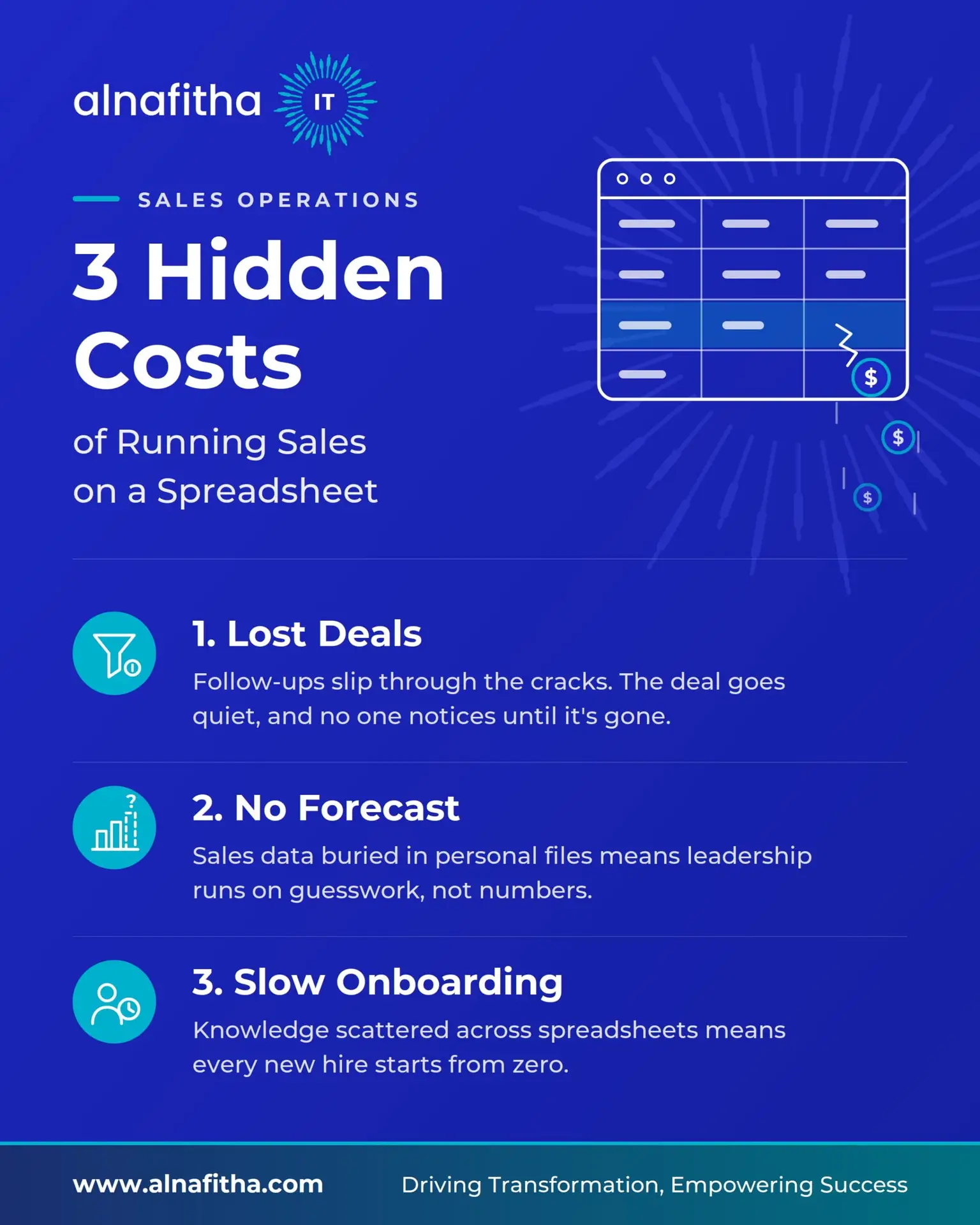
Every sales manager in the Kingdom knows the moment. A strong lead goes silent, a deal stalls with no clear reason, and nobody can say who was supposed to follow up or when. The culprit is almost always the same: the pipeline lives in Excel.
A spreadsheet feels free and familiar, which is exactly why it survives long past its usefulness. The problems are structural. Two reps overwrite each other’s edits. A column gets sorted and the rows scramble. The “latest” version is whichever file someone last emailed. There is no audit trail, no reminder, and no way to know whether a follow-up actually happened. For a growing Saudi SMB, the cost of this is not abstract. It shows up as lost revenue you never see, because the deal was never recorded as lost in the first place.
The second hidden cost is leadership blindness. When sales data sits in personal files, an Operations Director or General Manager has no dependable monthly revenue forecast. Decisions about hiring, inventory, and cash flow get made on gut feeling. A proper Zoho CRM system turns scattered notes into a forecast you can defend in a board meeting.
The third cost is onboarding. When product knowledge, deal history, and account context are spread across individual spreadsheets, every new sales hire starts from zero. Ramp time stretches into months. Centralising that knowledge in one system is one of the fastest, least glamorous returns a CRM delivers.
What a Zoho CRM System Actually Replaces
Zoho CRM is not a fancier spreadsheet. It is a structured sales operating system. Leads, contacts, accounts, and deals each live in their own module, linked together, so a single customer record carries its full history. Workflow automation handles the follow-ups that humans forget, assigning tasks and triggering reminders the moment a deal changes stage.
For Saudi sales teams, a few capabilities matter most. Pipeline management gives every deal a defined stage and owner, ending the “who owns this?” confusion. Sales forecasting projects monthly and quarterly revenue from real pipeline data, which is the visibility leadership has been missing. Zia, Zoho’s built-in AI assistant, suggests the best time to contact a lead and flags win probability, so reps spend time where it converts. And because Zoho CRM offers an Arabic interface and integrates with regional channels like WhatsApp, it fits how business is done across the Kingdom rather than forcing teams to adapt to a foreign workflow.
If your team also handles support, marketing, and service in addition to sales, it is worth understanding the difference between the standalone product and Zoho CRM Plus, the unified customer engagement suite that brings sales, marketing, and help desk onto one interface.
Choosing the Right Zoho CRM Edition for Your Team
One of the most common questions Saudi buyers ask, reflected directly in regional search demand around Zoho CRM, is whether it fits an SMB. It almost always does, because the platform is designed to scale with you rather than force a single rigid package on every business.
Zoho CRM comes in several editions, and the right one depends on team size and how you sell. Smaller teams getting their first structured pipeline in place need the essentials: lead and deal management, dashboards, and basic automation. Growing sales teams move up to editions that add deeper sales automation, email integration, and inventory features that a real pipeline needs. Larger or more complex operations step into editions built around Zia AI, territory management, and heavier customisation. The point is that you start where you are and grow into more capability as the team matures, without rebuilding from scratch.
The edition you license is only part of the picture, and this is where buyers who go it alone often stumble. The larger value comes from implementation: migrating clean data, designing the pipeline to match how you actually sell, building automations, and training the team so the system gets used. A well-run rollout is what separates a CRM that transforms a sales floor from one that quietly becomes another ignored tool. For a plan and a quote scoped to your team size and goals, the most reliable path is to speak directly with an authorised partner rather than rely on generic figures online.
A Realistic Zoho CRM Implementation Timeline
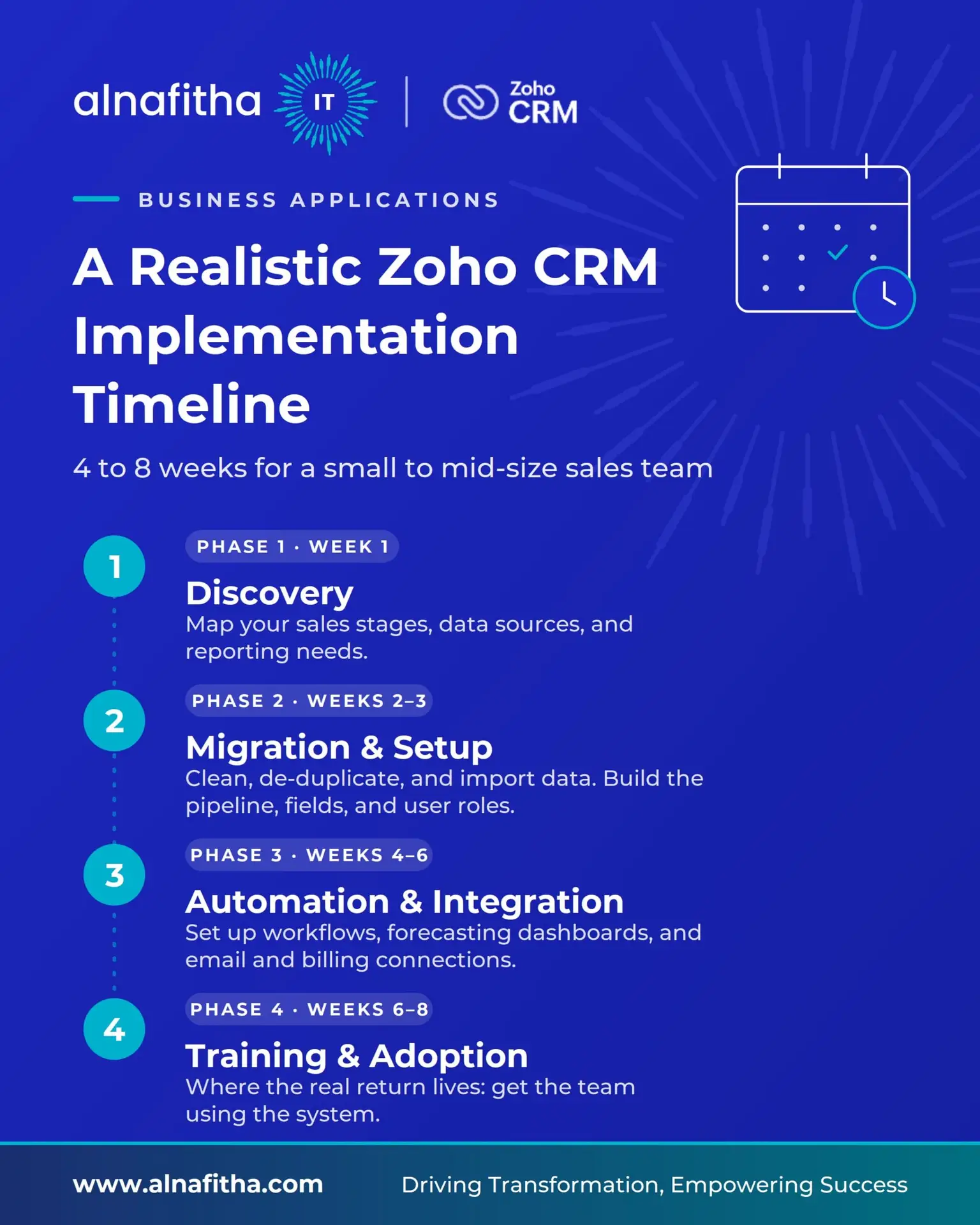
Treat anyone who promises a CRM “live by Friday” with caution. A serious Zoho CRM implementation for an SMB sales team follows a sequence, and rushing it is how projects fail.
The first phase, roughly the opening week, is discovery: mapping your sales stages, data sources, and reporting needs. The second phase covers data migration and configuration, usually two to three weeks, where spreadsheet records are cleaned, de-duplicated, and imported, and the pipeline, custom fields, and user roles are built. The third phase is automation and integration, where workflows, forecasting dashboards, and connections to email and billing systems are set up. The final phase is training and adoption, which is where the real return lives. Expect a total of four to eight weeks for a small to mid-size team, depending on data quality and how many integrations you need.
Alnafitha’s approach starts with a full picture of your business model before touching the software, examining each functional area to build a configuration that matches your requirements rather than a generic template. You can see the broader set of sales and marketing solutions the team delivers across the Zoho ecosystem.
Compliance Is Part of the Build, Not a Bolt-On
For a Saudi business, moving customer data into a CRM is also a data protection decision. The Personal Data Protection Law (PDPL) is fully enforced and overseen by the Saudi Data and Artificial Intelligence Authority (SDAIA). Organisations must obtain clear consent before processing personal data, honour data subject rights to access and delete information, and respect restrictions on transferring data outside the Kingdom. Non-compliance carries fines reaching SAR 5 million. A CRM configured by people who understand these obligations builds consent capture and access controls into the system from the start, instead of leaving you exposed.
Two more factors make a CRM project strategically smart right now. Vision 2030’s SMB digitisation agenda actively favours digitally mature suppliers in government procurement, so a documented, modern sales system can strengthen your eligibility. And ZATCA e-invoicing means that connecting your CRM to your billing workflow keeps the quote-to-invoice process compliant and audit-ready, which is one of the more valuable integrations a Saudi SMB can build early. You can read more on the SDAIA’s official data protection framework and the national Vision 2030 priorities that shape this digitisation push.
Why an Authorised Partner Changes the Outcome
Zoho CRM is approachable enough that a determined operations lead could try to set it up alone. The reason most successful Saudi deployments run through a partner is that the platform’s value is locked behind good configuration, and configuration is where local context matters: Arabic enablement, ZATCA-ready integration, PDPL-compliant data handling, and a pipeline designed around regional sales behaviour.
As an authorised Zoho partner and the Zoho Inspire “Building Success” Partner of the Year for KSA, Alnafitha’s Business Applications team brings exactly that. The team handles complex data migration, workflow automation, Arabic interface implementation, and integration with local payment and billing systems, then runs the training programs that drive real adoption. This is the difference between buying software and building a sales capability. Saudi firms such as Sulaiman Al-Rajhi Real Estate Investments have already partnered with Alnafitha to move onto Zoho CRM and reshape how they manage customer relationships.
Conclusion
The spreadsheet was never the problem you set out to solve. It was a workaround that quietly grew into a liability: missed follow-ups, no forecast, slow onboarding, and zero visibility for the people running the business. A Zoho CRM system addresses all four on a timeline measured in weeks, with an edition that fits your team and compliance built in rather than bolted on. The decision is no longer whether to leave the spreadsheet behind. It is whether you do it cleanly, with a partner who understands the Saudi market, or learn the hard lessons on your own time.
Ready to replace the spreadsheet with a sales system you can forecast on? Talk to Alnafitha’s Zoho CRM specialists and get a realistic plan and quote for your team.
Frequently Asked Questions
Is there a free version of Zoho CRM, and is it enough for a Saudi SMB? Zoho CRM offers a free edition aimed at very small teams, with basic leads, contacts, and reports. It is useful for testing the idea, but most growing Saudi sales teams quickly need a paid edition for automation, email integration, and unlimited records. The free tier proves the concept; the paid editions run a real sales operation. A partner can advise which edition matches your team before you commit.
Which Zoho CRM edition is right for a Saudi SMB sales team? It depends on team size and how you sell. Smaller teams usually start with an edition covering core pipeline management and basic automation, then move up as they need deeper sales automation, AI insights from Zia, or territory management. The cleanest way to match an edition to your needs is a short scoping conversation with an authorised partner, who can also factor in Arabic enablement and ZATCA integration.
How long does a Zoho CRM implementation take? For a small to mid-size sales team, a proper implementation typically runs four to eight weeks, covering discovery, data migration, pipeline and automation setup, and training. The timeline depends mainly on how clean your existing data is and how many integrations, such as ZATCA billing, you need.
Does Zoho CRM meet Saudi PDPL requirements? Zoho CRM can be configured to support PDPL obligations around consent, data subject rights, and access control, but compliance depends on how it is set up. Working with a partner who understands SDAIA’s requirements ensures consent capture and data handling are built in from the start rather than discovered during an audit.
Can Zoho CRM connect to our billing and ZATCA e-invoicing? Yes. Zoho CRM integrates with Zoho’s finance applications and other billing systems, so the quote-to-invoice workflow can be linked and kept ZATCA-compliant. This is one of the higher-value integrations for Saudi SMBs and is best scoped during implementation.
Is Zoho CRM a good alternative to heavier CRM platforms? For most Saudi SMBs, yes. Compared with bulkier enterprise platforms, Zoho CRM delivers pipeline management, forecasting, and AI-driven insights without the complexity and overhead that often go unused, which is why regional buyers frequently compare it favourably against bigger options when team size and ease of adoption are the deciding factors.