

Microsoft 365 Compliance: Quick Takeaways
- Microsoft 365 compliance tooling addresses a large share of the technical controls inside NCA ECC-2:2024, but it never satisfies the framework on its own. The Essential Cybersecurity Controls span governance, defence, resilience, and third-party and cloud security, and most of the governance and policy controls remain the organization’s responsibility.
- The platform’s strongest native coverage sits in the Cybersecurity Defence domain: identity and access management, data and information protection, email protection, cryptography, and event logging are all built into Microsoft 365 E5.
- The most common gaps in Saudi deployments are not missing features. They are misconfigured defaults, unassigned licenses, and governance documentation that auditors expect to see.
- Data residency has historically been a real constraint, but Microsoft’s Saudi Arabia datacenter region is expected to be available for cloud workloads from Q4 2026, which changes the localization conversation for KSA entities.
- A structured Microsoft 365 compliance assessment, mapped to ECC-2:2024 and SAMA CSF, is the difference between owning a powerful platform and being audit-ready.
Why Microsoft 365 Compliance Is a Board-Level Question in Saudi Arabia
For CISOs and IT managers operating in the Kingdom, Microsoft 365 compliance has moved from an IT housekeeping task to a regulatory obligation. The National Cybersecurity Authority’s Essential Cybersecurity Controls, updated to ECC-2:2024, set the minimum cybersecurity baseline for government entities and for private-sector organizations that own, operate, or host Critical National Infrastructure. The framework now consists of four main domains, 28 subdomains, and 108 main controls, a deliberate streamlining from the previous edition designed to make implementation cleaner.
The practical problem is that many Saudi enterprises already run Microsoft 365 across email, identity, documents, and collaboration. Their most sensitive data already lives there. So the real question every security leader is asking is not whether to adopt the platform, but how much of NCA ECC-2:2024 Microsoft 365 actually covers, and exactly where the organization still carries unaddressed risk going into an audit.
That uncertainty is well founded. Microsoft operates a shared responsibility model. Microsoft secures the underlying cloud infrastructure and certifies it against international standards, but the customer is responsible for configuring policies, assigning the right licenses, classifying data, and producing the governance evidence regulators ask for. Confusing the two is where compliance exposure begins.
Where Microsoft 365 Compliance Covers NCA ECC Controls Natively
The Cybersecurity Defence domain is the heart of ECC-2:2024 and the area where Microsoft 365 compliance capabilities are strongest. Mapped against the framework’s subdomains, here is where the platform genuinely earns credit.
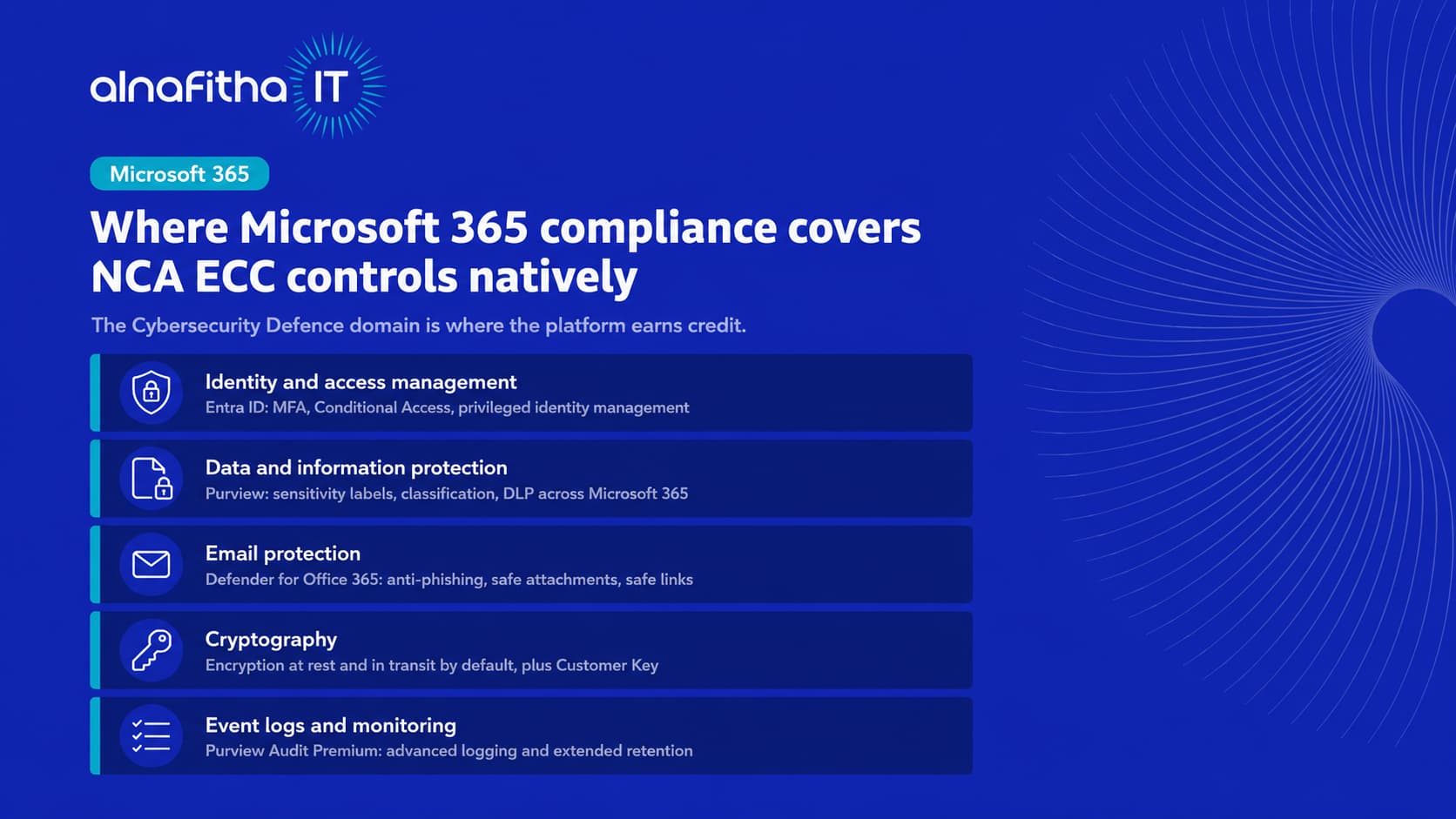
Identity and Access Management. ECC requires that only authorized users gain secure, restricted access. Microsoft Entra ID delivers multi-factor authentication, Conditional Access, privileged identity management, and periodic access reviews. These are built into Microsoft 365 E5 rather than bolted on, which directly supports the IAM subdomain.
Data and Information Protection. ECC mandates data classification, labelling, and privacy controls. Microsoft Purview Information Protection provides sensitivity labels, automatic classification, and Data Loss Prevention policies that work across Exchange, SharePoint, OneDrive, and Teams. This addresses one of the most heavily weighted control areas in any ECC assessment.
Email Protection. The framework calls for protecting the email service, including MFA for webmail and remote access and anti-phishing measures. Microsoft Defender for Office 365 covers anti-phishing, safe attachments, and safe links, while Exchange Online enforces the access requirements.
Cryptography. ECC requires approved cryptographic solutions and secure key management. Microsoft 365 encrypts data at rest and in transit by default, and Customer Key gives organizations additional control over their encryption keys.
Event Logs and Monitoring. ECC requires the collection and retention of cybersecurity event logs. Microsoft Purview Audit (Premium) and Microsoft 365 Defender provide advanced audit logging and extended retention, supporting both monitoring and incident investigation.
Tying these together is Microsoft Purview Compliance Manager, which maps your live configuration against regulatory frameworks, calculates a compliance score, and separates the controls Microsoft already handles from the improvement actions your team still owns. It is the natural starting point for any Microsoft 365 compliance engagement because it makes the gaps visible rather than assumed.
Microsoft 365 Compliance Gaps: The Controls It Does Not Close
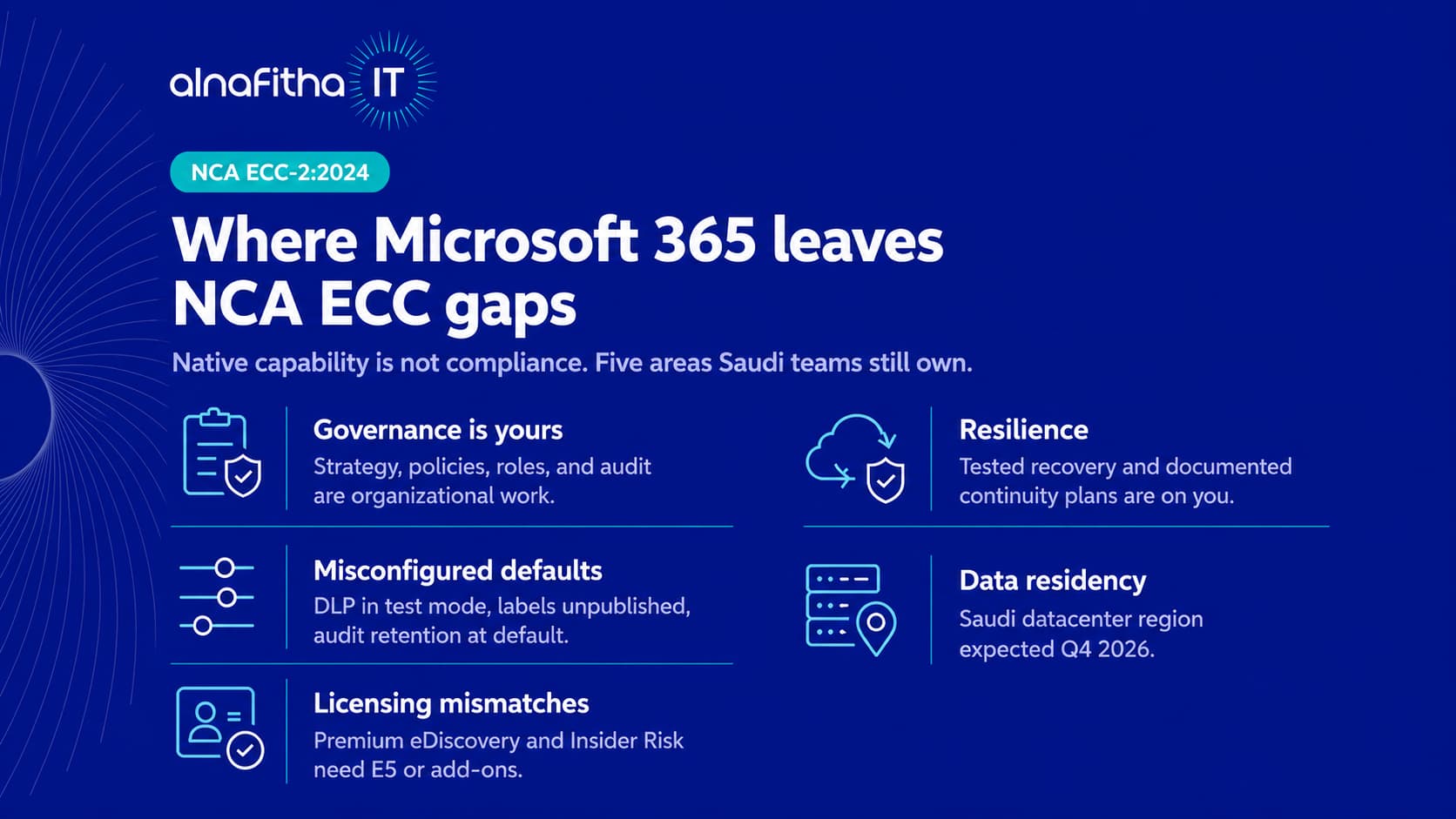
Governance controls are almost entirely yours. The entire Cybersecurity Governance domain, covering strategy, policies and procedures, roles and responsibilities, risk management, and periodic review and audit, is organizational work. No license configures a cybersecurity strategy or an approved policy set. ECC-2:2024 also introduced a Saudization requirement mandating that cybersecurity roles be filled by Saudi professionals, which is a workforce and HR matter no platform can satisfy.
Misconfigured defaults create silent exposure. This is the single most common finding in real assessments. An organization may hold Microsoft 365 E5 licenses while DLP policies sit in test mode, sensitivity labels are unpublished, audit retention is left at the default, or Conditional Access excludes legacy protocols. The capability exists, the control does not, and an auditor will record it as a finding.
Licensing mismatches. Many advanced compliance features, including Premium eDiscovery, Insider Risk Management, and advanced audit, require E5 or specific add-ons. Running E3 while assuming E5-level coverage produces a structural gap. Understanding exactly what each tier includes is foundational, which is why the difference between Microsoft 365 E5 and lower tiers for security and compliance deserves a deliberate review before any ECC mapping exercise.
Resilience needs more than the cloud. The Cybersecurity Resilience domain integrates cybersecurity into business continuity management. Microsoft provides high availability and backup capabilities, but tested recovery procedures, documented continuity plans, and evidence of periodic testing remain the organization’s responsibility.
Data residency and localization. This has been a defining concern for KSA entities. Microsoft’s Saudi Arabia datacenter region is expected to be available for cloud workloads from Q4 2026, which will offer local data residency and reduced latency. Until an organization’s tenant data is committed to that region, residency must be addressed through tenant configuration, the Advanced Data Residency add-on where eligible, and clear documentation of where data physically resides.
The SAMA Dimension for Financial Institutions
For banks, insurers, and financing companies, NCA ECC is not the only lens. The SAMA Cybersecurity Framework imposes its own expectations on identity, data protection, monitoring, and third-party risk. The encouraging reality is that Microsoft 365 compliance controls map cleanly across overlapping requirements, so a single well-configured Conditional Access or DLP control can satisfy multiple obligations at once. The complication is that financial regulators expect deeper evidence and tighter third-party governance, which raises the documentation bar considerably.
How Alnafitha IT Closes the Microsoft 365 Compliance Gap
Owning Microsoft 365 and being compliant with NCA ECC-2:2024 are two different states, and the distance between them is exactly where most audit findings live. As a Microsoft partner with more than 30 years of presence in the Kingdom, Alnafitha IT works with CISOs and IT managers to turn platform capability into demonstrable compliance.
Engagements typically begin with a regulatory gap analysis that maps the live Microsoft 365 tenant against ECC-2:2024 and, where relevant, SAMA CSF, using Compliance Manager as the evidence baseline. From there, the focus shifts to design and remediation: hardening Conditional Access, moving DLP policies from test to enforcement, publishing sensitivity labels, configuring audit retention to meet logging requirements, and right-sizing licensing so the controls the regulation expects are actually live. Just as important, the work produces the governance documentation and control attestation reports that auditors and boards ask to see.
This is decision-stage work. If your organization is weighing whether your current Microsoft 365 estate will withstand an ECC audit, a structured assessment removes the guesswork. You can explore the broader cybersecurity solutions Alnafitha delivers across the Kingdom to see how compliance fits into a wider security posture.
Conclusion: From Capable Platform to Audit-Ready Posture
Microsoft 365 is one of the most capable compliance platforms available to Saudi enterprises, and it natively addresses a substantial portion of the technical controls inside NCA ECC-2:2024, particularly across identity, data protection, email, cryptography, and logging. What it does not do is govern itself. The governance domain, the documentation, the workforce requirements, and above all the correct configuration of powerful features remain the organization’s responsibility.
For a CISO or IT manager preparing for an ECC audit, the path forward is clear: map what the platform covers, identify what it does not, fix the misconfigured defaults before an auditor finds them, and build the evidence trail regulators expect. Do that, and Microsoft 365 compliance shifts from a source of uncertainty to a genuine competitive and regulatory advantage.
Ready to find out exactly where your Microsoft 365 environment stands against NCA ECC-2:2024? Talk to Alnafitha’s compliance specialists and turn your platform into an audit-ready posture.
Frequently Asked Questions
Does Microsoft 365 make my organization NCA ECC-2:2024 compliant on its own? No. Microsoft 365 provides native capabilities that address many technical controls, especially in the Cybersecurity Defence domain, but compliance also requires governance policies, documented procedures, correct configuration, and audit evidence that the platform cannot produce for you. Compliance is a shared responsibility between Microsoft and your organization.
Which NCA ECC controls does Microsoft 365 cover best? The strongest coverage is in identity and access management, data and information protection, email protection, cryptography, and event logging and monitoring. These map to Microsoft Entra ID, Microsoft Purview, and Microsoft Defender capabilities included in Microsoft 365 E5.
Where are the biggest Microsoft 365 compliance gaps for Saudi organizations? The most common gaps are the entire governance domain, misconfigured defaults such as DLP policies left in test mode or unpublished sensitivity labels, licensing mismatches where E3 is assumed to deliver E5 capabilities, business continuity evidence, and data residency until the local datacenter region is in use.
Do I need Microsoft 365 E5 for ECC compliance, or is E3 enough? E3 covers foundational compliance features, but advanced controls such as Premium eDiscovery, Insider Risk Management, and advanced audit require E5 or specific add-ons. Many ECC-relevant capabilities depend on E5, so licensing should be reviewed against your specific control requirements before any mapping exercise.
When will Microsoft 365 data be hosted in Saudi Arabia? Microsoft’s Saudi Arabia datacenter region is expected to be available for cloud workloads from Q4 2026, offering local data residency and reduced latency. Until then, residency is managed through tenant configuration and, where eligible, the Advanced Data Residency add-on.
Does Microsoft 365 also help with SAMA Cybersecurity Framework compliance? Yes. Many Microsoft 365 controls map across both NCA ECC and SAMA CSF, so a single well-configured control can satisfy overlapping requirements. Financial institutions should expect stricter evidence and third-party governance expectations under SAMA, which raises the documentation requirement.