

Key Takeaways: Comparing Enterprise IT Support Services
- Support proposals differ far more in scope than in price. The gap sits in tier coverage and in what happens when a target is missed.
- Response time is not resolution time. A 15-minute response guarantee can still leave a P1 outage running for days without breaching anything.
- Under NCA ECC-2:2024, cybersecurity managed service centers using remote access must sit fully inside Saudi Arabia. That is a disqualifier, not a preference.
- Request the escalation matrix, severity definitions, and service credit clause before comparing numbers.
- ISO/IEC 20000-1 certification means a provider’s service levels were independently audited rather than asserted.
Three vendors send you proposals for enterprise IT support services. All three promise 24/7 coverage. All three quote a similar annual figure. Two of them will fail you during your first serious incident, and the proposals give you almost no way to tell which two.
This is the central problem in support procurement. Proposals are written to look comparable while hiding the variables that decide whether a Sunday-night database failure clears in two hours or two days. Teams then default to price, because price is the only field that lines up cleanly.
The fix is knowing which questions expose the difference before signing. This guide covers the five areas where enterprise IT support services genuinely diverge, and the clauses to request from every vendor on your shortlist.
Why Enterprise IT Support Services Look Identical on Paper
Proposals converge because vendors write them to pass procurement filters, not to describe operations. Everyone claims 24/7 availability, certified engineers, and rapid response, since those terms appear in most RFPs.
What the documents rarely define is the boundary of each claim. “24/7 support” might mean a staffed operations center at 3am on Friday, or a voicemail queue that raises a ticket for Sunday triage. Both are technically accurate, yet only one helps during an outage.
Coverage carries the same ambiguity. A proposal listing “Microsoft, VMware, and backup infrastructure” does not say whether support ends at the operating system layer or reaches the applications your finance team depends on. When a fault sits between two vendors, vague scope becomes a week of finger-pointing while systems stay down.
Therefore treat every unqualified claim as a question. Vendors worth shortlisting answer with documents; the rest answer with reassurance.
Understand What L1 to L4 Support Actually Covers
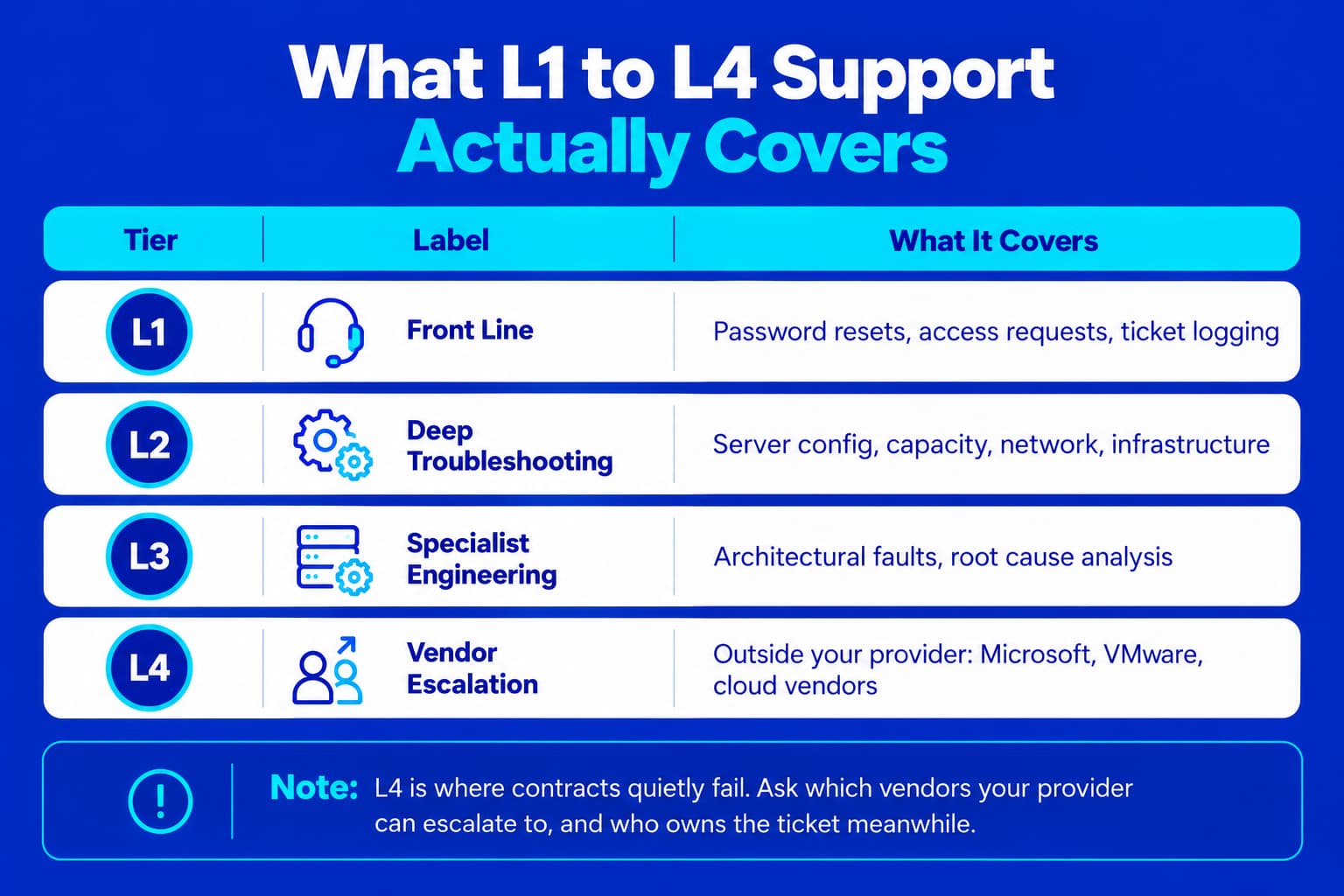
Every comparison of enterprise IT support services starts with the support tiers, and misreading them is the most common scoping error in enterprise contracts.
L1 is the front line: initial contact, password resets, access requests, basic troubleshooting, and ticket logging. First contact resolution is the metric that matters, since every ticket L1 closes is one your senior engineers never see.
L2 takes what L1 cannot close. It handles issues escalated by L1 teams, including in-depth troubleshooting, hardware repairs, and network problems, and often requires access to system-level configurations. Server configuration, capacity issues, and most infrastructure work land here.
L3 is the specialist tier, covering architectural faults, root cause analysis, and incidents that threaten service continuity. A key characteristic of L3 work is that its outputs should flow back down the support hierarchy, so a strong L3 function reduces future ticket volume rather than only closing today’s.
L4 sits outside your provider entirely, where responsibility shifts to external parties: hardware manufacturers, software vendors, or cloud providers holding proprietary knowledge and diagnostic tools that internal teams lack.
That last tier is where contracts quietly fail. Without a formal partnership between your provider and the vendor behind your critical platform, an L4 escalation becomes your problem at the worst moment. Ask which vendors they can escalate to on your behalf, at what partnership level, and who owns the ticket meanwhile.
Read the SLA for Resolution, Not Response
The SLA is where enterprise IT support services either commit or hedge. Response time measures acknowledgement. Resolution time measures repair. Vendors compete on the first because it is cheap to promise and easy to hit.
An SLA guaranteeing a 15-minute response commits the provider to a human reply, not to restored service. Without a resolution target or workaround obligation, a severity-one outage can run for days while the vendor stays technically compliant.
Request these five items from every shortlisted provider:
- Severity definitions in writing. Who classifies an incident as P1, and can you dispute a downgrade? Vendors that unilaterally control severity control their own SLA performance.
- Resolution or workaround targets per severity level, separate from response targets.
- The escalation matrix, with named roles and timeframes. A P1 unresolved at four hours should trigger automatic escalation without you having to demand it.
- Service credits and their trigger conditions. Credits are the only clause that gives an SLA financial weight. If a missed target costs the vendor nothing, it is a stated intention rather than a commitment.
- Reporting cadence and format. ISO/IEC 20000-1 requires organizations to manage and report against agreed service levels, with SLAs including measurable targets that can be monitored, reported on, and reviewed.
One further test settles most shortlists. Ask for measured performance against these targets over the last twelve months rather than the targets themselves. Providers running a mature service management system produce that report easily, and those who cannot have told you something important.
Apply the Saudi Compliance Filter Before Comparing Price
For organizations in the Kingdom, regulation eliminates some vendors regardless of commercial terms. Applying this filter first saves weeks spent evaluating proposals that cannot be signed.
The NCA’s Essential Cybersecurity Controls (ECC-2:2024) address outsourcing directly. Control 4-1-2 requires that cybersecurity requirements for contracts and agreements with third parties, such as SLAs, include non-disclosure clauses, secure removal of the entity’s data upon end of service, communication procedures in the event of a cybersecurity incident, and an obligation on the third party to apply the entity’s cybersecurity requirements.
Control 4-1-3 goes further for managed services. It requires a cybersecurity risk assessment before signing contracts, and states that cybersecurity managed service centers for monitoring and operations which use remote access shall be fully located in the Kingdom of Saudi Arabia.
That second clause is decisive. An offshore monitoring center serving a government entity or critical infrastructure operator is not a saving; it is an audit finding. ECC-2:2024 also mandates that all cybersecurity positions be filled by full-time qualified Saudi professionals, expanding on ECC-1 where only senior roles carried this requirement.
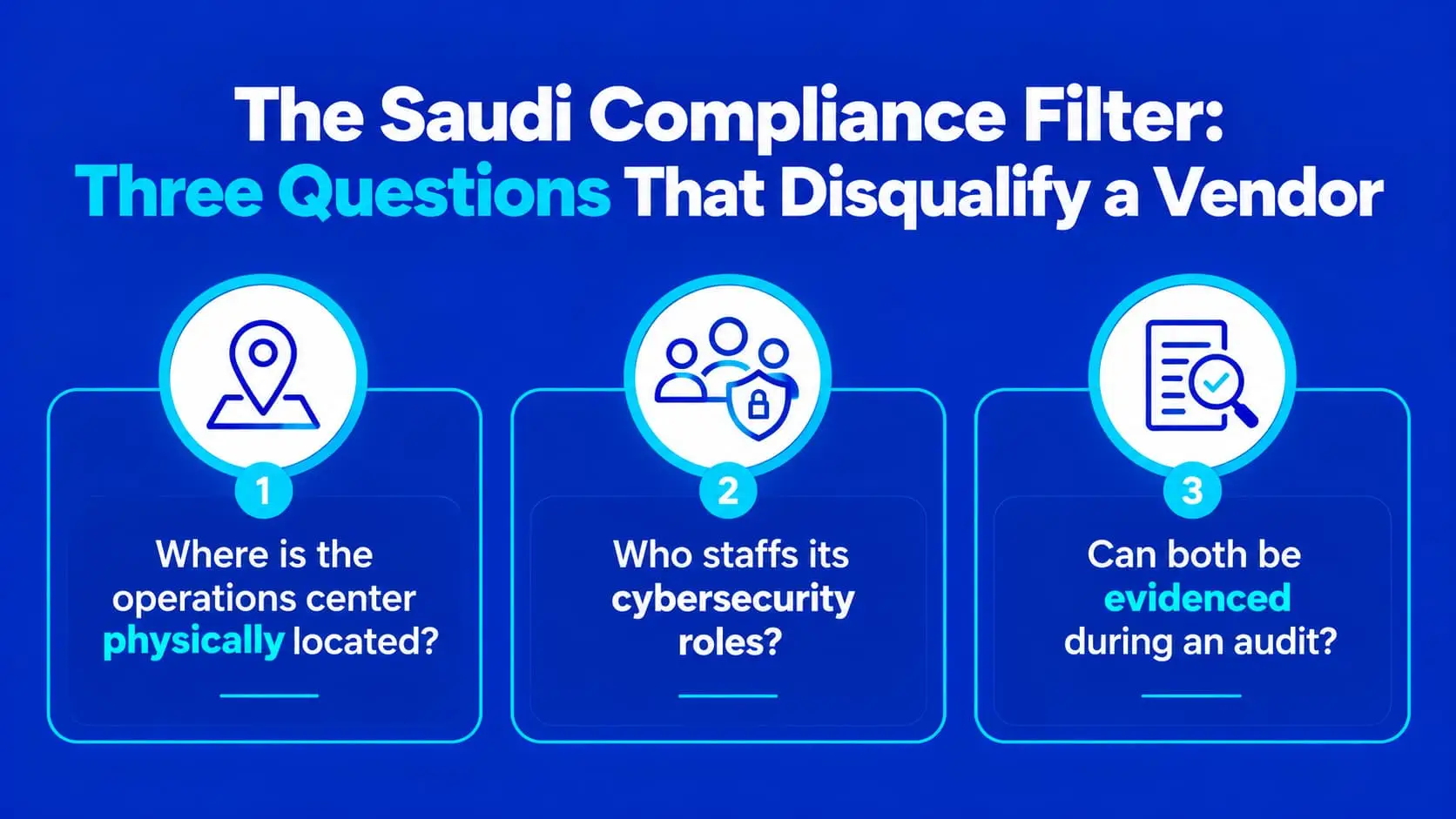
Three questions settle it. Where is the operations center physically located? Who staffs its cybersecurity roles? Can both be evidenced during an audit? Cloud and hosting arrangements carry parallel obligations, including separation of your environment from other entities’ and return of data in usable format when service ends.
Use ISO 20000 as a Verification Shortcut
Certification will not tell you whether a provider is right for your environment. It does tell you whether their service management claims have been audited by someone independent.
ISO/IEC 20000-1:2018 specifies requirements for an organization to establish, implement, maintain and continually improve a service management system, covering the planning, design, transition, delivery and improvement of services. It complements ITIL rather than replacing it: ITIL offers guidance, while ISO 20000-1 sets certifiable requirements. Any vendor can claim ITIL alignment, but certification means an auditor tested the claim.
The standard also benefits buyers by being strict. All requirements are mandatory, and unlike ISO 27001 there is no mechanism to exclude requirements from the scope of certification. Common nonconformities centre on incomplete service catalogues, unmeasurable SLAs, weak problem management, and poor integration between processes, which describes precisely the failures that damage support relationships.
Where a provider holds the certification, ask for the scope statement. Certification covering one delivery center abroad tells you less than certification covering the team serving you.
How Alnafitha IT Structures Enterprise IT Support Services
Alnafitha IT has delivered technology services in the Saudi market since 1993, with offices in Riyadh, Jeddah, and Dammam and more than 7,000 customers across government and private sectors. The support model is built around the comparison points above rather than around headline availability claims.
Alnafitha ONE Services covers the full escalation path. A 24/7 service desk manages ticket creation, dispatch, closure, and reporting. L2 engineers handle ITSM and ITOM work across server configuration, capacity, asset, availability, and security management. L3 remote specialists cover infrastructure, backup, and disaster recovery failover, and issue regular health check reports rather than waiting for incidents. Since the practice spans Microsoft, ManageEngine, Veeam, and VMware, L4 escalation runs through an existing partnership instead of a ticket you file yourself.
Two structural details matter at procurement. Contracts scale automatically, so new products or vendors entering your environment fall under the active agreement without renegotiation. Support hours flex between reactive incidents and proactive work, converting unused capacity into health checks instead of letting it expire. A Technical Account Manager owns onboarding while a Customer Success Manager acts as single escalation contact, removing the ambiguity that appears when nobody named in the contract owns an open issue.
Where the underlying service management system matters more than the support contract alone, Alnafitha’s IT Service Management consultancy covers gap assessment and auditing, ISO 20000 implementation and certification, and ITIL advisory.
Conclusion: Compare Scope First, Price Last
The lowest annual figure often belongs to the vendor whose scope ends exactly where your risk begins. Price only produces a sound decision once scope, severity definitions, escalation paths, and compliance position line up across every proposal.
Run your shortlist through five questions. What does each tier from L1 to L4 cover? Are resolution targets defined separately from response targets? What triggers escalation, and what does a missed target cost the vendor? Where is the operations center, and who staffs it? Has the service management system been independently certified?
Vendors who answer in writing are describing an operation. Vendors who answer with adjectives are describing a hope.
Ready to compare properly? Talk to Alnafitha IT’s team to review your current support agreement against these criteria and get a scoped proposal with defined severity levels, escalation paths, and measurable service targets.
Frequently Asked Questions
What are enterprise IT support services?
Enterprise IT support services are contracted arrangements covering incident resolution, system monitoring, and infrastructure management across an organization’s technology estate. They span L1 service desk through L3 specialist engineering, plus escalation to vendors at L4. Unlike break-fix arrangements, enterprise support operates under a service level agreement with defined severity levels, response and resolution targets, and reporting obligations.
What is the difference between managed services and break-fix support?
Break-fix support charges per incident and engages only after something fails. Managed services operate under a fixed agreement and include proactive monitoring, patching, and health checks designed to prevent incidents. Break-fix costs less in a quiet quarter, but budgets become unpredictable and there is no commercial incentive for the provider to reduce failure frequency.
What should be included in an enterprise IT support SLA?
At minimum: severity level definitions with a stated classification authority, response targets per severity, resolution or workaround targets per severity, a named escalation matrix with timeframes, service credits tied to missed targets, coverage windows including Saudi public holidays, reporting cadence, and data handling obligations at contract termination. Under ECC-2:2024, contracts should also address non-disclosure, secure data removal at service end, and incident communication procedures.
Does NCA ECC apply to my organization?
ECC-2:2024 applies to government agencies in Saudi Arabia including ministries, authorities, and establishments, along with their affiliated companies and entities inside and outside the Kingdom, and to all private sector entities owning, operating, or hosting Critical National Infrastructure. The NCA encourages all other entities in the Kingdom to adopt the controls as best practice. Sector regulators such as SAMA apply additional frameworks for financial institutions.
How is enterprise IT support priced?
Common models include per-user or per-device monthly fees, tiered packages by coverage level, and pooled support hours drawn down across incidents and project work. Pooled hours suit organizations with variable demand, particularly where unused capacity can be redirected into proactive work. Compare on scope coverage per riyal rather than headline annual figures, since a lower price frequently reflects narrower tier coverage or excluded vendors.
Can we keep an internal IT team and still use external support?
Yes, and this is the most common enterprise arrangement. External providers typically absorb L1 volume and after-hours coverage while internal teams focus on strategic work and business-specific applications. Under ECC-2:2024, entities in scope retain local accountability for cybersecurity roles regardless of outsourcing, so the internal team keeps ownership of risk decisions while the provider handles operational depth.
What questions should we ask potential IT support vendors?
Ask for measured SLA performance over the last twelve months rather than targets. Request the escalation matrix with named roles, the severity classification process, service credit triggers, the ISO 20000 certification scope statement, the physical location of the operations center, vendor partnership levels for L4 escalation, and reference customers of comparable size in your sector.