

Brief Takeaways
- Microsoft Unified Support is priced as a percentage of your total Microsoft spend, not the support you actually use, so the bill climbs every year even when your ticket volume stays flat.
- Saudi enterprises renewing Enterprise Agreements after the November 2025 pricing changes are seeing Unified Support costs rise alongside their licensing spend, often without a matching rise in value.
- Most organizations underuse the proactive entitlements they already pay for, which means real money is sitting unclaimed inside the contract.
- A structured contract review tied to actual usage, NCA ECC-2:2024 third-party obligations, and your renewal calendar is the fastest way to recover value.
- Alnafitha IT, a Saudi Microsoft partner since 1993, helps Kingdom enterprises review, right-size, and operationalize Microsoft Unified Support so the spend matches the support delivered.
The Quiet Cost Sitting Inside Your Microsoft Contract
If you are an IT Manager or CIO at a Saudi enterprise, Microsoft Unified Support is probably one of the larger line items in your annual technology budget. It is also one of the least examined. The contract renews, the invoice arrives, finance pays it, and the cycle repeats. Few teams stop to ask whether the number on that invoice reflects the support they consume.
That question matters more in 2026 than it did even a year ago. Microsoft Unified Support is not priced on usage. It is priced on a percentage of your total annual Microsoft spend, covering Microsoft 365, Dynamics 365, and Azure consumption over the previous twelve months. According to Microsoft’s own Unified plan details, rates begin in the range of eight to ten percent of that spend. As your cloud footprint grows, the support bill grows with it, whether or not you open a single additional ticket.
For Saudi organizations deep into Vision 2030 digital transformation, cloud spend is rising fast. Azure migrations, Microsoft 365 E5 rollouts, and Copilot adoption all push the licensing baseline up. Each increase quietly inflates the Unified Support percentage on top. The result is a support contract that scales with your ambition rather than your need.
How Microsoft Unified Support Actually Prices You
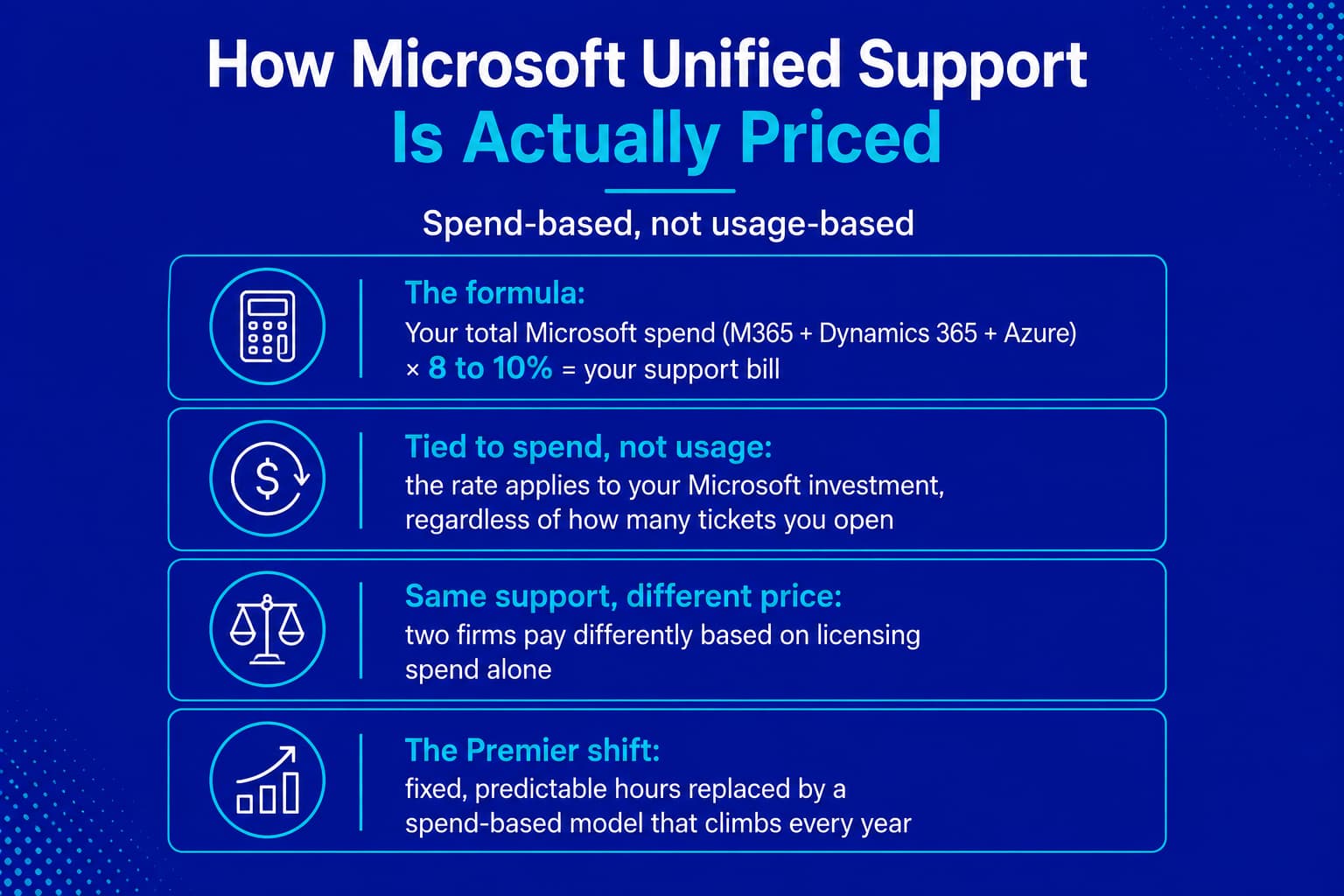
Understanding the mechanism is the first step to controlling it. Think of Unified Support pricing like an insurance premium tied to the total value of everything you own, rather than to how often you file a claim. Two companies can buy identical support and pay wildly different amounts simply because one spends more on Microsoft licensing.
Here is the practical effect. An enterprise that previously held a fixed-hours Premier Support agreement knew exactly what it paid and what it received. Under Unified, that predictability is gone. Microsoft retired Premier Support and moved customers to the Unified model, where the calculation is spend-based rather than consumption-based. Organizations that open a modest number of cases each year often find their cost per resolved incident has multiplied, because the price was never linked to incidents in the first place.
This is why the search demand around this topic in the Kingdom is dominated by cost and comparison questions. Decision-makers are asking how Microsoft Unified Support is calculated, how much it costs, how it differs from Premier Support, and whether the proactive services justify the figure. These are not idle questions. They are the questions of buyers who suspect they are overpaying and want evidence before the next renewal.
The Entitlements You Already Paid For, And Probably Never Used
The cost story has a second half that gets far less attention. Unified Support includes proactive entitlements: on-demand assessments, advisory hours, technical training, and access to designated support resources. These are bundled into the price you already pay. Most organizations leave a meaningful portion of them on the table.
When the in-house team is busy keeping systems running, nobody schedules the security assessment, books the architecture review, or claims the training credits. The entitlement expires unused at the end of the term. You paid for proactive support and received only reactive break-fix. That gap between what is purchased and what is consumed is pure recoverable value, and it is invisible unless someone reviews the contract line by line against actual activity.
This is the heart of the problem. The issue is rarely that Unified Support has no value. The issue is opaque pricing, unclear value against cost, and underused entitlements that no one is tracking. Fixing it does not require abandoning Microsoft. It requires a disciplined review.
The Microsoft Unified Support Compliance Angle in Saudi Arabia
There is a regulatory dimension that sharpens the case for a structured review. The National Cybersecurity Authority’s Essential Cybersecurity Controls, ECC-2:2024, place clear obligations on how Saudi organizations manage third-party and outsourced cybersecurity relationships. Domain 4 of the framework addresses cybersecurity risks arising from third parties, including outsourcing and managed services, and requires that these relationships align with organizational policies and applicable regulations. You can review the controls directly in the NCA’s official ECC publication.
Your support arrangement is a third-party relationship. Whether support cases are handled by Microsoft directly or through a managed partner, the controls expect contractual clarity, defined responsibilities, and accountability. For government entities and critical national infrastructure operators in the Kingdom, working with a Saudi-based partner that understands local accountability requirements is not just convenient. It supports the governance posture the regulator expects. A contract review is therefore both a financial exercise and a compliance exercise, and the two reinforce each other.
What a Real Microsoft Unified Support Review Looks Like

A useful Microsoft Unified Support review is not a quick glance at the invoice. It is a methodical comparison of three things: what you are paying, what you are entitled to, and what you actually use. Done properly, it surfaces the questions that protect your budget at renewal.
The review starts with your spend profile, since that drives the price. It maps every proactive entitlement in the agreement against your consumption record, exposing the assessments and advisory hours going to waste. It aligns the findings with your renewal timeline, because the only moment you have leverage is before you sign again. And it frames everything against your NCA ECC-2:2024 third-party obligations, so the support model strengthens rather than complicates your compliance position.
The outcome is a clear picture: where the money goes, where the value leaks, and what to change before the next term begins. That clarity is what turns a renewal from a rubber stamp into a negotiation.
Where Alnafitha IT Fits
This is precisely the work Alnafitha IT ONE Services is built for. As a Saudi Microsoft partner operating in the Kingdom since 1993, Alnafitha sits in a rare position. It understands the Microsoft contractual and licensing machinery from the inside, it knows the Saudi regulatory landscape, and it delivers support locally with certified engineers who work to your service levels around the clock.
That combination matters because reviewing a Unified Support contract well requires fluency in all three areas at once. A pure cost-cutting vendor may shave the invoice but miss the compliance exposure. A generic managed service provider may handle tickets but lack the Microsoft licensing depth to read the contract correctly. Alnafitha brings the licensing expertise, the local accountability, and the operational support capability together, so the review produces decisions you can defend to both finance and the regulator.
For Saudi enterprises, this also reframes the relationship with Microsoft constructively. The goal is not to walk away from Microsoft technology. It is to ensure the support wrapped around that technology is sized correctly, fully used, and properly governed. A strong local partner makes the Microsoft investment work harder, not less.
Take the First Step Before Your Next Renewal
Microsoft Unified Support will keep pricing itself off your growing Microsoft spend regardless of how much support you consume. The only way to change the equation is to examine the contract deliberately, claim the entitlements you have already funded, and align the arrangement with your compliance obligations and renewal calendar.
The best time to do that is well before the renewal date, while you still hold leverage. If your organization wants a clear, evidence-based view of what your Microsoft Unified Support contract is really delivering, talk to Alnafitha’s specialists and start the review on your terms.
Frequently Asked Questions
What is Microsoft Unified Support? Microsoft Unified Support is Microsoft’s enterprise support offering that replaced the older Premier Support model. It provides reactive technical support across your Microsoft products along with proactive services such as assessments and advisory hours, priced as a percentage of your total annual Microsoft spend rather than on a fixed number of support hours.
How is Microsoft Unified Support cost calculated? The cost is based on your historical Microsoft spend over the previous twelve months, covering Microsoft 365, Dynamics 365, and Azure consumption. A percentage rate, which Microsoft publishes as starting in the eight to ten percent range, is applied to that spend. Because the price tracks your licensing and cloud footprint, it tends to rise each year as your Microsoft usage grows.
What is the difference between Microsoft Unified Support and Premier Support? Premier Support was consumption-based, meaning you purchased a set number of support hours and knew the cost upfront. Unified Support is spend-based, calculated as a percentage of your overall Microsoft investment. Microsoft retired Premier Support and migrated customers to Unified, which typically costs more for organizations with lower ticket volumes.
Why does my Microsoft Unified Support bill keep increasing? Because the price is tied to your total Microsoft spend, any growth in your licensing or Azure consumption raises the support cost automatically. Saudi enterprises expanding their cloud estate or adopting new Microsoft 365 plans often see their Unified Support figure climb without any change in the actual support they use.
Can a Microsoft partner in Saudi Arabia help with Unified Support? Yes. A Saudi-based Microsoft partner such as Alnafitha IT can review your contract, identify unused entitlements, align the arrangement with NCA ECC-2:2024 third-party requirements, and provide local support delivery. This helps ensure you pay for value received and meet Kingdom compliance expectations.
Is reviewing my Unified Support contract the same as leaving Microsoft? No. A contract review optimizes how your Microsoft support is structured, used, and governed. The aim is to get full value from your existing Microsoft investment and support entitlements, not to replace Microsoft technology.
How does NCA ECC-2:2024 relate to Microsoft Unified Support? Domain 4 of the Essential Cybersecurity Controls addresses third-party and outsourcing cybersecurity. Your support arrangement is a third-party relationship, so it falls within the governance and accountability expectations the controls set, making compliance a natural part of any contract review.