
Outsourcing enterprise IT support is a continuity decision before it is a cost decision. When core systems go dark, the question is not what you saved. It is how fast someone is already working the problem. This guide gives Saudi IT directors a concrete way to evaluate managed IT services providers. It focuses on the three things that protect uptime: coverage, response times, and remote monitoring.
Brief Takeaways
- Demand 24×7 coverage in writing. A mention of “after-hours support” is not coverage.
- Response time and resolution time are two separate clocks. Negotiate each per priority tier.
- Remote monitoring is what prevents the incident. Ask how it works, and ask to see the dashboard.
- Repeat incidents signal a process gap. A provider aligned to ISO 20000 runs structured problem management.
- Local context is not optional in Saudi Arabia. Data residency, Arabic support, and regulatory familiarity separate a real partner from a global vendor learning on your account.
Why Managed IT Services Matter Now in Saudi Arabia
Managed services have moved from a secondary option to a core strategy in the Kingdom. Vision 2030’s digital-first mandate is driving that shift. The Saudi managed services market is projected to grow from USD 5.12 billion in 2025 to USD 7.83 billion by 2030. That is a CAGR of 8.2%.
The pressure behind the number is real. Cloud workloads keep expanding while technical talent stays scarce. A 2026 IDC report put the managed IT services market in Saudi Arabia above 4.2 billion SAR. It is growing at 18% annually, driven mainly by a shortage of local technical talent.
For an IT director, this reshapes the roadmap. Building every capability in-house is now slower and more expensive than partnering for it. But not every provider means the same thing by “support.” The first distinction to settle is break-fix versus managed:
| Break-fix support | Managed IT services | |
| Model | Reactive, pay per incident | Proactive, fixed recurring fee |
| Monitoring | None between calls | Continuous, 24×7 |
| Incentive | Earns more when things break | Earns more when things stay stable |
| Coverage | Ad hoc | Contractual SLA |
| Best for | Small, stable environments | Enterprises needing uptime |
The right managed IT services provider becomes an extension of your team. The wrong one becomes a second problem on top of the first. The rest of this guide is the discipline to tell them apart.
Coverage: What 24×7 Managed IT Services Really Mean
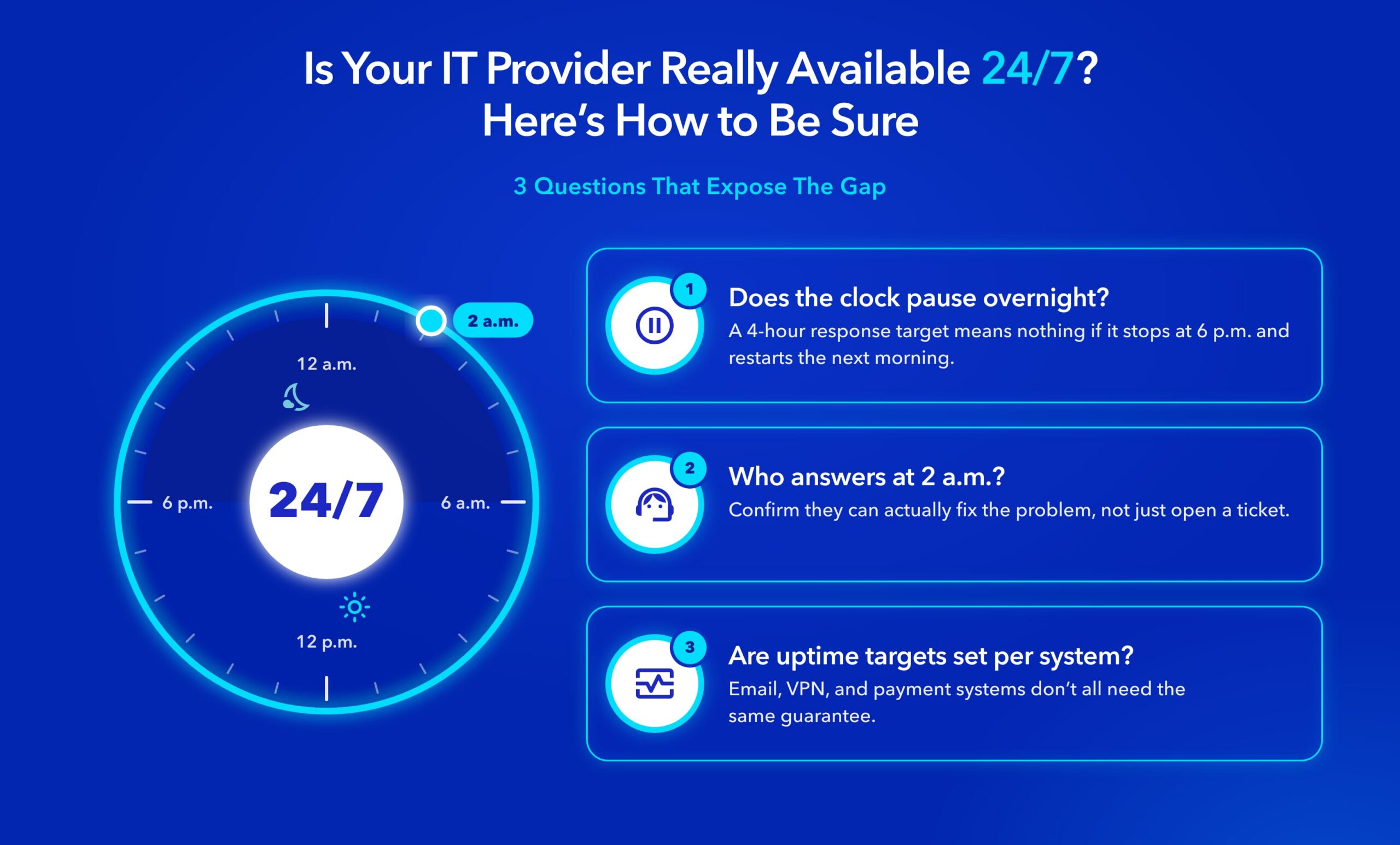
Start with coverage, because everything else depends on it. If your business runs after hours, your SLA must say so in writing.
The trap is common. A proposal promises “24/7 peace of mind” in the marketing. Then it scopes the SLA to business hours only. If your systems run around the clock, you need explicit 24×7 coverage stated in writing. A general mention of after-hours support is not enough.
Three questions expose the gap. First, does the response clock pause overnight? A four-hour target means nothing if it stops at 6 p.m. and resumes the next morning. Second, who answers at 2 a.m.? Confirm they can act, not just open a ticket. Third, are uptime targets defined per system? Email, VPN, and payment platforms rarely need the same guarantee. Uptime should be specific by system rather than one blanket number.
Response Time Versus Resolution Time in Your SLA
This is the most common mistake in reviewing a contract. The two clocks get treated as one.
Response time measures how fast the provider starts. Resolution time measures how long until it is fixed. A provider might respond to an outage in 15 minutes but take two days to restore operations. It has met its response commitment while leaving the business down. Negotiate both clocks, independently, per tier.
Use these benchmarks to hold providers to account:
| Priority | Example | Response target | Resolution target |
| P1 | Full outage affecting everyone | 15 to 30 minutes | 4 hours or fewer |
| P2 | Major function down, many users affected | 30 to 60 minutes | 8 hours |
| P3 | Moderate impact, workaround exists | 2 hours | 24 hours |
| P4 | Low impact or informational | 8 hours | 72 hours |
Then define when the clock starts. Require a clear definition of what counts as “business down.” Confirm who declares it. And state whether the clock starts when the ticket opens, when an alert triggers, or when the provider verifies the issue.
The stakes justify the rigor. A single hour of downtime now exceeds USD 300,000 for over 90% of mid-size and large enterprises, per ITIC’s 2024 report.
Remote Monitoring: The Managed IT Services Edge
The best incident is the one your users never notice. That is what monitoring buys. It also separates mature providers from reactive ones.
A published uptime figure tells you what is promised. It does not tell you whether trouble can be seen coming. A 99.9 percent guarantee may sound strong. The stronger question is whether a provider can detect problems early, prevent security-related outages, and restore systems quickly.
Demand specifics. Proactive monitoring means continuous performance analysis that flags anomalies before they escalate. Issues get addressed before end users notice. Ask about recovery objectives too. A managed IT services SLA should include recovery time objectives, recovery point objectives, and backup validation. It should also treat cybersecurity as part of uptime, since ransomware and account compromise both cause downtime. Finally, insist on transparent reporting. If you cannot see the monitoring, you cannot verify it.
Repeat Incidents and the ISO 20000 Filter
If the same failure keeps returning, you have a process problem, not bad luck. Here an audited standard becomes a practical filter.
ISO 20000-1 is a certifiable standard. An independent accredited body audits the provider and issues a formal certificate of conformity. That third-party verification is the point. Anyone can claim mature processes. The standard covers more than a dozen processes. These include incident, change, capacity, continuity, and service reporting. Problem management, the discipline that stops repeat incidents, sits inside it.
The business signal is clear. ISO 20000 helps organizations improve service delivery, reduce risk, and demonstrate best practice. It is often required in supply chains and government contracts. Ask the provider how their problem-management process closes the loop on recurring incidents. The answer tells you whether you are buying a fix or a discipline.
The Saudi Context: Compliance, Residency, and Language
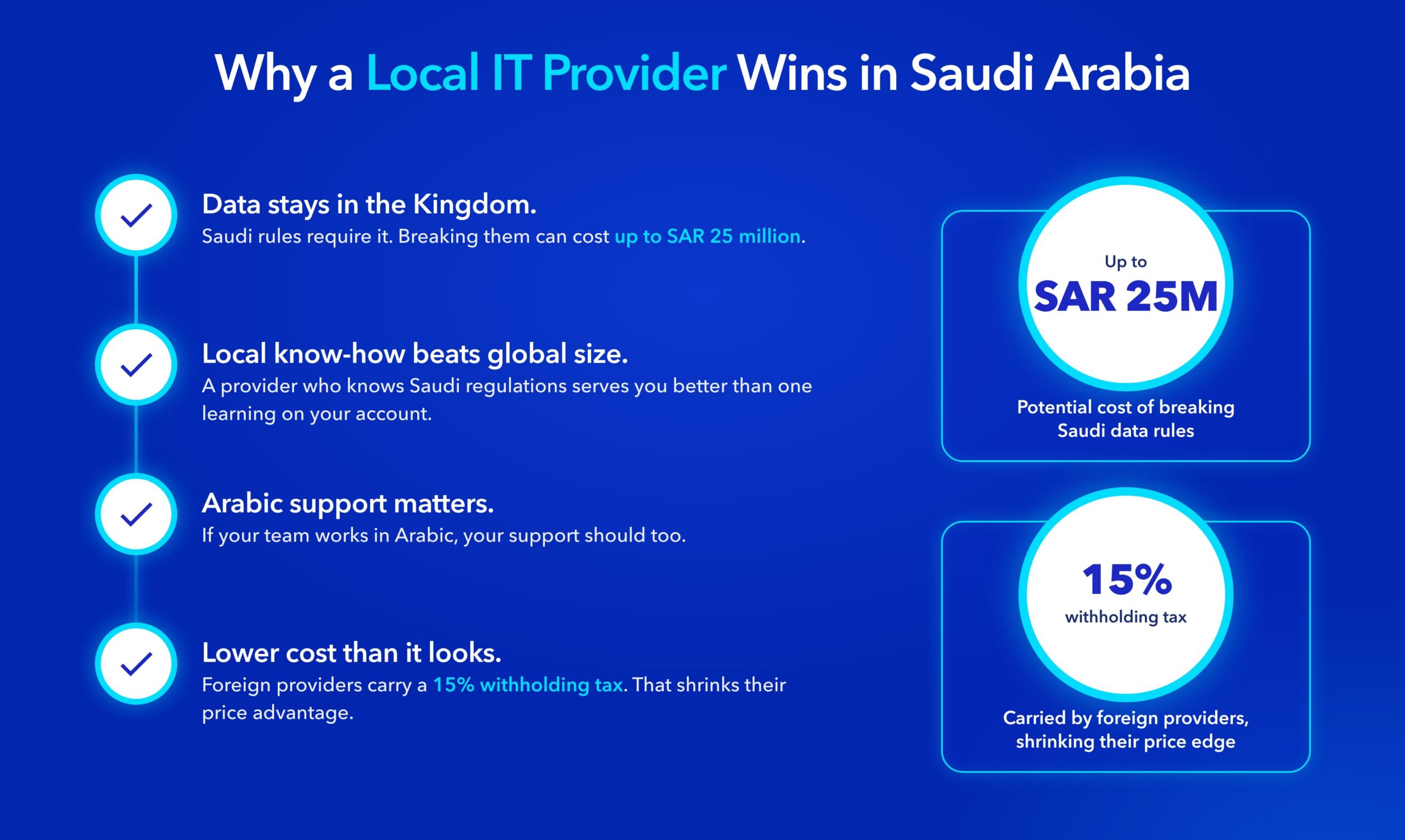
A global provider with an impressive SLA can still be the wrong choice here. Local context is a hard requirement.
Data residency is the clearest case. The Communications, Space and Technology Commission (CST) enforces strict data-residency rules, classifying data into tiers, with the stricter levels required to stay on servers inside the Kingdom. The CST also holds broad enforcement powers, with penalties that can reach SAR 25 million. Your provider’s hosting choices have to keep you compliant.
There is also the practical side. A provider who understands local regulatory requirements beats a global vendor unfamiliar with them. And if your team works in Arabic, support must be in Arabic. Cost follows suit. IT services from providers outside Saudi Arabia are subject to 15% withholding tax. That narrows the price gap with local providers.
The lesson is simple. Weight local presence, Arabic support, and Kingdom-based hosting as heavily as the technical SLA.
How Alnafitha IT Delivers Managed IT Services
Alnafitha IT is a 100% Saudi company founded in 1993. So the local context above is where we started, not something we adapted to. Our managed IT services run through Alnafitha IT ONE Services. They are built to meet the demands this guide describes.
On coverage, the service desk operates 24/7 for ticket creation, dispatch, and reporting. It is backed by L2 engineers for ITSM and ITOM tasks. An L3 remote team is available around the clock for infrastructure, backup, and disaster recovery.
On monitoring, a dedicated team provides 24/7 event management with real-time alerting. Problems are caught before they become downtime.
The relationship is structured. A Technical Account Manager guides onboarding. A Customer Success Manager acts as your single point of contact. Contracts extend coverage automatically as you add vendors. For the process maturity that prevents repeat incidents, our IT Service Management practice turns support into a system rather than a series of rescues.
Your Managed IT Services Evaluation Checklist
Before you sign, confirm each item in writing:
- 24×7 coverage stated explicitly, with a response clock that does not pause overnight
- Separate response and resolution targets per priority tier
- A clear definition of when the clock starts and who confirms severity
- Per-system uptime targets, not one blanket percentage
- Documented proactive monitoring with a dashboard you can see
- Recovery time and recovery point objectives, plus backup validation
- Alignment to ISO 20000 and a real problem-management process
- Kingdom-based data residency, Arabic support, and regulatory familiarity
- Escalation procedures naming who takes over and when
If a provider hesitates on any of these, treat the hesitation as information. The strongest partners answer without flinching. They built the operation to survive the questions.
Ready to compare support plans against this checklist? Talk to the Alnafitha IT team and put your requirements next to what a Saudi-based partner can commit to in writing.
Frequently Asked Questions
What is the difference between IT services and managed IT services? Traditional IT services are reactive. You call when something breaks and pay per fix. Managed IT services are proactive and contractual. The provider takes ongoing responsibility for monitoring, maintaining, and supporting your environment under an SLA, for a predictable recurring fee. The shift is from paying to fix problems to paying to prevent them.
What SLA response time should I demand in Saudi Arabia? For a Priority 1 full outage, expect a 15 to 30 minute response and a resolution target of four hours or fewer. Lower priorities carry longer windows. Negotiate response and resolution as separate commitments per tier. Confirm the targets apply 24×7 if your operations run around the clock.
Why does data residency matter when choosing a provider in the Kingdom?The CST classifies data into tiers, and the more sensitive levels must stay on servers inside Saudi Arabia. The regulator also carries broad enforcement powers, with penalties that can reach SAR 25 million. A provider whose hosting keeps your data inside the Kingdom removes that exposure. A Saudi-based provider also gives you Arabic support and familiarity with local frameworks like PDPL and the NCA controls. .
Is ISO 20000 certification important for a managed IT services provider? Yes, when repeat incidents and consistent quality matter. ISO 20000 is an independently audited standard. It covers incident, change, continuity, and problem management. Alignment signals structured, repeatable processes rather than individual effort. It is often required in government and enterprise contracts.
Should we keep IT in-house or outsource it? It depends on scale and talent. Building 24×7 coverage, deep monitoring, and multi-vendor expertise in-house is expensive. It is also hard to staff amid the current talent shortage. Many Saudi enterprises use a hybrid model. An internal team focuses on strategy. A managed IT services partner handles day-to-day operations, monitoring, and after-hours coverage.