

What This RPA ROI Guide Covers for Saudi Organisations
Robotic Process Automation (RPA) is gaining traction across Saudi enterprises as pressure mounts to cut operational costs, meet ZATCA e-invoicing mandates, and align with Vision 2030 efficiency targets. But before committing to a platform, Operations Directors and IT Managers need a clear method to quantify the return. This article walks you through a practical RPA ROI framework built for the Saudi market, and explains why Zoho One, available through Alnafitha IT, gives mid-sized organisations a faster, more cost-effective path to measurable automation gains.
Why RPA Has Become a Priority for Saudi Businesses Right Now
The timing matters. Saudi Arabia’s RPA market stood at approximately $127 million in 2024 and is projected to grow at a compound annual rate close to 19% through 2032. That figure is not driven by hype. It reflects concrete operational pressure across finance, government services, healthcare, and retail, covering sectors where manual workflows have become a measurable liability.
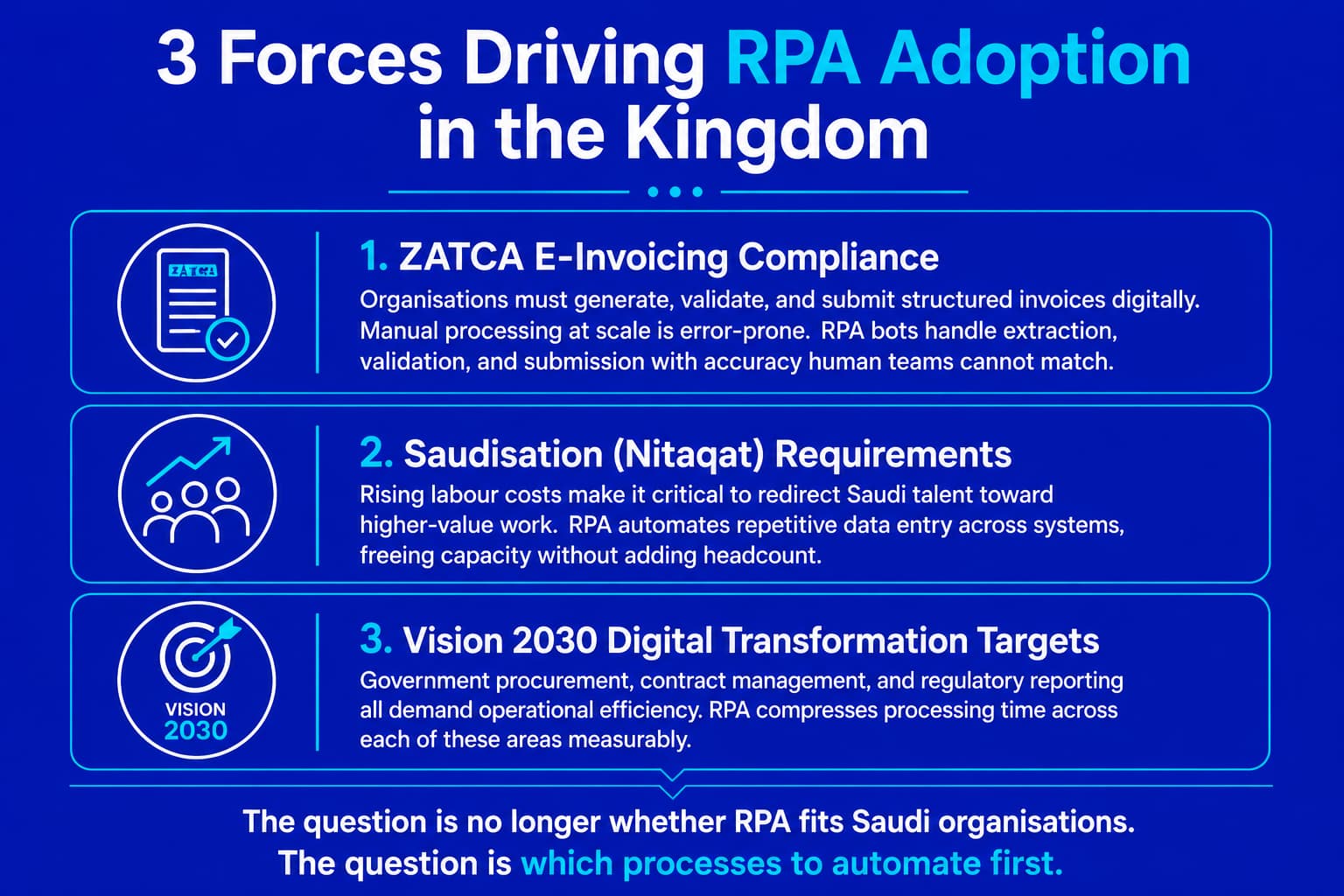
Three forces are accelerating RPA adoption in the Kingdom specifically:
ZATCA e-invoicing compliance requires organisations to generate, validate, and submit structured invoices through integrated digital channels, in line with ZATCA’s Phase 2 e-invoicing mandate. Doing this manually at scale is both error-prone and resource-heavy. RPA bots handle the repetitive data extraction, validation, and submission steps with accuracy that manual teams cannot consistently match.
Saudisation (Nitaqat) requirements raise the cost of labour and make it strategically important to redirect Saudi talent toward higher-value work. When a finance team spends hours entering transaction data across systems, that is not high-value work. Automating it with RPA frees that capacity without adding headcount.
Vision 2030 digital transformation targets push both public and private sector entities to modernise operations. Government procurement, contract management, and regulatory reporting are all areas where RPA delivers measurable time compression.
The question is no longer whether RPA fits Saudi organisations. The question is which processes to automate first, and how to calculate the return before committing to a platform.
The Four Numbers Every IT Manager Needs Before Any RPA Decision

A credible RPA business case comes down to four inputs. These apply whether you are running a pilot on one process or scoping an enterprise-wide rollout.
1. Fully Loaded Labour Cost Per Hour
This is not the basic salary. It includes benefits, social insurance contributions, training overhead, and any outsourcing costs associated with the task. For Saudi enterprises, GOSI contributions, housing allowances, and Saudisation premium all factor in. A finance analyst in Riyadh handling invoice reconciliation manually typically carries a fully loaded cost that is significantly higher than the raw salary figure.
2. Annual Hours Consumed by the Target Process
Map the process first. Identify how many employees touch it, how many steps are involved, and how many hours per week it consumes in aggregate. A realistic assessment includes error correction time, which manual processes always generate. Multiply the weekly hours by 52 to get the annual baseline.
3. Error Rate and Its Downstream Cost
Manual data entry in finance, HR, and procurement consistently carries error rates between 1% and 5%. Each error has a downstream cost: rework time, audit exposure, delayed approvals, or failed system reconciliations. RPA bots operating on structured, rule-based processes regularly achieve accuracy above 99.9%. Quantify what your current error rate costs annually.
4. Total Cost of Ownership for the RPA Platform
This includes licensing, implementation, integration work, and annual maintenance. This is where platform choice directly shapes your ROI calculation. Enterprise RPA vendors like UiPath or Automation Anywhere carry licensing costs that often start at $9,000 to $15,000 per year per bot and scale up sharply for enterprise deployments. For organisations already operating on Zoho, Zoho RPA, included as part of Zoho One, significantly compresses this cost line.
The ROI Formula
ROI (%) = [(Annual Labour Savings + Annual Error Reduction Value) – Total Platform Cost] / Total Platform Cost x 100
Industry benchmarks from Automation Anywhere and Forrester put typical enterprise RPA ROI between 100% and 250% in the first 12 to 18 months, with top-performing implementations reaching 380%. Payback periods typically fall between six and nine months when organisations automate the right processes with the right platform cost structure.
Which Processes Are Actually Automation-Ready in Saudi Organisations
Not every process qualifies. RPA delivers reliable returns on processes that are high-volume, rule-based, and involve structured data moving between systems. Processes that require human judgment, frequent exception handling, or unstructured inputs are not good first targets.
In the Saudi B2B context, the highest-value automation candidates consistently appear in:
Finance and Accounts Payable: Invoice extraction from email, ZATCA phase 2 submission workflows, account reconciliation across ERP and banking systems, and payment status updates. A finance team handling 500 invoices per month manually can automate that workflow with RPA and redeploy 60% to 80% of the associated labour time within the first quarter of deployment.
HR and Onboarding: New employee data entry across HR systems, government portal registrations, GOSI submission updates, and WPS (Wage Protection System) compliance reporting. Each of these involves structured data that moves predictably between defined systems.
Sales Operations and CRM Maintenance: Syncing contact data between email, CRM, and ERP systems, generating and distributing quotations, and updating opportunity stages from email responses. Sales teams that rely on manual CRM hygiene consistently lose data quality over time. RPA maintains it automatically.
IT Operations: Routine monitoring alerts, incident ticket creation, user provisioning, and software audit reporting. These are among the fastest processes to automate and often deliver ROI within the first 90 days.
One important caveat: if your organisation runs heavily customised legacy ERP systems such as older SAP or Oracle configurations with non-standard interfaces, integration complexity increases materially. In those environments, the implementation cost line in your ROI calculation needs to account for additional technical scoping before you can accurately project a return timeline.
Where Zoho One Fits: RPA Without the Enterprise Price Tag
For mid-sized Saudi organisations that are already using Zoho’s ecosystem or currently evaluating it, the RPA question has a straightforward answer. Zoho One, which Alnafitha IT implements and supports across the Kingdom, bundles Zoho RPA within its suite of 45+ integrated business applications.
This matters for three reasons specific to the ROI calculation:
The platform cost line drops significantly. Rather than purchasing a standalone RPA licence on top of your existing software stack, Zoho RPA is available as part of a subscription that already includes CRM, finance, HR, and operations tools. The ROI denominator, your Total Cost of Ownership, is materially lower than with dedicated enterprise RPA platforms.
Integration complexity is minimal within the Zoho ecosystem. When your CRM is Zoho CRM, your finance system is Zoho Books, and your HR platform is Zoho People, RPA bots connect these applications without custom API development. The bots work through user interfaces across web, desktop, and cloud applications, which means they also connect to non-Zoho systems when needed, including legacy applications that lack modern APIs.
ZATCA compliance workflows are native. Alnafitha IT’s Zoho Finance Plus implementation already addresses VAT and e-invoicing requirements. Layering RPA on top of that foundation means ZATCA submission workflows can be automated quickly, with the compliance logic already embedded in the underlying platform.
Zoho RPA’s recorder-based approach lets Operations teams and IT Managers build initial bots without deep development expertise. A process analyst can record the steps, review the generated workflow, and deploy a working bot in days rather than months. You can explore Zoho RPA’s full feature set to assess which of your workflows qualify before committing to implementation.
A Practical Three-Step Approach to Your RPA Business Case
Before presenting an RPA investment to leadership, structure the business case around three concrete outputs:
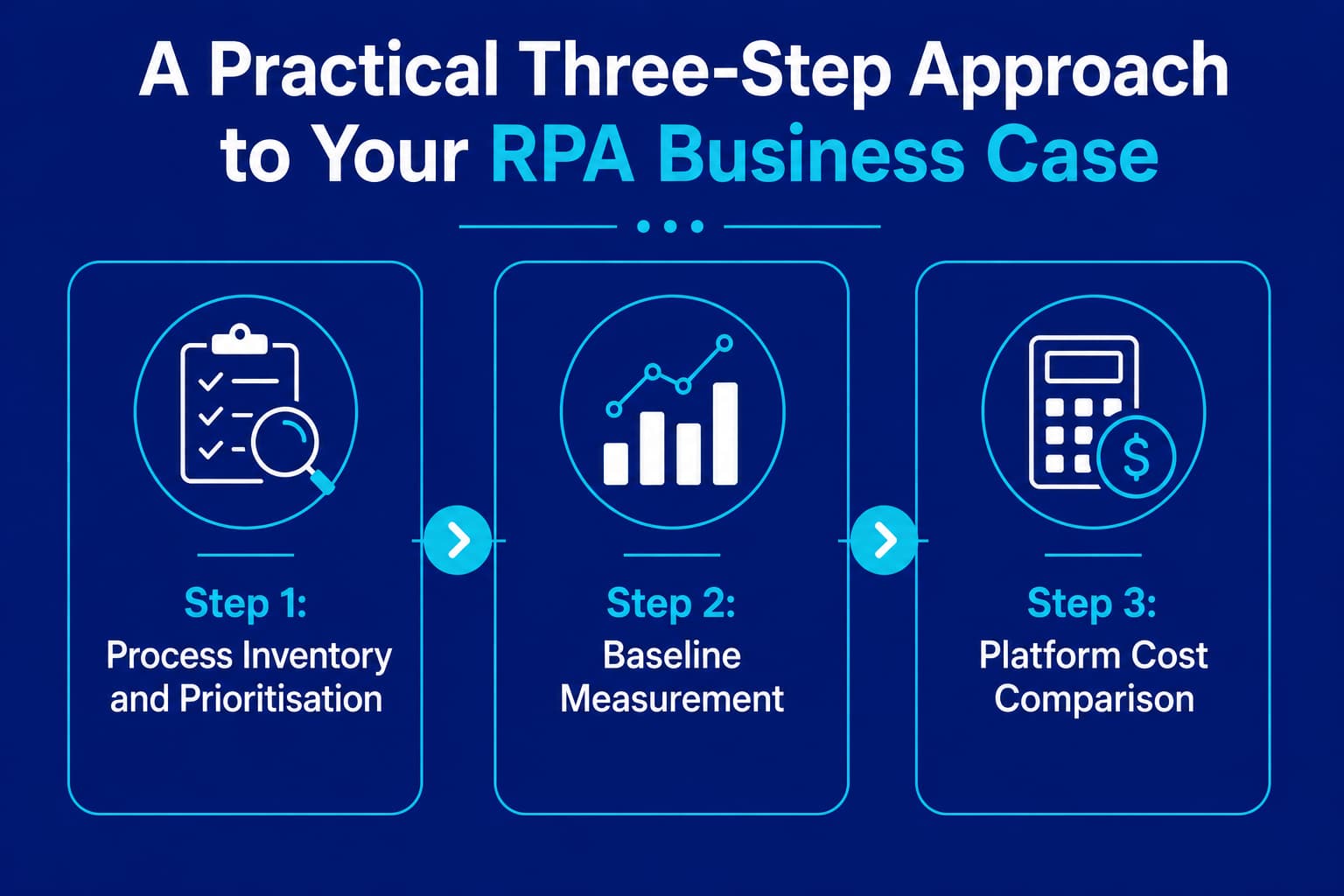
Step 1: Process Inventory and Prioritisation List every repetitive, rule-based process your team owns. Score each one on volume (how many times per month), time consumed per instance, error frequency, and cross-system dependency. Processes that score high on all four dimensions are your tier-one automation candidates.
Step 2: Baseline Measurement For your top three processes, measure the actual time and error cost over four weeks. This gives you real numbers, not estimates. The difference between estimated and measured baselines is often significant, and measured baselines produce far more defensible ROI projections.
Step 3: Platform Cost Comparison Run the ROI formula with at least two platform cost scenarios: a standalone enterprise RPA licence and a Zoho One bundle that includes RPA. For organisations already evaluating or using Zoho applications, the difference in the total cost of ownership calculation is often decisive.
Conclusion
Saudi organisations are operating in a market where labour costs are rising, regulatory compliance requirements are expanding, and digital transformation is no longer optional. RPA addresses all three pressures simultaneously, but only when the business case is built on real process data and accurate platform cost assumptions.
The ROI calculation is not complicated. What it requires is honest measurement of the baseline, a realistic assessment of which processes qualify, and a platform choice that does not inflate the cost side of the equation.
For organisations running on Zoho or evaluating it as their business operating system, Zoho One with Zoho RPA, delivered by Alnafitha IT, offers a path to process automation with a cost structure that makes the ROI arithmetic work faster and more reliably than standalone enterprise alternatives.
If you are ready to scope your first RPA business case or assess which of your current processes qualify for automation, speak with Alnafitha IT’s team. We help Saudi organisations build the business case before they commit to the platform.
Frequently Asked Questions
What does RPA stand for and what does it do? RPA stands for Robotic Process Automation. It refers to software bots that replicate human actions within digital systems, opening applications, entering data, moving information between platforms, and executing workflows, without requiring any changes to existing software infrastructure. RPA is designed for high-volume, rule-based tasks that follow a consistent, predictable sequence.
Which industries in Saudi Arabia are adopting RPA the fastest? Finance and banking lead RPA adoption in Saudi Arabia, followed by government services, healthcare, and telecommunications. These sectors share a common profile: large transaction volumes, strict regulatory reporting requirements, and significant legacy system infrastructure that benefits from automation without requiring full replacement.
How long does it take to see ROI from an RPA implementation? Industry data consistently puts the payback period for well-scoped RPA implementations at six to nine months. Organisations that automate high-volume, clearly defined processes with a cost-effective platform structure often see positive ROI before the end of the first year. Implementations with complex legacy integrations or poorly defined processes take longer.
Can RPA work with ZATCA e-invoicing requirements in Saudi Arabia? Yes. ZATCA phase 2 e-invoicing compliance involves structured, rule-based data extraction, validation, and submission workflows. This is exactly the type of process RPA handles reliably. Organisations running Zoho Finance Plus with Zoho RPA can automate the extraction and submission steps, reducing manual effort and the risk of compliance errors.