
Brief takeawayThe SAMA Cyber Security Framework is the mandatory standard every Saudi bank is measured against. It sets four control domains, 32 subdomains, and a six-level maturity model where Level 3 is the floor, not the goal. The work that decides your audit outcome sits in three technical areas: endpoint, identity, and cloud. This guide shows how to sequence those areas, where the framework overlaps with NCA ECC-2:2024 and the PDPL so you build a control once and reuse the evidence, and how to reach a defensible maturity level without running four separate compliance projects. |
Every bank, insurer, finance company, and payment provider licensed by the Saudi Central Bank operates under one non-negotiable standard: the SAMA Cyber Security Framework. Issued in 2017 and enforced through supervisory examinations ever since, it defines how financial institutions in the Kingdom identify, manage, and prove control over cyber risk.
The situation has changed sharply since the framework first landed. Saudi banks now sit at the intersection of several regulatory regimes at once. The SAMA cybersecurity framework governs financial-sector security. NCA ECC-2:2024 sets the national baseline. The Personal Data Protection Law, in full force since September 2024, governs customer data. Cloud adoption pulls in the NCA Cloud Cybersecurity Controls on top. The question most CISOs bring to the table is no longer whether to comply. It is how to sequence the work so that endpoint, identity, and cloud controls satisfy the SAMA cybersecurity framework and the frameworks stacked beside it, without the cost and contradiction of running each as a separate project.
This article answers that question the way an IT leadership team needs it answered: the structure of the framework, what Level 3 actually demands, the technical sequence that de-risks an audit, and how to turn overlapping mandates into shared evidence.
What the SAMA Cyber Security Framework Requires
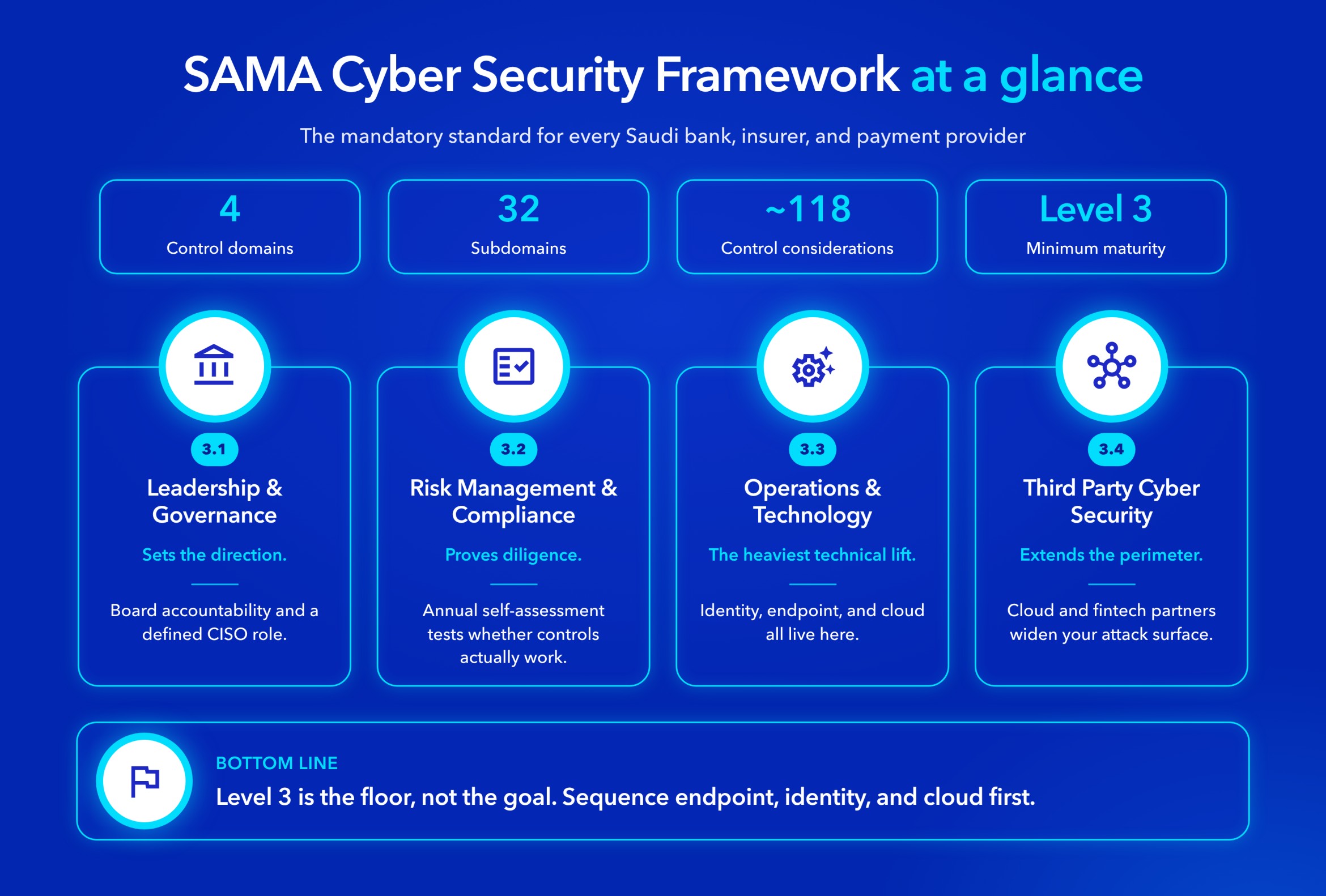
The SAMA Cyber Security Framework is a mandatory, principle-based standard built on four control domains, 32 subdomains, and roughly 118 control considerations, all assessed against a six-level maturity model. That is the short answer. The detail below is what turns it into a plan.
SAMA drew the framework from established international standards, including NIST, ISO 27001, PCI DSS, and Basel, then shaped it to the Saudi financial sector. It applies to every regulated entity with no size exemptions and no grace period for newer licensees. Ownership stays with SAMA; adoption and evidence stay with you. The official text sits in the SAMA Rulebook, and every serious readiness effort should start from that source rather than a summary.
The Four Control Domains of the SAMA Cyber Security Framework
Each domain maps to a section of the framework and to a different part of your organization. Governance sets the direction, risk management proves diligence, operations does the technical heavy lifting, and third-party control extends the perimeter to your vendors.
| Domain (CSF section) | What it governs | Where banks feel it most |
|---|---|---|
| Cyber Security Leadership and Governance (3.1) | Board accountability, a cyber security committee, a defined CISO role, and a strategy tied to the institution’s risk appetite. | Governance gaps stall everything downstream. SAMA looks for approved documentation, not informal awareness. |
| Cyber Security Risk Management and Compliance (3.2) | Risk classification, treatment plans, compliance monitoring, penetration testing, and independent audit. | Annual self-assessment and evidence chains. Reviews test whether controls actually work. |
| Cyber Security Operations and Technology (3.3) | Identity and access, network security, endpoint protection, secure configuration, vulnerability management, and monitoring. | The heaviest technical lift: identity, endpoint, and cloud controls all live here. |
| Third Party Cyber Security (3.4) | Supplier due diligence, security clauses in contracts, and ongoing assurance over vendor access. | Cloud providers and fintech partners expand the attack surface SAMA holds you accountable for. |
SAMA Cyber Security Framework Maturity Model: Why Level 3 Is the Floor
Compliance is scored, not passed or failed. Every control is rated against a six-level maturity model, and SAMA requires Member Organizations to operate at Level 3 or higher across all domains. Levels are cumulative: you cannot claim Level 3 on a control without first satisfying Levels 1 and 2, and assessors look specifically for that evidence chain during reviews.
| Level | Name | What it means |
|---|---|---|
| 0 | Non-existent | No control in place. |
| 1 | Ad-hoc | The control exists informally, applied inconsistently. |
| 2 | Repeatable but informal | The control is practiced but not documented. |
| 3 | Structured and formalized | Defined, approved, documented, and demonstrably operating. The regulatory minimum. |
| 4 | Managed and measurable | Effectiveness is measured, tracked, and improved. |
| 5 | Adaptive | Continuous improvement, with metrics driving change as threats evolve. |
Level 3 means a control is defined, approved, documented, and demonstrably operating. Informal awareness does not count. For banks in particular, SAMA has signaled higher expectations in specific areas, with Level 4 sought in domains such as threat intelligence, access control, and incident response. That distinction matters when you plan budget: the technical areas SAMA scrutinizes hardest are exactly the ones a modern bank leans on most, which is identity, endpoint, and cloud.
Endpoint, Identity, and Cloud in the SAMA Cyber Security Framework: The Sequence That De-Risks an Audit
Most of the technical control considerations in the SAMA Cyber Security Framework live in one domain, Operations and Technology (3.3). Within it, three areas carry the weight of a banking audit. Sequencing them correctly is what separates a smooth self-assessment from a scramble for evidence.
Identity first, because governance depends on it
Identity is where the framework starts to bite. SAMA compliance mandates multi-factor authentication for privileged users and expects strong access control across sensitive systems. Access governance also underpins the board-level accountability the Governance domain demands, since you cannot demonstrate control over your environment if you cannot demonstrate who has access to what and why.
Getting identity right early pays off twice. It closes one of the most common audit failure points, and it produces the access logs and review records that later controls depend on. A practical walk-through of these requirements sits in our guide to SAMA-compliant access management for Saudi businesses, which maps MFA, privileged access, and access reviews to the specific expectations examiners raise.
Endpoint next, because it is where evidence is won or lost
Endpoint control is the layer that turns policy into provable practice. The framework expects secure configuration, vulnerability management, patching discipline, and monitoring across the estate, and Mobile Device Management is explicitly named as a required technology control. The benefit of doing this well is not only a hardened fleet. It is the continuous, audit-ready record that lets you answer the one question every SAMA review returns to: do the controls actually work?
This is also where most institutions fail on evidence rather than on controls. A device may be patched and configured correctly, yet if the institution cannot produce the record on demand, the maturity score drops. Automated, centralized management of endpoints and patches closes that gap and keeps you assessment-ready across the year instead of only in the weeks before an examination.
Cloud last, because it inherits the two before it
Cloud is where the frameworks converge. A Saudi bank running digital services on cloud infrastructure answers to the SAMA cybersecurity framework, NCA ECC, the Cloud Cybersecurity Controls, and the PDPL at the same time, over one architecture. Built well, a single, well-scoped program satisfies all of them together and a single penetration test can generate evidence across several. Built as separate workstreams, cloud becomes the source of duplicated effort and contradictory documentation.
The Third Party Cyber Security domain (3.4) reaches directly into cloud decisions. Supplier due diligence, security clauses in contracts, and ongoing assurance over vendor access are all in scope, because SAMA holds you accountable for the risk your cloud and fintech partners introduce.
The SAMA Cyber Security Framework Advantage: Turning Overlapping Mandates Into Shared Evidence
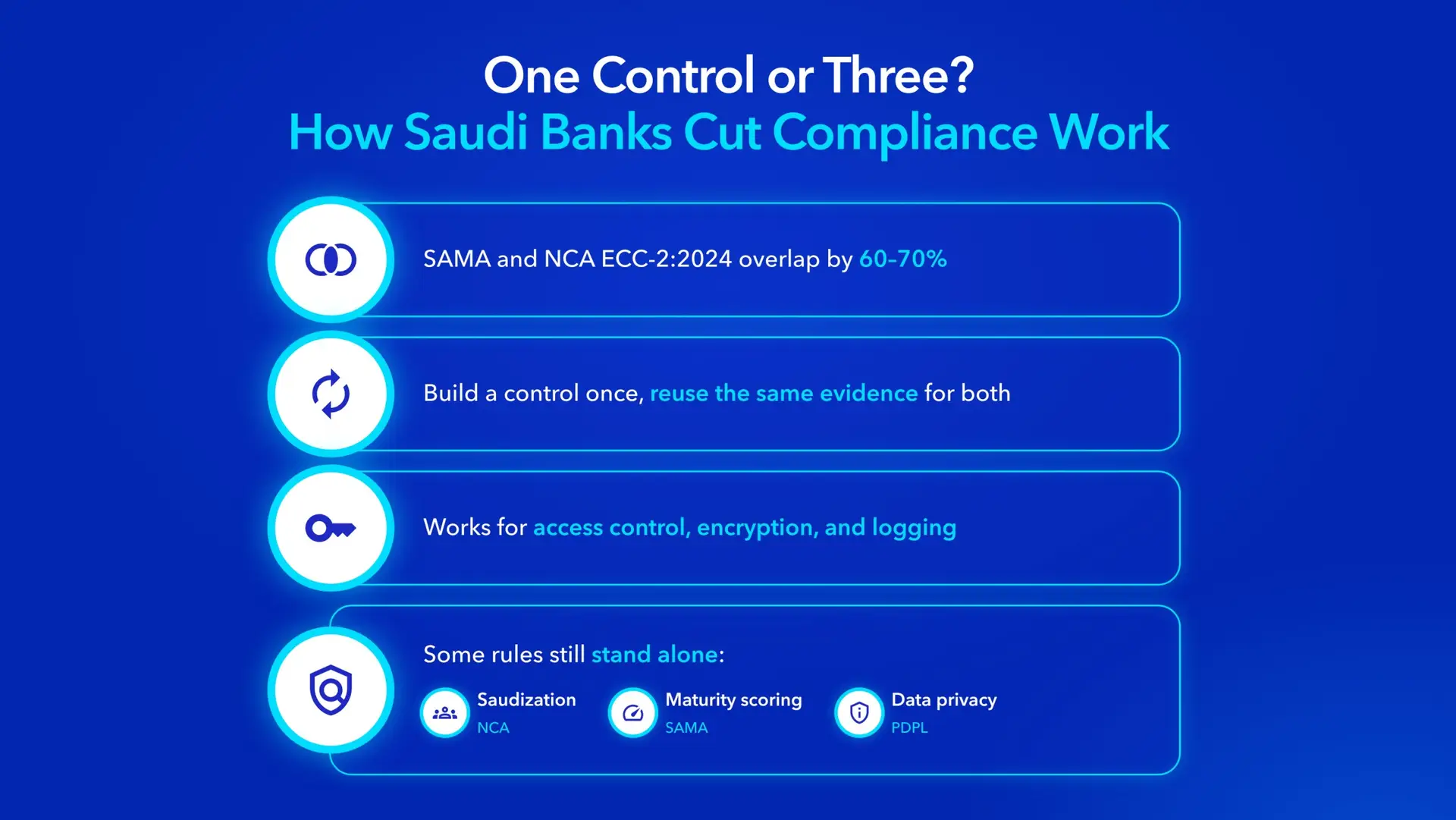
The biggest efficiency available to a Saudi bank is control reuse. The SAMA cybersecurity framework and NCA ECC-2:2024 share a large portion of their technical controls, with industry practitioners putting the overlap in the range of 60 to 70 percent. Build an access control, an encryption standard, or a logging capability once, and it can serve both frameworks with shared evidence.
The differences are where dual compliance demands real, separate work, and they are worth naming so nothing is missed:
- Saudization of cyber roles. NCA ECC-2:2024 requires cybersecurity roles to be filled by qualified Saudi nationals. The SAMA framework imposes no equivalent workforce mandate.
- The maturity model. SAMA’s six-level maturity scoring is specific to its framework; NCA and PDPL assess differently, so evidence has to be shaped for each.
- Data localization and privacy. The PDPL and NDMO rules add architectural requirements around personal data that the SAMA framework does not fully cover on its own.
The reference point for the national baseline is the National Cybersecurity Authority’s own Essential Cybersecurity Controls. Reading the SAMA framework and the ECC side by side is the fastest way to see where a single control satisfies both, and where you still have a genuine gap to close.
Where Alnafitha IT Fits in Your SAMA Cyber Security Framework Program
Meeting the SAMA Cyber Security Framework is less about buying more tools and more about sequencing controls, documenting them to a defined standard, and proving they work under examination. That is the work Alnafitha IT is built around. As a Saudi-based provider with deep roots in the local regulatory landscape, Alnafitha delivers the identity, endpoint, and cloud controls the framework demands and the assessment discipline that turns them into a defensible maturity score.
The approach runs the full path rather than a single slice of it: gap assessment against all four domains, remediation across access management, endpoint and patch control, and cloud security, and the evidence structure SAMA reviews expect. You can see the breadth of that work across Alnafitha’s cybersecurity solutions, and the examination side is covered in our guide to SAMA cybersecurity audits for Saudi businesses. The aim throughout is the same: a program that satisfies the SAMA cybersecurity framework and the frameworks around it from one architecture, with evidence you can produce on demand.
| Ready to move from checklist to a defensible Level 3?
Book a SAMA readiness assessment with Alnafitha IT. We map your current posture against all four domains, identify the endpoint, identity, and cloud gaps that matter most, and build the sequenced roadmap your board and your SAMA submission both need. Start the conversation at. |
Conclusion
The SAMA Cyber Security Framework rewards institutions that treat it as an operating discipline rather than an annual paperwork exercise. Four domains, a Level 3 floor, and a hard focus on evidence set the rules. Endpoint, identity, and cloud decide the outcome. And the overlap with NCA ECC-2:2024 and the PDPL means the smart move is to build each control once and reuse it everywhere it fits. Sequence the work in that order, document it to a defined standard, and a SAMA examination stops being a scramble and becomes a demonstration of a program that already works.
Frequently Asked Questions
What is the SAMA Cyber Security Framework?
It is the mandatory cybersecurity standard issued by the Saudi Central Bank in 2017 for all regulated financial institutions in the Kingdom. It defines four control domains, 32 subdomains, and roughly 118 control considerations, assessed against a six-level maturity model that all Member Organizations must meet at Level 3 or higher.
Who must comply with the SAMA cybersecurity framework?
Every entity supervised by the Saudi Central Bank: banks, insurance and reinsurance companies, finance companies, credit bureaus, payment service providers, fintechs, and financial market infrastructure. There are no size exemptions and no grace periods for new licensees.
What maturity level does SAMA require?
Level 3 (Structured and Formalized) is the minimum across all domains. Levels are cumulative, so you must satisfy Levels 1 and 2 first. For banks, SAMA signals higher expectations, often Level 4, in areas such as threat intelligence, access control, and incident response.
How often must a bank self-assess against the framework?
SAMA requires a periodic self-assessment, performed annually against a questionnaire and submitted through SAMA’s regulatory channel. SAMA reviews and audits the results, and may conduct supervisory examinations, so evidence must be maintained year-round rather than assembled just before an audit.
How does the SAMA framework relate to NCA ECC and the PDPL?
They are separate, mandatory obligations that often apply at once. The SAMA cybersecurity framework and NCA ECC-2:2024 share an estimated 60 to 70 percent of their technical controls, so much of the evidence can be reused. The PDPL adds privacy and data-handling requirements on top. A single integrated program is far more efficient than treating each as its own project.
Can Alnafitha IT help a Saudi bank reach SAMA compliance?
Yes. Alnafitha IT delivers the identity, endpoint, and cloud controls the framework requires, along with gap assessment against all four domains and the evidence structure SAMA examinations expect. You can start with a readiness assessment through alnafitha.com/contact-sales.