

Brief Takeaway: Choosing managed SOC services is a two-part decision, and most Saudi organizations only complete half of it. They compare vendor proposals, usually on price, and skip the readiness work that determines whether any provider can actually protect them. This guide covers both halves: four criteria for evaluating managed SOC services, the questions that expose weak providers, and the environment preparation that turns a monitoring contract into real security.
Every CISO in Saudi Arabia has sat through the same pitch: 24/7 monitoring, a wall of certifications, and a price that undercuts the last proposal. Six months later, a real alert fires at 2 AM on a Friday, and the response arrives as an email ticket the next morning.
When that happens, one of two things went wrong. Either the buyer chose a weak provider, or the buyer handed a capable provider an environment it could not see into. Both failures are preventable, and both start with treating managed SOC services as a purchase instead of a program.
Why Choosing Managed SOC Services on Price Alone Fails
Price comparison works when the product is identical across vendors. Managed SOC services are the opposite. One provider ingests logs from your endpoints, identity systems, cloud, and firewalls, then correlates them with threat intelligence. Another collects firewall logs only and forwards alerts without triage. On paper, both are a SOC. In an incident, only one of them is.
The cost gap between providers is usually a coverage gap in disguise. Before comparing numbers, define what you are buying. That starts with four evaluation criteria.
Part One: Four Criteria for Evaluating Managed SOC Services
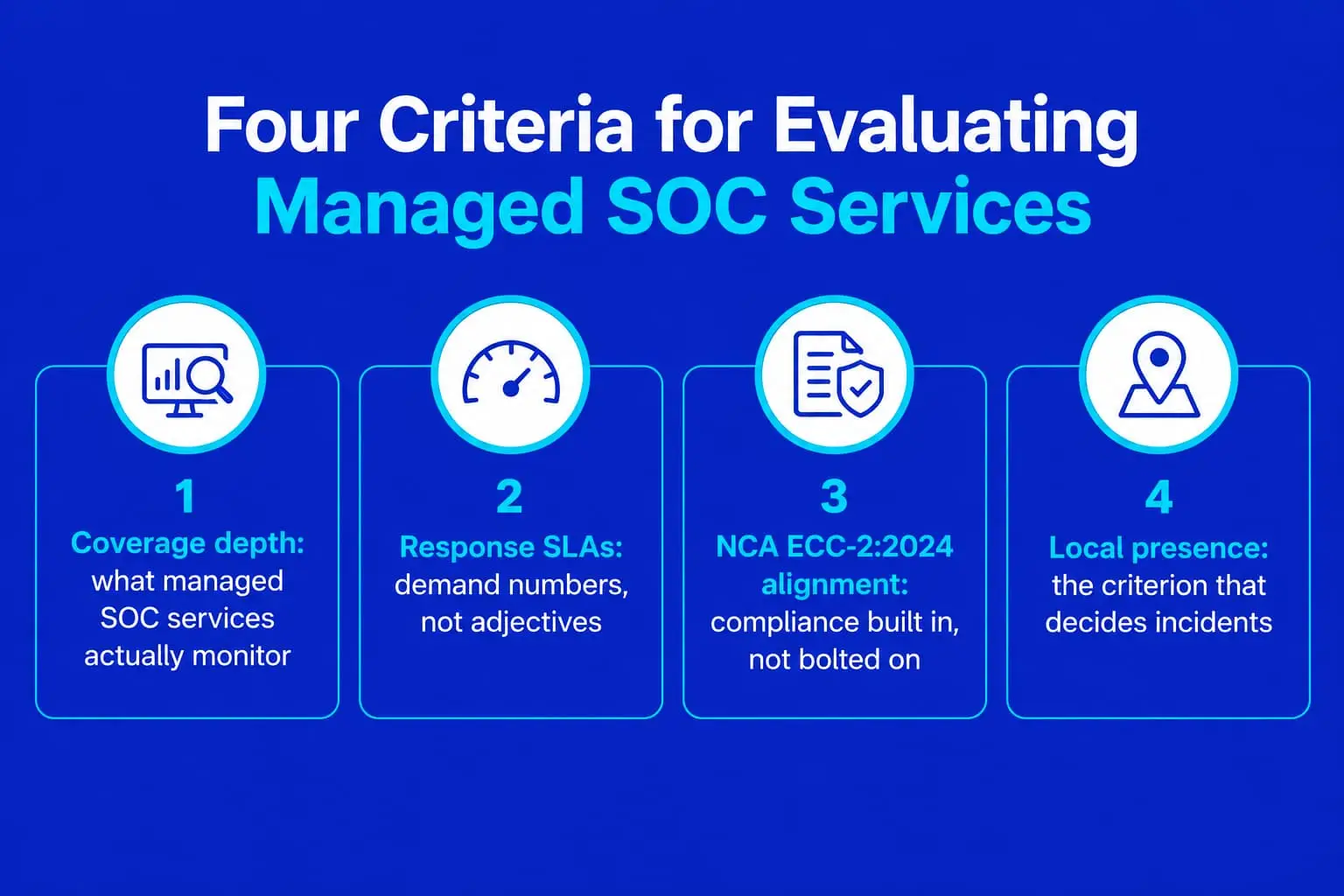
1. Coverage depth: what managed SOC services actually monitor
Start by asking for the log source list. A credible provider of managed SOC services should monitor endpoints, servers, network devices, identity and access systems, email, and cloud platforms as standard scope. If cloud workloads or identity logs cost extra, your visibility has holes exactly where modern attacks begin.
Ask how detection works, not just what gets collected. A SIEM platform that correlates events across sources, applies behavioral analytics, and enriches alerts with threat intelligence produces far fewer false positives than raw log forwarding. Then ask who reviews the output. Tiered analyst coverage, with L1 triage escalating to L2 and L3 investigation, is the difference between a monitoring service and a security operation.
2. Response SLAs: demand numbers, not adjectives
“Rapid response” is a marketing phrase. An SLA is a contract. Reliable managed SOC services define response in measurable terms: mean time to detect, time to first analyst action per severity level, and time to containment for confirmed incidents.
Push for severity-based tiers: a critical incident affecting a domain controller should trigger analyst engagement within minutes, not hours. Then ask two questions most buyers skip. First, what happens when the SLA is breached? A provider with no financial accountability has no real SLA. Second, ask for historical SLA performance reports. A provider that cannot show its own numbers is asking you to buy a promise.
3. NCA ECC-2:2024 alignment: compliance built in, not bolted on
For organizations in scope of the National Cybersecurity Authority’s Essential Cybersecurity Controls (ECC-2:2024), the SOC decision is also a compliance decision. The framework organizes requirements across four domains: cybersecurity governance, defense, resilience, and third-party and cloud computing cybersecurity. Continuous security event monitoring and structured incident response sit at the heart of the defense domain, which is precisely the work a managed SOC performs on your behalf.
There is a second layer many buyers miss. Your SOC provider is itself a third party under ECC-2:2024, so its own security posture, data handling, and contractual controls fall under the third-party domain. Ask where your log data lives, who can access it, and how the provider demonstrates its own compliance. The updated framework also carries Saudization requirements for cybersecurity roles, which directly affects offshore-heavy providers. A vendor that cannot map its service to specific ECC controls will leave that mapping work, and the audit risk, with you.
4. Local presence: the criterion that decides incidents
Global providers look impressive in proposals. Then a severe incident requires an analyst on site, a regulator notification in Arabic, or an escalation call during a Saudi public holiday, and the distance becomes operational risk.
Local presence means more than a sales office in Riyadh. It means security engineers physically in the Kingdom, familiarity with SAMA and PDPL obligations alongside NCA requirements, and escalation paths that operate on your calendar. It also means understanding the threat activity actually targeting Saudi sectors, from ransomware campaigns against critical infrastructure to phishing spikes during Ramadan. Providers without regional grounding tune their detections for someone else’s threat profile.
Seven Questions That Expose a Weak Provider
Put these in your RFP and score the answers:
- Which log sources are included in base scope, and which cost extra?
- What is your time to first analyst action for a critical severity incident?
- What financial remedies apply when an SLA is missed?
- Which specific ECC-2:2024 controls does your service address, control by control?
- Where is our log data stored, and who has access to it?
- How many of your security staff are based in Saudi Arabia?
- Can we speak to two current clients in our sector?
Vague answers to questions 3, 4, and 7 are disqualifying. Confident providers answer them in writing.
Part Two: Prepare Your Environment Before Any Managed SOC Services Provider Signs On
Here is the half of the decision most buyers skip. Managed SOC services inherit your environment. A provider cannot detect what your infrastructure does not log, cannot prioritize incidents against severity levels you never defined, and cannot produce ECC evidence from monitoring gaps.
Readiness means four things. First, log coverage: endpoints, identity systems, and cloud workloads must generate the telemetry a SOC needs, with a tuned SIEM foundation underneath. Second, defined severity tiers: you decide what counts as critical before a vendor decides it for you. Third, an ECC control map: know which ECC-2:2024 requirements the contract must cover so nothing falls between your team and theirs. Fourth, an integration inventory of the firewalls, endpoint protection, and identity platforms the provider must connect to on day one.
Organizations that complete this work sign better contracts and hold providers accountable from the first month. Organizations that skip it discover the gaps during their first incident, which is the most expensive audit there is.
Where Alnafitha IT Fits in Your Managed SOC Decision
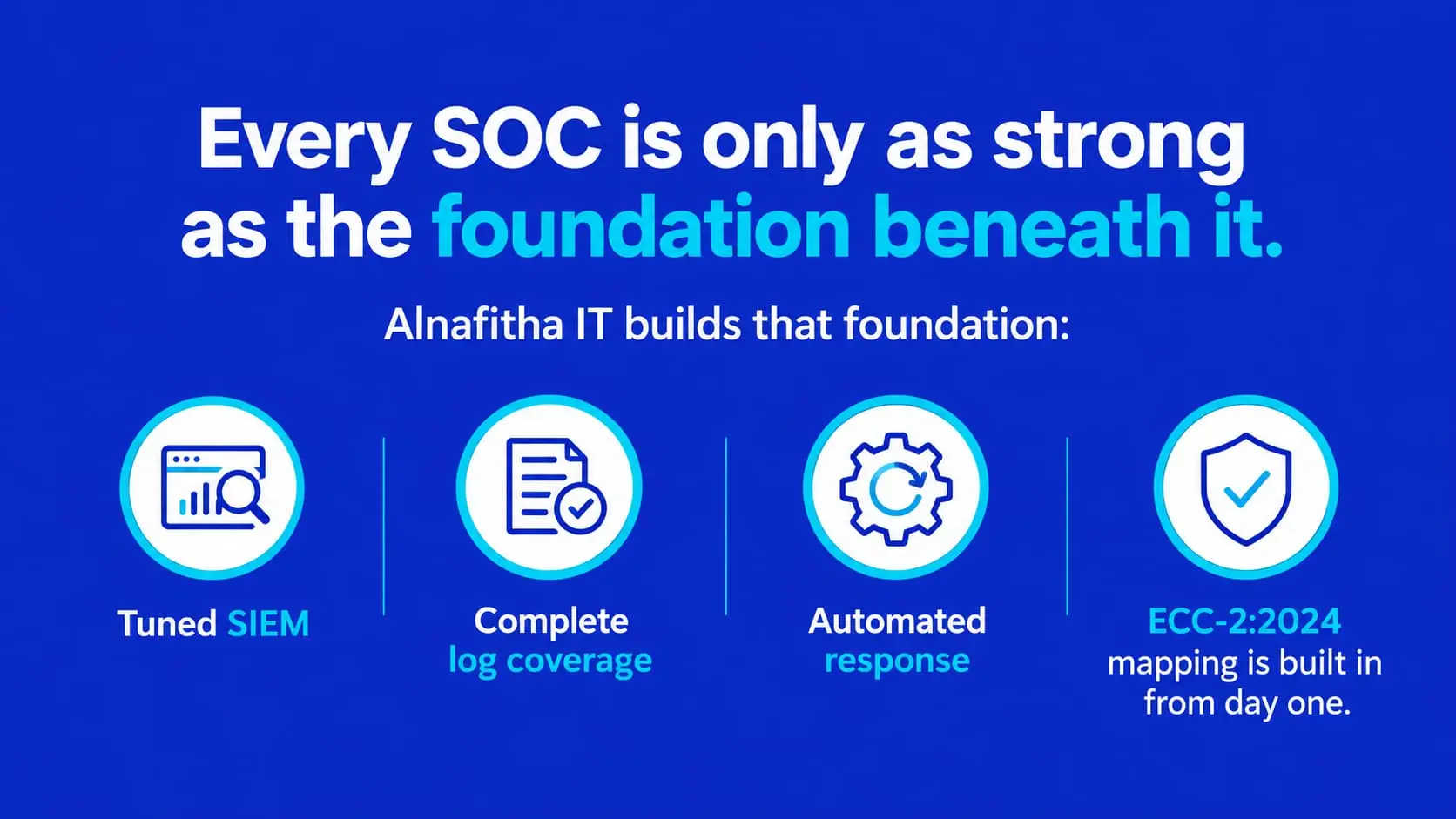
This readiness work is exactly what Alnafitha IT delivers. Operating in the Saudi market since 1993, our cybersecurity practice builds the detection foundation any SOC depends on: SIEM implementation and tuning, log management across endpoints, identity, and cloud, threat intelligence integration, and incident response automation. We also handle the compliance mapping that connects your monitoring setup to ECC-2:2024 evidence requirements, so whichever provider you select inherits an environment that is already audit-ready.
Because our engineers work inside the Kingdom, that groundwork comes with local context. SAMA, PDPL, and NCA obligations are part of the design, not an afterthought, and the severity definitions we build with you reflect how Saudi regulators expect incidents to be classified and reported.
If you are evaluating managed SOC services this year, do not start with vendor proposals. Start with an honest picture of your own environment. Book a security assessment with our team and we will map your visibility gaps, define the severity tiers and SLA requirements you should demand from any provider, and identify exactly which ECC controls your contract needs to cover.
Walk into vendor negotiations knowing more about your environment than they do. That is how you stop buying on price.
FAQs About Managed SOC Services in Saudi Arabia
What is the difference between a managed SOC and an in-house SOC? An in-house SOC gives you full control but requires building a 24/7 team, a detection stack, and ongoing tuning, which is a multi-year investment few Saudi organizations can staff. Managed SOC services deliver the same monitoring and response capability as a contracted service, with defined SLAs and faster time to operation. Many organizations run a co-managed model, keeping strategy internal while outsourcing around-the-clock monitoring.
How quickly should managed SOC services detect and respond to threats? There is no single benchmark, but the contract should define detection and response times per severity level. Critical incidents should reach a human analyst within minutes. What matters most is that the provider commits to numbers in writing, reports against them monthly, and accepts remedies when targets are missed.
Do managed SOC services help with NCA ECC-2:2024 compliance? Yes, when the provider maps its service to specific controls. Continuous monitoring, incident response, and event logging requirements in the defense domain align directly with SOC operations. The provider must also satisfy the third-party domain itself, covering data residency, access controls, and contractual security requirements.
What should we prepare before signing with a managed SOC provider? Four things: complete log coverage with a tuned SIEM foundation, severity definitions that reflect your business priorities, a map of the ECC-2:2024 controls the contract must cover, and an inventory of the systems the provider needs to integrate with. A pre-contract security assessment covers all four and strengthens your negotiating position.