

SIEM Solution: Brief Takeaways
- NCA ECC 2.0 explicitly mandates a SIEM solution for cybersecurity event log collection, continuous monitoring, and a minimum 12-month log retention period.
- The right SIEM solution must map directly to ECC control domains, particularly Cybersecurity Event Logs and Monitoring Management (Control 2-12) and Cybersecurity Incident and Threat Management.
- SAMA CSF-regulated organizations face an additional layer of operational requirements that demand real-time event correlation and automated incident response workflows.
- ManageEngine Log360, delivered through Alnafitha IT, provides pre-built NCA ECC compliance templates, 2,000+ threat detection rules, and UEBA capabilities designed for enterprise SOC environments.
- Legacy SIEM platforms impose high licensing costs and significant tuning overhead; purpose-built alternatives reduce false positive noise and accelerate compliance readiness.
The Compliance Deadline Is Not a Target Date. It Is an Operating Condition.
Saudi enterprises operate under the National Cybersecurity Authority’s Essential Cybersecurity Controls. A SIEM solution is not a future investment. It is a present requirement. The framework is explicit: organizations must identify the required technologies for cybersecurity event log collection, maintain continuous monitoring of security events, and retain those logs for a minimum of 12 months. For CISOs and SOC Managers across government entities, critical national infrastructure operators, and financial institutions regulated under the SAMA Cybersecurity Framework, SIEM is not a checkbox. It is the operational spine of compliance.
The challenge, however, is not whether to deploy a SIEM solution. Most enterprise security teams in Saudi Arabia already know they need one. The real challenge is selecting the right SIEM solution, and understanding which criteria actually determine whether that solution will hold up under an NCA audit, a SAMA CSF assessment, or an active threat scenario. Getting this decision wrong is expensive. Getting it right is a strategic advantage.
What NCA ECC 2.0 Actually Requires From Your SIEM Solution
The NCA ECC 2.0 framework, updated in 2024, places specific technical demands on any SIEM solution deployed within scope organizations. Under the Cybersecurity Event Logs and Monitoring Management domain (Control 2-12), organizations must:
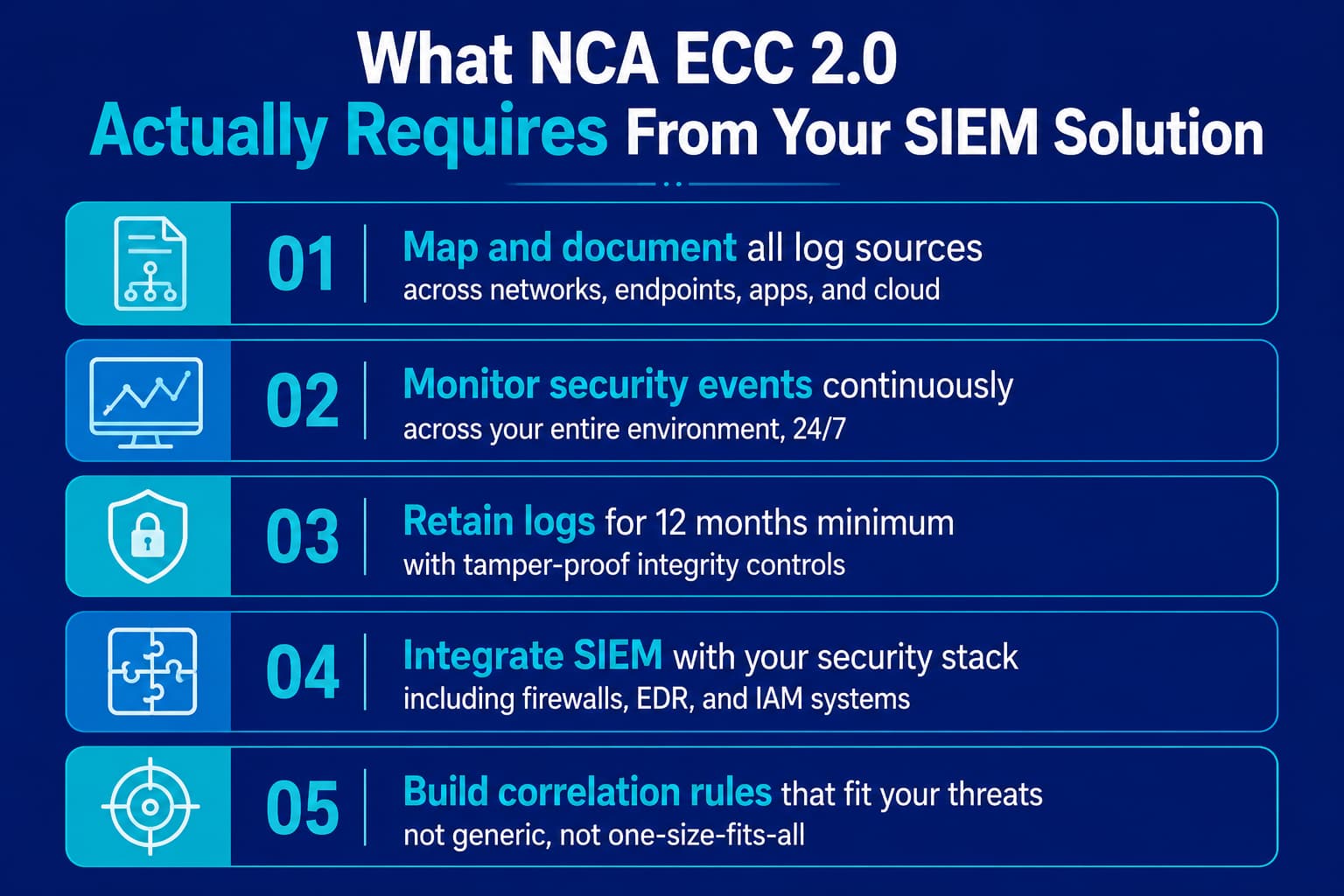
- Identify and document the required technologies, including a SIEM, for centralized log collection across all relevant sources
- Implement continuous monitoring of cybersecurity events across networks, endpoints, and applications
- Enforce a log retention policy of no less than 12 months with integrity controls that prevent tampering
- Integrate the SIEM with security tools such as firewalls, endpoint protection, and identity systems
- Define and implement correlation rules and use cases tailored to the organization’s threat profile
Beyond event logging, the Cybersecurity Incident and Threat Management domain requires the SIEM to support structured incident response, classification, and reporting to NCA. Forensic readiness is a stated requirement, meaning the SIEM must maintain an immutable audit trail capable of supporting root cause analysis after a security event.
For organizations operating under SAMA CSF, the requirements extend further into operational process controls: continuous monitoring must be complemented by documented escalation procedures and evidence of regular testing.
A SIEM solution that cannot produce audit-ready compliance reports mapped to these specific controls is not a compliant solution, regardless of its market reputation or Gartner placement.
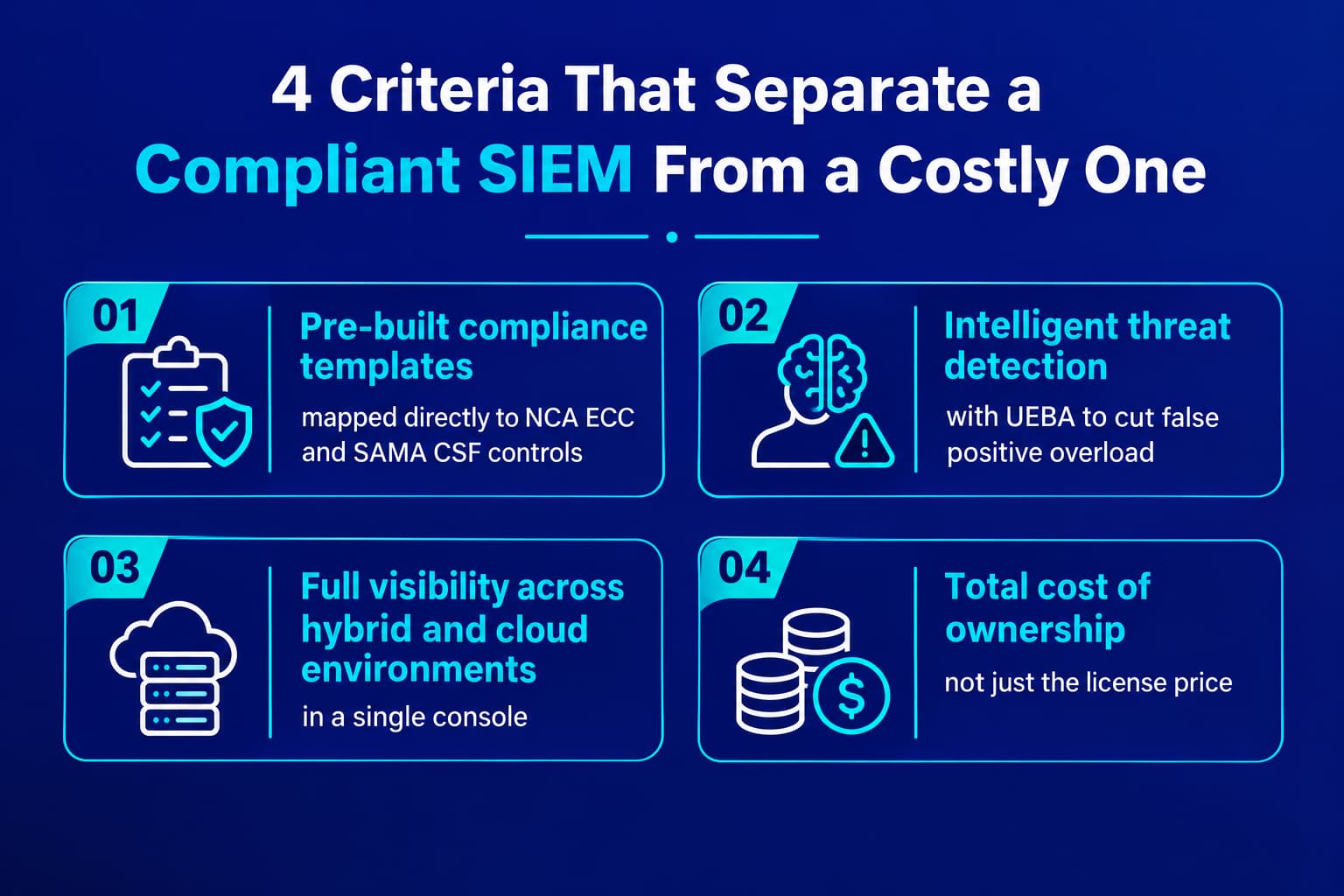
The Four Criteria That Separate Compliant SIEM Solutions From Costly Ones
1. Pre-Built Compliance Mapping to NCA ECC and SAMA CSF
The most significant time drain in any SIEM deployment is custom rule development. Enterprise SOC teams in Saudi Arabia cannot afford to spend months building detection logic and compliance reports from scratch. The right SIEM solution comes with pre-built compliance templates that map directly to NCA ECC controls and SAMA CSF requirements, ready to activate on day one.
ManageEngine Log360 includes over 30 pre-built audit templates for major compliance mandates. Its NCA compliance module maps capabilities directly to ECC control requirements, covering privileged access auditing, identity and access management controls (ECC-2-2), and forensic readiness through cryptographic hashing of audit trails. This is not generic compliance coverage. It is control-specific alignment that SOC Managers can demonstrate to auditors without manual mapping exercises.
2. Intelligent SIEM Solution Threat Detection That Reduces False Positive Overload
One of the most persistent operational failures in enterprise SIEM deployments is alert fatigue. When a SOC team receives thousands of alerts per day and cannot distinguish critical incidents from noise, the SIEM becomes a liability rather than an asset. The root cause is almost always a combination of poorly tuned correlation rules and the absence of behavioral analytics.
An effective SIEM solution for the Saudi market must include User and Entity Behavior Analytics (UEBA) alongside static rule-based detection. UEBA enables the platform to establish behavioral baselines and flag deviations, such as a user logging in from two geographically distant locations within a short timeframe, without relying solely on predefined signatures. This is particularly important for detecting insider threats and compromised credentials, both of which are priority threat vectors under NCA ECC’s Cybersecurity Incident and Threat Management domain.
Log360’s Vigil IQ module addresses this directly, providing over 2,000 MITRE ATT&CK-mapped detection rules alongside anomaly detection and threat intelligence correlation. The platform’s precision tuning capabilities are specifically designed to reduce false positives while maintaining complete threat coverage, a critical balance for SOC teams operating in high-volume enterprise environments.
3. Total Visibility Across Hybrid and Cloud Environments
Saudi enterprises are not running purely on-premises infrastructure. The adoption of Microsoft Azure, AWS, and hybrid Microsoft 365 environments is well advanced across banking, government, and energy sectors. A SIEM solution that monitors only on-premises log sources leaves critical visibility gaps, particularly around cloud access, privileged identity activity, and shadow IT behavior.
The selection criteria must include native integration with Active Directory, cloud platforms (Azure, AWS, GCP), Microsoft 365, Exchange, and network devices, without requiring custom connectors or professional services engagements for each integration. The SIEM should normalize and correlate log data from all these sources within a single console, so SOC analysts are working from one unified view rather than switching between platforms.
For NCA ECC compliance specifically, this unified visibility is what enables the continuous monitoring requirement to be met across the full scope of an organization’s information assets, not just the data center perimeter.
4. SIEM Solution Total Cost of Ownership, Not Just License Price
Legacy enterprise SIEM platforms, including some of the most widely known names in the market, carry a deceptive cost structure. The per-gigabyte or per-event-per-second pricing model means that as an organization’s environment grows, SIEM costs scale rapidly and unpredictably. Saudi organizations that began SIEM deployments five to seven years ago on legacy platforms are now facing renewal costs that are difficult to justify against the actual security outcomes delivered.
The evaluation of a SIEM solution must account for total cost of ownership over a three-to-five-year horizon, including deployment costs, professional services requirements, staff training, ongoing tuning, and the cost of false positive investigations. Purpose-built platforms with transparent pricing and lower operational overhead consistently outperform legacy SIEM deployments on this metric, particularly for mid-to-large enterprise environments where SOC team capacity is constrained.
Why Log360 Is the SIEM Solution Saudi Enterprises Are Choosing
ManageEngine has appeared in the Gartner Magic Quadrant for SIEM for eight consecutive years, most recently in 2025. This sustained recognition reflects not just product maturity but a pricing and deployment model that enterprise security teams in Saudi Arabia find operationally viable.
Log360 consolidates five core security capabilities into a single platform: Active Directory auditing (ADAudit Plus), event log management (EventLog Analyzer), Microsoft 365 monitoring (M365 Manager Plus), Exchange auditing (Exchange Reporter Plus), and cloud security monitoring (Cloud Security Plus). For a SOC Manager, this means one console, one data model, and one set of compliance reports across the entire environment.
The platform’s NCA compliance module directly addresses the privileged access requirements under ECC-2-2, monitoring all privileged user activities including MFA bypass attempts and unauthorized access to critical systems. Its immutable audit trail with cryptographic hashing satisfies the forensic readiness requirements that NCA auditors look for.
For organizations subject to SAMA CSF, Log360’s SOAR capabilities and integrated incident workflows provide the documented escalation and response process evidence that regulators require.
Alnafitha IT, as an authorized ManageEngine partner in Saudi Arabia, delivers Log360 with full implementation, integration, and ongoing support services. This means organizations are not acquiring a platform and then navigating deployment independently. The SIEM solution delivery at Alnafitha includes scoping, architecture design, rule configuration, compliance mapping, and SOC team enablement, all delivered by a team with deep familiarity with the Saudi regulatory environment.
For CISOs working within organizations that also have cybersecurity risk and compliance program requirements, Alnafitha’s cybersecurity risk and compliance services complement the SIEM deployment with a broader governance and audit readiness framework.
The SIEM Selection Conversation You Should Be Having With Your Vendor
Before committing to any SIEM solution, enterprise security leaders in Saudi Arabia should require answers to the following from any vendor or partner:
- Can you show us a control-by-control mapping of your SIEM to NCA ECC 2.0, specifically for Controls 2-12 and the Incident Management domain?
- How does your platform handle log retention integrity, and can it produce forensic-grade evidence for an NCA audit?
- What is the out-of-the-box coverage for UEBA and anomaly detection, and how are false positives managed at scale?
- What is the total cost of ownership for our environment size over five years, and how does pricing scale with data volume?
- What is the deployment and onboarding timeline from signature to go-live?
A SIEM vendor or partner that cannot answer these questions with specifics is not ready for the Saudi enterprise market. The regulatory environment here is not flexible on timelines, and the consequences of non-compliance under NCA ECC are not hypothetical.
Conclusion
Choosing a SIEM solution in the Saudi Arabian market is no longer a generalist decision. NCA ECC 2.0 and SAMA CSF have defined specific technical requirements that narrow the field considerably. The right SIEM solution must deliver pre-built compliance mapping, intelligent behavioral detection, full hybrid environment visibility, and a predictable total cost of ownership. Organizations that evaluate candidates against these criteria, rather than vendor reputation alone, make better decisions and reach compliance readiness faster.
Alnafitha IT has the technical expertise, regulatory knowledge, and vendor partnerships to help your organization select, deploy, and operationalize the right SIEM solution for your environment and compliance obligations.
Ready to evaluate your SIEM options against NCA ECC 2.0 requirements? Contact the Alnafitha IT team to start a compliance-focused SIEM assessment today.
Frequently Asked Questions
What is a SIEM solution and why does NCA ECC require it?
A SIEM solution (Security Information and Event Management) is a platform that collects, correlates, and analyzes log data from across an organization’s IT environment to detect security incidents in real time. NCA ECC 2.0 explicitly mandates the use of a SIEM for cybersecurity event log collection and continuous monitoring. It is listed as a required technology within the Cybersecurity Event Logs and Monitoring Management control domain.
Which SIEM solution is best for Saudi organizations under NCA ECC 2.0?
The best SIEM solution for NCA ECC compliance is one that provides pre-built control mappings to the ECC framework, supports a minimum 12-month log retention with integrity controls, includes UEBA for behavioral threat detection, and integrates with hybrid cloud and on-premises environments. ManageEngine Log360, delivered through authorized partners like Alnafitha IT, is purpose-built to meet these requirements.
How does a SIEM solution help with SAMA CSF compliance?
SAMA CSF requires financial institutions to implement continuous security monitoring, documented incident response workflows, and evidence of regular operational testing. A well-configured SIEM solution addresses all of these requirements by providing real-time event correlation, automated alerting, structured incident management, and audit-ready reporting that satisfies SAMA regulatory reviews.
What is the full name of SIEM? SIEM stands for Security Information and Event Management. It refers to a category of security platforms that combine security information management (log storage and analysis) with security event management (real-time monitoring and alerting) into a unified solution.
How does a SIEM solution work in a cybersecurity context?
A SIEM solution works by collecting log data from all sources across an organization’s environment, including servers, network devices, endpoints, cloud platforms, and applications. It normalizes this data into a common format, applies correlation rules and behavioral analytics to identify suspicious patterns, generates alerts for security incidents, and produces compliance and forensic reports. For enterprise SOC teams, the SIEM is the central platform from which all threat detection, investigation, and response activities are coordinated.
How much does a SIEM solution cost for a Saudi enterprise?
SIEM solution pricing varies significantly depending on data volume, number of log sources, deployment model (on-premises vs. cloud), and the level of professional services required. Legacy platforms with per-gigabyte pricing can become very expensive as environments scale. Purpose-built alternatives like ManageEngine Log360 offer more predictable pricing models with lower total cost of ownership. For an accurate assessment based on your environment, contact Alnafitha IT for a customized evaluation.
How do I choose the right SIEM solution for my organization?
The selection should be based on four criteria: direct compliance mapping to the frameworks that apply to your organization (NCA ECC, SAMA CSF), intelligent threat detection with UEBA to manage false positive volume, full visibility across your hybrid and cloud environment, and total cost of ownership over a multi-year horizon. Engaging an experienced implementation partner who understands the Saudi regulatory environment is also a key factor in making a selection that delivers compliance readiness, not just platform capability.