

Brief Takeaways: What Every Industrial Business in Saudi Arabia Needs to Know About OT Security
- OT security protects the industrial control systems that run Saudi Arabia’s refineries, power grids, water plants, and factories, and it follows different rules from traditional IT security because downtime and physical safety are on the line.
- The biggest risk in Saudi industrial environments today is the convergence of IT and OT networks, which gives attackers a path from a corporate email inbox straight to a production line.
- The NCA Operational Technology Cybersecurity Controls (OTCC-1:2022) are mandatory for critical national infrastructure operators, and non-compliance can carry penalties reaching 25 million riyals.
- A practical OT security program does not start by replacing legacy machinery. It starts with asset visibility, network segmentation, strict access control, and continuous monitoring of the IT layer that OT now depends on.
- Alnafitha IT delivers the network security, identity governance, vulnerability management, and SIEM capabilities that secure this IT-OT boundary, backed by deep familiarity with Saudi regulatory frameworks.
Why OT Security Has Become a Boardroom Priority in Saudi Arabia
Walk into any refinery in Jubail, any power station near Dammam, or any production facility in Riyadh’s industrial cities, and you are standing inside a network of machines that were never designed to face the internet. These are operational technology systems: the SCADA platforms, programmable logic controllers, and industrial sensors that physically run the Kingdom’s economy. For decades, they were isolated and safe. Vision 2030 changed that by connecting them to corporate networks and the cloud for efficiency, remote monitoring, and data-driven decisions. That same connection opened a door, and OT security is now the discipline that keeps it closed.
The pressure is not theoretical. Saudi Arabia records one of the highest average numbers of breached records per incident in the world, and the energy sector in particular draws well-funded, often state-backed attackers who study a single target for months. When the question Saudi decision-makers type into a search engine is “what is the difference between IT and OT security,” they are really asking a deeper one: how do we protect systems where an outage is measured not in lost emails, but in halted production and physical risk.
IT Security vs OT Security: The Difference That Defines Your Strategy
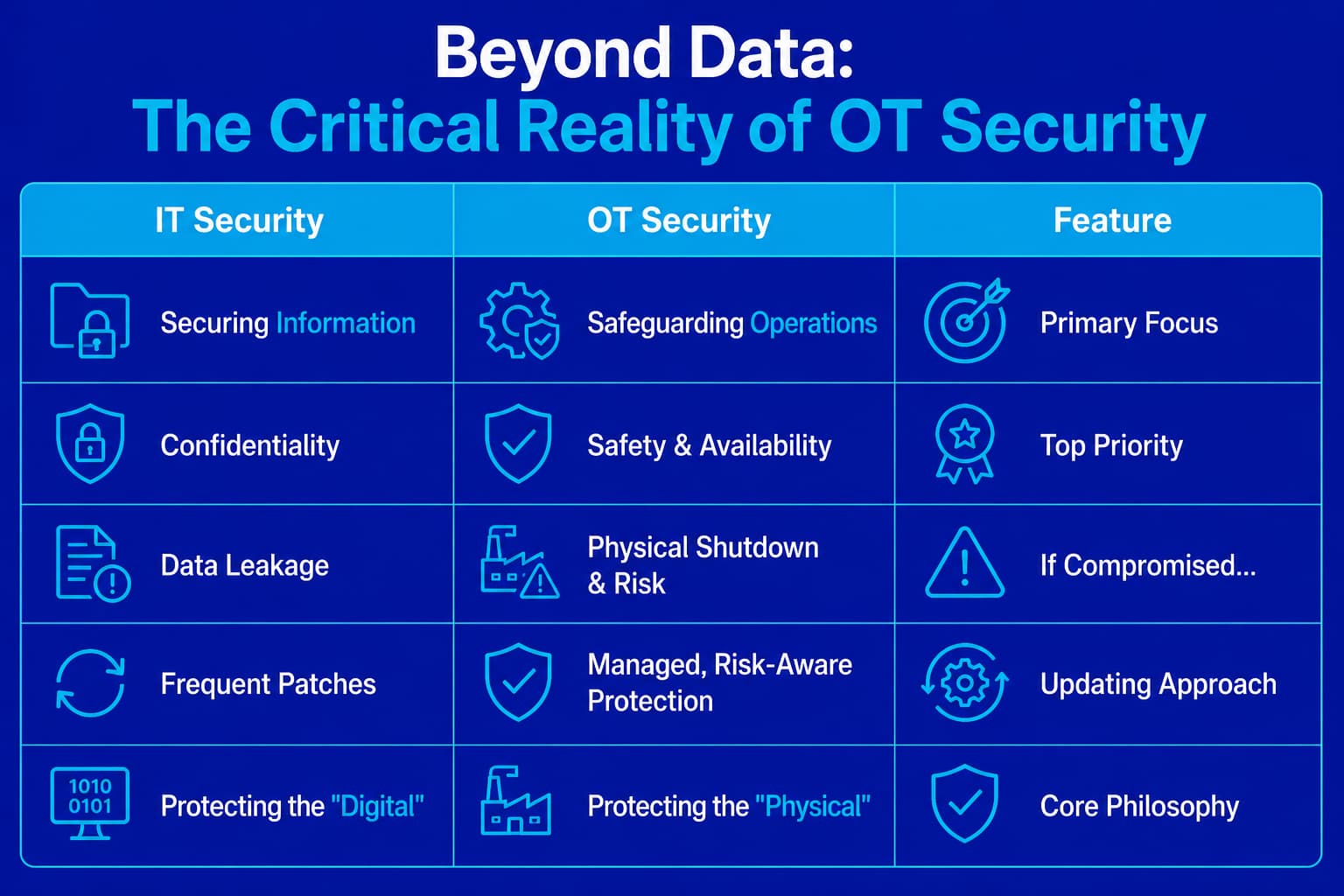
This is the most common question in the Saudi market, and the answer shapes every decision that follows. Traditional IT security protects data. If a server is compromised, information leaks, and that is serious, but the building keeps running. OT security protects processes. If a control system is compromised, a valve can open, a turbine can stop, or an entire facility can shut down.
That difference flips the usual priorities. In IT, confidentiality often comes first. In OT, availability and safety come first, because the system cannot simply be taken offline for a patch on a Tuesday afternoon. A refinery running equipment built twenty or thirty years ago cannot be updated the way a laptop is. This is why effective OT security does not begin with ripping out legacy machinery. It begins with protecting the environment around it.
The Real Threat: Where IT and OT Now Meet
The single largest vulnerability across Saudi industrial environments is IT-OT convergence. When previously isolated control systems get linked to corporate IT and cloud platforms, an attacker who phishes an employee in the finance department can move laterally toward the systems that operate pipelines and process controls. The corporate network becomes the entry point, and the industrial network becomes the target.
Three pain points make this harder to manage. First, legacy OT assets cannot be patched without costly downtime. Second, third-party vendors, contractors, and remote access stretch the attack surface far beyond the facility walls. Third, many operators lack a complete inventory of what is actually connected to their network, which means an intrusion can go unnoticed until production is already affected. Add the global shortage of specialists who understand both industrial systems and cybersecurity, and the gap becomes clear.
NCA OTCC-1:2022: The Compliance Mandate You Cannot Defer
Saudi Arabia did not leave this to chance. The National Cybersecurity Authority issued the Operational Technology Cybersecurity Controls (OTCC-1:2022) as an extension of the Essential Cybersecurity Controls (ECC-1:2018), specifically to raise the security baseline for industrial control systems. The controls are mandatory for government and private sector organizations that own, operate, or host critical national infrastructure across energy, water, transportation, and manufacturing.
The framework spans strategy, people, processes, and technology, with explicit requirements for network segmentation, identity and access management, secure remote access, asset inventory, and auditable monitoring. This is not a checklist exercise. The NCA has authority to issue fines for non-compliance, with penalties reaching up to 25 million riyals. For any industrial leader in the Kingdom, OTCC compliance has become an operating condition, not a future project.
Building Practical OT Security: Five Capabilities That Matter
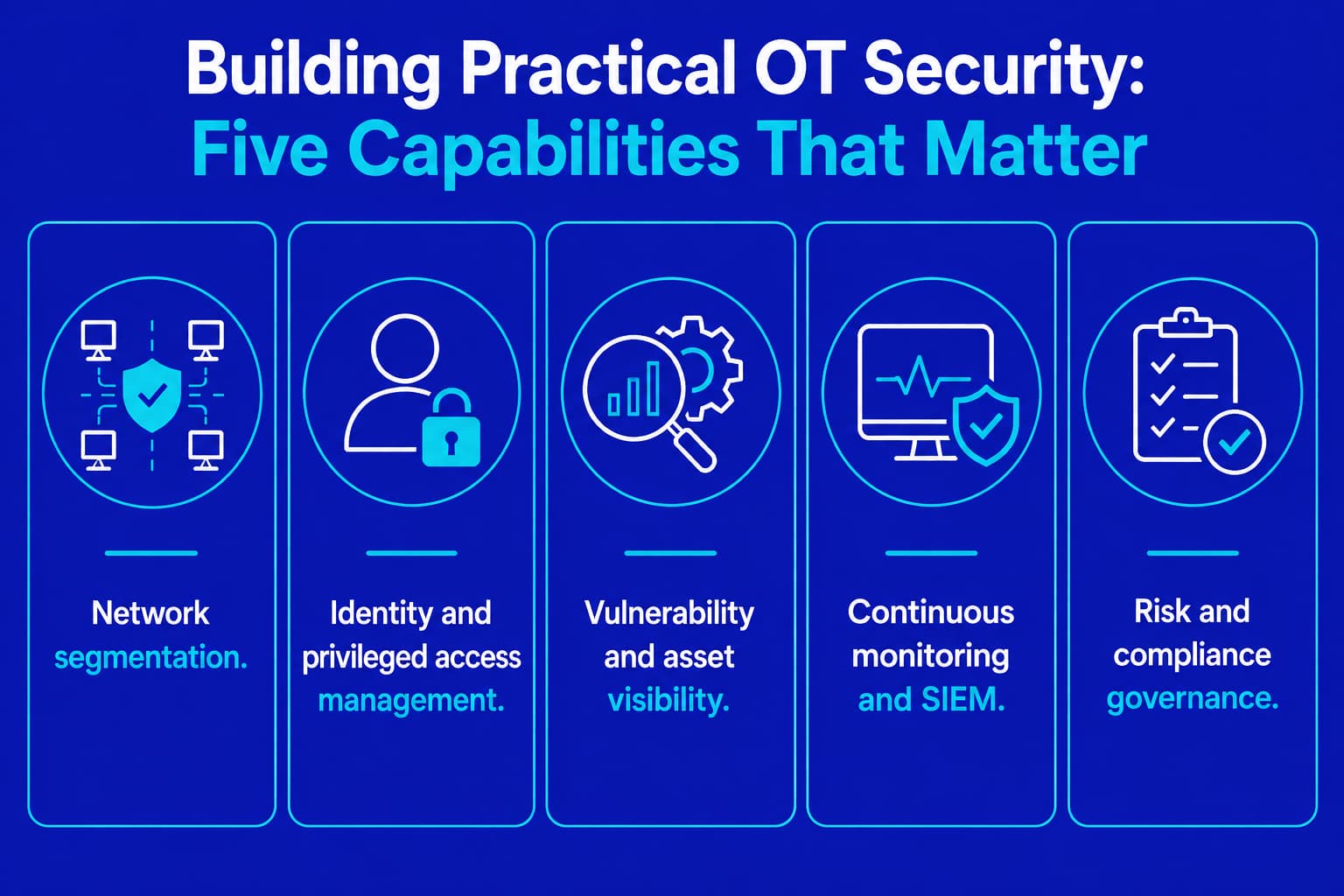
Securing an OT environment is about disciplined layers, not a single product. These are the capabilities that map directly to OTCC requirements and to the questions Saudi security teams are actually asking.
Network segmentation. Isolating the OT network from the corporate IT network is the first and most important control. Done correctly, it ensures that a breach on the IT side cannot travel into industrial systems. This is the foundation OTCC explicitly calls for.
Identity and privileged access management. OTCC mandates role-based access, multi-factor authentication, and the elimination of shared credentials, especially for the vendors and remote engineers who touch critical assets. Controlling who can reach what, and recording every session, closes one of the most exploited gaps in OT.
Vulnerability and asset visibility. You cannot protect what you cannot see. Continuous discovery and assessment of every connected asset gives security teams the inventory and risk posture that OTCC requires, and that auditors look for.
Continuous monitoring and SIEM. A Security Information and Event Management platform collects logs from across the environment, correlates events, detects anomalies, and produces the documented response evidence that regulators demand. This is the technical backbone of any security operations capability.
Risk and compliance governance. Mapping technical controls to the OTCC and ECC frameworks, and maintaining audit-ready evidence, turns scattered tools into a defensible compliance program.
How Alnafitha IT Secures the IT-OT Boundary
Most Saudi industrial breaches do not start inside a PLC. They start in the IT layer that OT now connects to, and that is precisely where a focused defense delivers the most value. Alnafitha IT, a fully Saudi provider operating in the Kingdom since 1993, secures this boundary with a portfolio built for exactly these requirements.
Through its network security solutions, Alnafitha implements the segmentation and access controls that keep corporate and industrial environments apart. Its identity and access management and privileged access capabilities enforce the strict credential governance OTCC demands. For continuous visibility, Alnafitha delivers SIEM and security event management built on ManageEngine Log360, giving security teams centralized log collection, real-time anomaly detection, and audit-ready compliance reporting in a single console. Vulnerability management adds the asset visibility layer, while Alnafitha’s risk and compliance services align the entire program with NCA frameworks.
This is not a box of tools handed over at the door. Alnafitha scopes, designs, deploys, and supports each capability with a team that understands the Saudi regulatory environment, which is what separates a compliant, resilient operation from one that is merely hoping to pass its next audit.
Conclusion: From Awareness to Action
OT security in Saudi Arabia has moved past the awareness stage. The threats are documented, the compliance mandate is enforced, and the budget conversations are happening in boardrooms across the energy and industrial sectors. The organizations that will thrive are the ones that stop treating OT security as an IT afterthought and start treating it as the protection of their most critical operations. The first step is understanding where your IT and OT environments meet, and how exposed that boundary is right now.
Ready to assess and secure your OT environment? Talk to Alnafitha IT’s cybersecurity team for a tailored evaluation aligned with NCA OTCC-1:2022.
Frequently Asked Questions
What is OT security? OT security, or operational technology security, is the practice of protecting the industrial control systems, SCADA platforms, and connected devices that run physical processes in sectors like oil and gas, energy, water, and manufacturing. Its priority is keeping operations available and safe, not just keeping data private.
What is the difference between IT security and OT security? IT security protects information and data, where the main concern is confidentiality. OT security protects physical processes and equipment, where availability and safety come first. A failure in IT can mean a data leak, while a failure in OT can mean a halted production line or a physical safety incident.
Is OT security mandatory in Saudi Arabia? Yes, for critical national infrastructure. The NCA Operational Technology Cybersecurity Controls (OTCC-1:2022) are mandatory for government and private organizations that own, operate, or host critical infrastructure, with penalties for non-compliance reaching up to 25 million riyals.
What are the main OT security risks in the oil and gas sector? The leading risks are IT-OT convergence allowing lateral movement from corporate networks into industrial systems, unpatched legacy equipment, third-party and remote access exposure, incomplete asset visibility, and industrial ransomware that can halt production and cause losses measured in millions per hour.
How do I start an OT security program without disrupting production? You start with visibility and segmentation rather than replacing machinery. Build a complete asset inventory, isolate the OT network from corporate IT, enforce strict access controls, and deploy continuous monitoring. These steps align with OTCC requirements and can be implemented without taking critical systems offline.
Which OT security standards apply in Saudi Arabia? The primary national standard is the NCA OTCC-1:2022, an extension of the Essential Cybersecurity Controls (ECC-1:2018). Many organizations also align with international frameworks such as IEC 62443 for industrial control system security. For a detailed breakdown of how the national controls map to industrial environments, see this guide to Saudi Arabia’s OT cybersecurity controls.