

Quick takeaway: Most enterprise AI programs fail because they start with a tool instead of a business problem. This guide gives Saudi CIOs and transformation leads a practical method used in AI strategy consulting: run a four-question readiness check, map every candidate use case on a value against effort matrix, and fund only the ideas that land in the right quadrant. You can apply the full method this week with a whiteboard and your leadership team.
Your organization has probably already run an AI pilot. Can anyone in the room say what it returned?
For most enterprises, the honest answer is no. Research from MIT’s NANDA initiative found that 95 percent of enterprise generative AI pilots deliver no measurable impact on profit and loss, despite an estimated 30 to 40 billion dollars in spending (MIT GenAI Divide report, Forbes). The pilots were not bad technology. They were answers to a question nobody had defined.
In Saudi Arabia, the pressure is sharper. The National Strategy for Data and AI sets a clear national direction under Vision 2030, and boards now expect every large organization to show progress against it. That expectation is healthy. What is not healthy is responding to it with scattered pilots and no roadmap. This article shows you how AI strategy consulting closes that gap, and how to run the first pass yourself.
Why Most Enterprise AI Pilots Stall
Pilots stall because they are chosen by enthusiasm, not by economics. A vendor demo impresses a department head, a proof of concept gets funded, and six months later nobody can connect it to a revenue line or a cost line.
Three patterns show up again and again in Saudi enterprises. First, the use case was never tied to a measurable business outcome, so success could not be declared or denied. Second, the data needed to move from demo to production was fragmented across systems that never talked to each other. Third, no one owned the decision to scale, so the pilot simply expired. None of these are technology failures. All of them are strategy failures, and all of them are avoidable.
What AI Strategy Consulting Actually Delivers
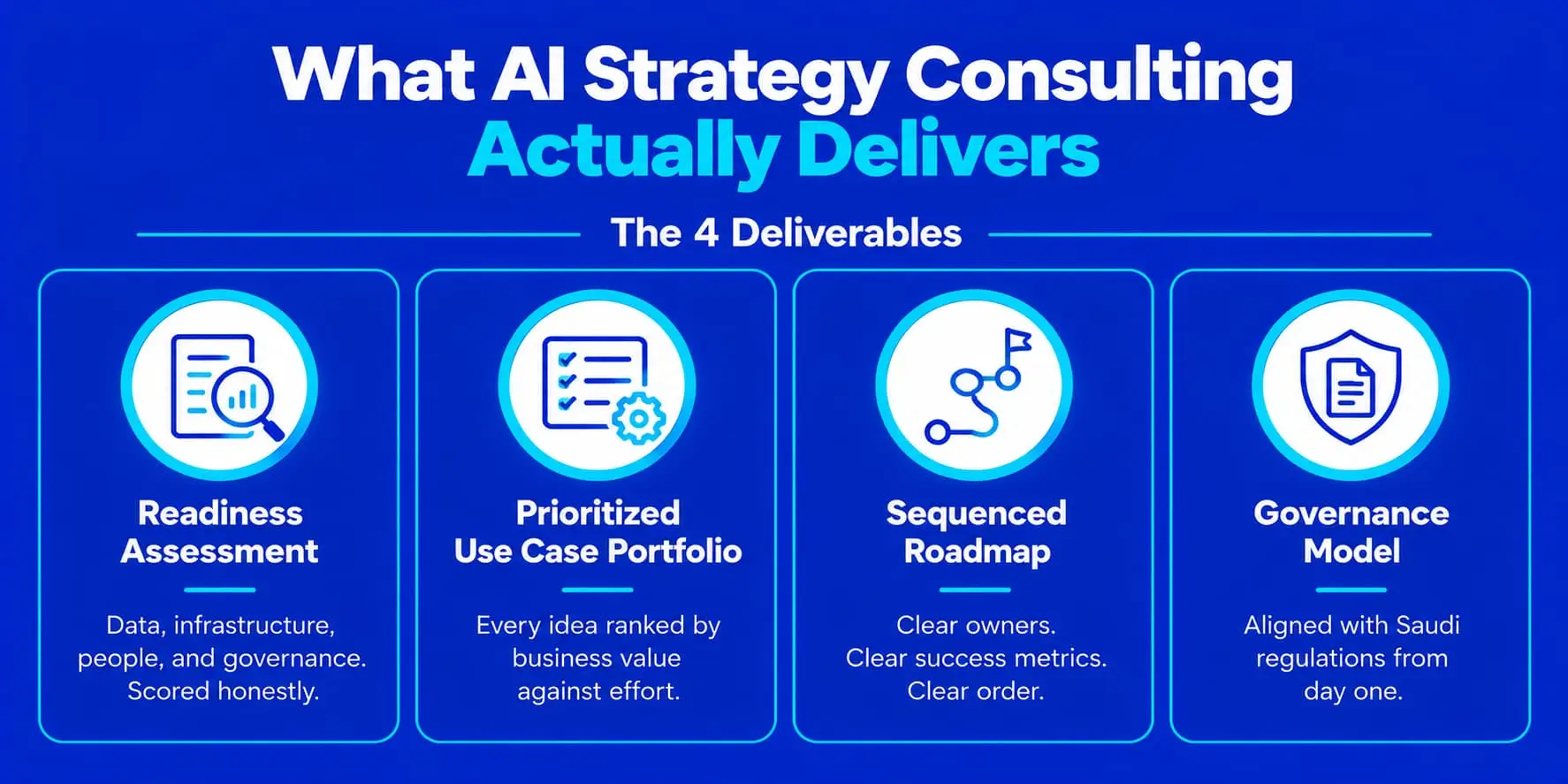
AI strategy consulting is the discipline of deciding where AI creates measurable business value in your specific organization, in what order, and with what foundations. It sits before any tool selection.
A serious engagement produces four things: a readiness assessment across data, infrastructure, people, and governance; a prioritized portfolio of use cases scored by value and effort; a sequenced roadmap with owners and success metrics; and a governance model that keeps the program aligned with Saudi regulatory expectations. If a proposal jumps straight to licenses and platforms, you are looking at a sales pitch, not AI strategy consulting.
A Readiness Check You Can Run This Week
Before mapping any use case, answer four questions honestly with your leadership team. Each takes one meeting, not one quarter.
Data: For the processes you care about most, does reliable data exist, and can you access it without a six-month integration project? Weak answers here push every use case up the effort scale.
Infrastructure: Can your current environment support AI workloads, or will every project begin with a platform build? Organizations with a mature cloud foundation move faster, which is why many Saudi enterprises start by reviewing their cloud infrastructure before committing to an AI portfolio.
People: Who will own each AI outcome at the business level? A use case without a named business owner is a science project.
Governance: Do you have a working position on data classification, privacy, and model oversight? In the Saudi market, this is where PDPL and sector regulators enter the picture, and where gaps become expensive later.
Score each dimension from one to five. Anything at two or below is a constraint your prioritization must respect.
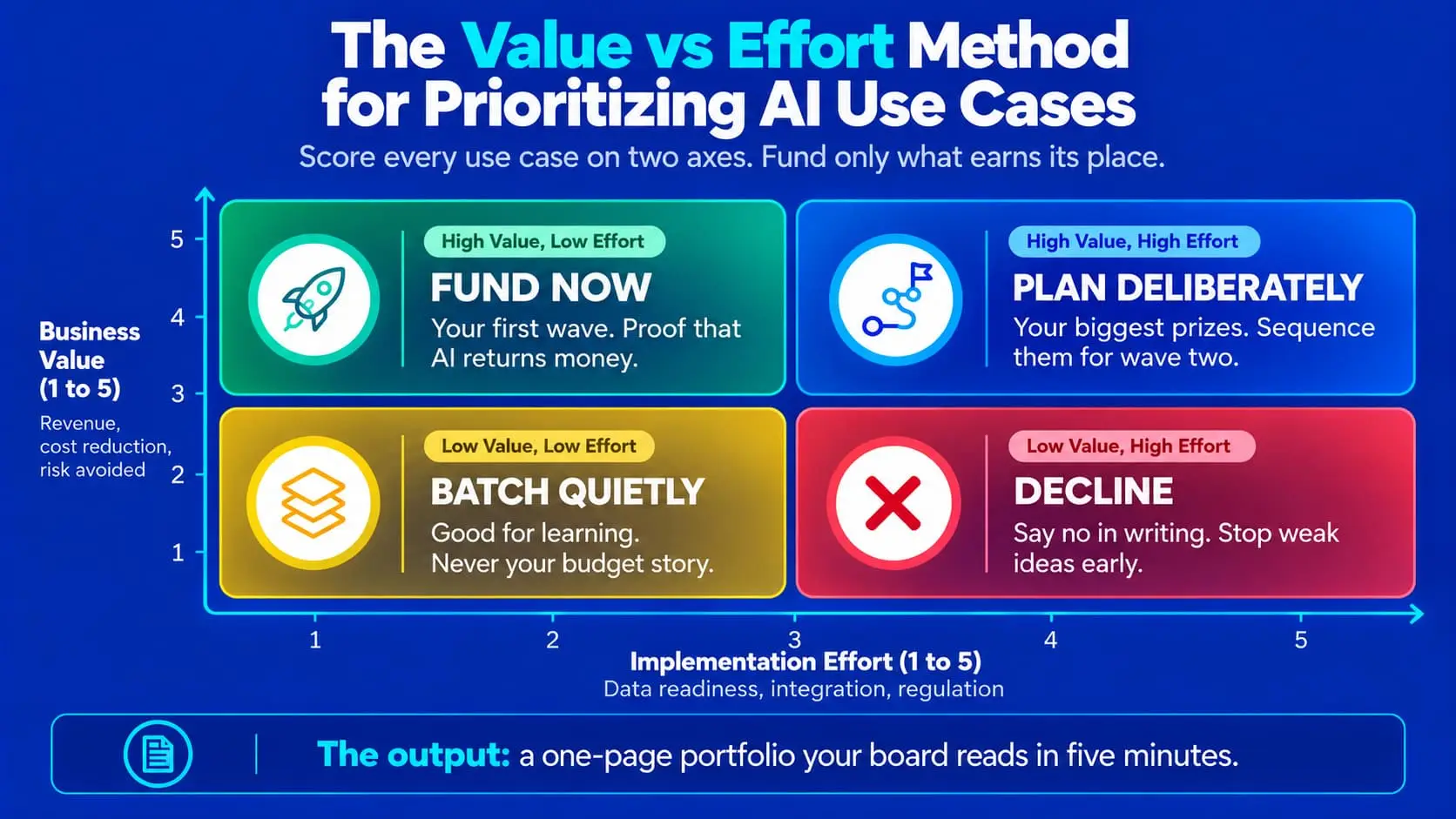
The Value Against Effort Method for Prioritizing AI Use Cases
Now list every candidate use case your teams have proposed. Aim for fifteen to thirty. Then score each one on two axes.
Business value (1 to 5): Estimate the annual impact in riyals, whether from revenue, cost reduction, risk avoided, or capacity released. Add a point if the use case advances a Vision 2030 or sector-specific commitment your board tracks. Be conservative. If you cannot estimate a number at all, that is a signal, not a detail.
Implementation effort (1 to 5): Score data readiness, integration complexity, change management load, and regulatory sensitivity. Your readiness check feeds directly into this score.
Plot the results on a simple 2×2 grid. Four quadrants emerge, and each one dictates an action:
- High value, low effort: fund now. These two or three use cases become your first wave and your proof that AI can return money.
- High value, high effort: plan deliberately. These are usually your biggest prizes. Sequence them for wave two, and use wave one to build the data and skills they need.
- Low value, low effort: batch quietly. Useful for momentum and learning, but never let them consume your budget narrative.
- Low value, high effort: decline. Say no in writing. Half the benefit of this method is creating a defensible reason to stop weak ideas early.
The output is a one-page portfolio your board can read in five minutes. That single page is worth more than any number of disconnected pilots.
A Worked Example: Scoring Three Use Cases at a Saudi Retailer
Here is how the matrix works in practice. Picture a Saudi retail group with 40 branches. The leadership team sits for one short session, puts three proposed ideas through the same two questions, and lands on three very different decisions:
| Use case | Estimated annual impact | Value | Effort | Decision |
| Arabic customer service chatbot | 150,000 SAR saved (half of 3,000 repeat calls a month) | 2/5 | 1/5 | Build now as a quiet learning project |
| Demand forecasting across 40 branches | 2 million SAR (a 10 percent cut in 20 million SAR of excess stock) | 5/5 | 4/5 | Wave two; fund data integration first |
| AI tool that drafts marketing posts | No credible figure | 1/5 | 3/5 | Declined, in writing |
The reasoning behind each row matters as much as the score.
The chatbot wins its slot because everything it needs already exists in the knowledge base. Its real return is not the 150,000 riyals; it is a team that learns to deliver and measure its first AI system at low cost.
The forecasting model is the biggest prize on the list, yet it depends on sales, inventory, and e-commerce data held in three systems that do not talk to each other. Launching it now on scattered data is exactly how pilots join the 95 percent, so the first funded milestone is connecting those systems, and the model comes after.
The marketing tool is declined for one reason: nobody could attach a number to it. The reason goes into the decision log, so when the idea resurfaces in a few months, there is a documented answer instead of a fresh debate.
One scoring session. Three different decisions, each traceable to a number. That is the difference between a portfolio and a wish list.
The output is a one-page portfolio your board can read in five minutes. That single page is worth more than any number of disconnected pilots.
How Alnafitha IT Approaches AI Strategy Consulting in Saudi Arabia
You can run the first pass alone, and you should. Where an external partner earns its place is in pressure-testing your value estimates, exposing the data constraints you cannot see from inside, and turning the winning quadrant into an executable roadmap.
Alnafitha IT has delivered IT solutions to Saudi enterprises and government entities since 1993, which means our AI strategy consulting work starts from a realistic view of how data actually flows inside organizations in the Kingdom. Our data and analytics practice assesses data quality and readiness before any use case is approved, so the effort scores in your matrix reflect reality rather than optimism. Because we also build and operate the underlying cloud, security, and IT management environments, the roadmap we hand you connects to teams who can deliver it, inside the compliance boundaries Saudi regulators expect.
Start With the Question, Not the Tool
Enterprise AI succeeds when it begins with a business problem, a number attached to that problem, and a sober view of the effort required to solve it. The readiness check and the value against effort matrix give you that starting point without a single license purchase. Run the exercise, rank your portfolio, and fund only what earns its place.
When you are ready to validate your assessment or move your first wave into execution, talk to the Alnafitha IT team. We will review your use case portfolio with you and show you where the fastest measurable value sits.
FAQs About AI Strategy Consulting
What is AI strategy consulting? AI strategy consulting is a structured engagement that identifies where AI creates measurable business value for a specific organization, assesses its readiness across data, infrastructure, people, and governance, and produces a prioritized roadmap. It precedes any technology purchase.
What are the typical deliverables of an AI strategy consulting engagement? A readiness assessment, a scored and prioritized use case portfolio, a sequenced implementation roadmap with owners and success metrics, and a governance framework aligned with Saudi regulations such as PDPL.
How do I choose an AI strategy consulting company in Saudi Arabia? Look for three things: local delivery experience with Saudi enterprises and regulators, a method that starts with business value rather than a product catalog, and the ability to execute the roadmap, not just present it.
Do we need perfect data before starting an AI strategy? No. You need an honest map of your data readiness, because it determines which use cases are genuinely low effort. Fixing data everywhere first is a common and expensive mistake; fix it where the value case justifies it.
How does AI strategy consulting support Vision 2030 goals? The National Strategy for Data and AI sets adoption ambitions that boards and regulators increasingly track. A prioritized AI roadmap lets your organization demonstrate credible, measurable progress against that agenda instead of isolated pilots.