
Cloud contact center solutions are quietly becoming the backbone of customer service in Saudi Arabia. As banks, retailers, and government entities race to serve people across phone, WhatsApp, chat, and email, the organizations pulling ahead are the ones that stopped running those channels on separate systems. This guide shows CX and IT leaders how to make that move, serve Arabic and English callers to the same standard, stay right with PDPL, and give supervisors real visibility, without a two-year IT project.
Key takeaways
- Cloud contact center solutions replace fragmented phone lines, chat tools, and email inboxes with one agent console, which is the fastest way to cut wait times and end context loss between channels.
- For the Saudi market, two requirements decide the shortlist: native Arabic and English customer experience, and clear alignment with the Personal Data Protection Law (PDPL), now in active enforcement.
- Supervisor visibility is a feature, not an afterthought. Real-time dashboards, quality scoring, and sentiment analysis turn service from a cost center into a measurable operation.
- AI agents handle repetitive, high-volume questions and hand off to human agents with full context. The goal is deflection with continuity, not replacing people.
- A phased rollout, discovery, pilot, then go-live, lets you validate results on a few queues before committing the whole operation.
Why customer experience in Saudi Arabia is being rebuilt now
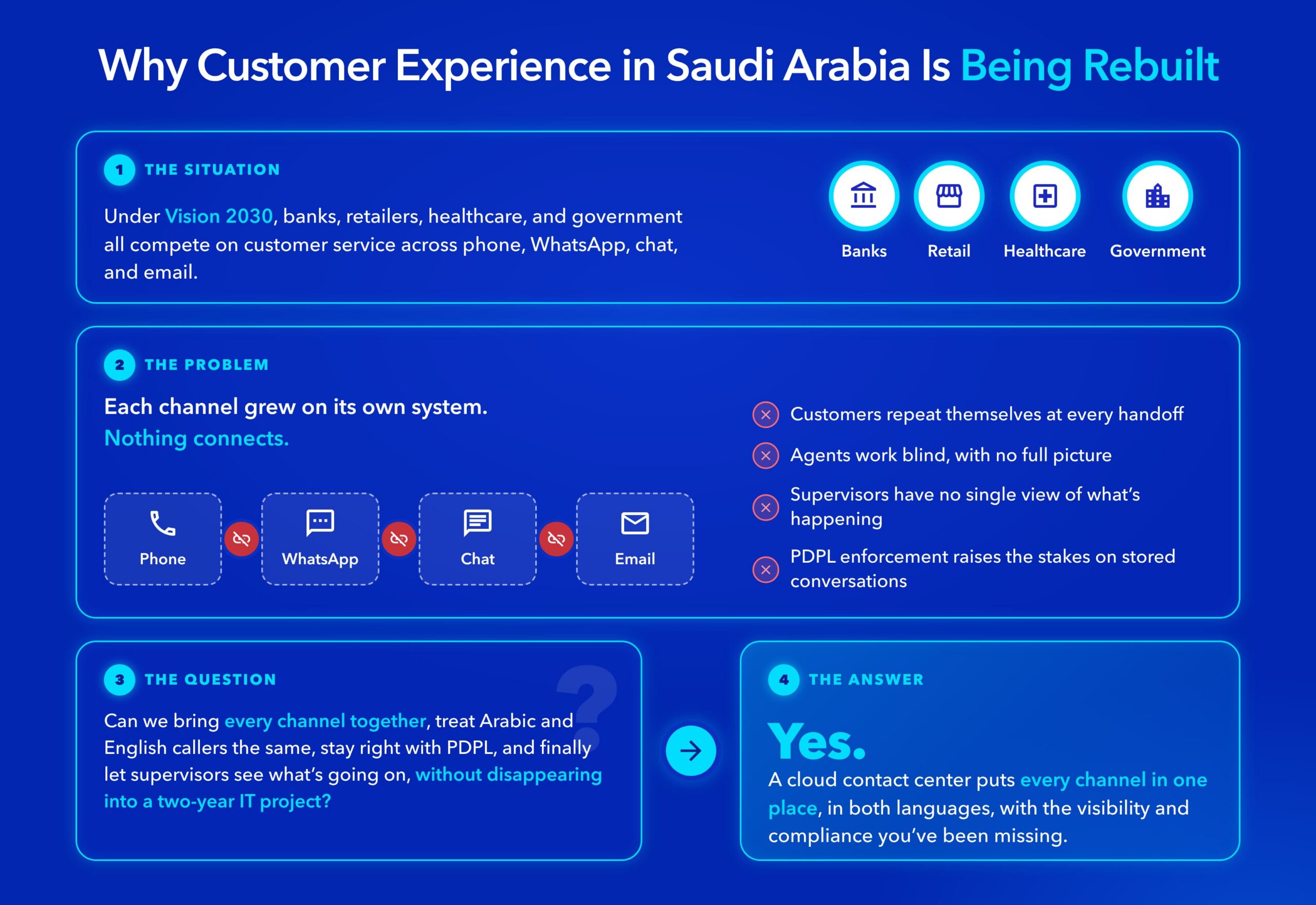
Customer service in the Kingdom has moved to the center of business strategy. Under Vision 2030, banks, retailers, healthcare providers, and government entities are all competing on how well they serve people across phone, WhatsApp, chat, and email. That is the situation every CX and IT leader now shares.
The complication is that most of these channels grew separately. A call center runs on one system, WhatsApp on another, email in a shared inbox, and none of them talk to each other. Customers repeat themselves at every handoff, agents work blind, and supervisors have no single view of what is actually happening. At the same time, the Personal Data Protection Law (PDPL) has moved into active enforcement, which raises the stakes on how customer conversations are captured, stored, and retained.
So the question leadership keeps returning to is direct: how do you unify every customer channel, serve Arabic and English callers to the same standard, satisfy PDPL, and still give supervisors the visibility to improve, all without a two-year IT project?
The answer for most Saudi organizations is a move to cloud contact center solutions. This guide explains what these platforms are, why they fit the Saudi market specifically, how AI agents work alongside your team, and how to sequence a rollout you can act on. By the end, you should be able to plan your next step without needing to call anyone first.
What cloud contact center solutions actually are
A cloud contact center is a single platform, hosted and maintained off your premises, that manages every customer conversation across voice, video, chat, email, WhatsApp, and social from one agent workspace. Instead of buying phone hardware and stitching separate tools together, you subscribe to the service and scale agents up or down as demand changes.
The industry term for this delivery model is CCaaS, or Contact Center as a Service. Two labels get confused here, so the table below sets them straight.
| Question | Cloud call center | Cloud contact center (CCaaS) |
| Channels covered | Voice calls only | Voice, video, chat, email, WhatsApp, social |
| Agent workspace | One channel per tool | One unified console for all channels |
| Customer context | Lost between channels | Follows the customer across every channel |
| Fit for Saudi behavior | Partial | Matches how customers move between phone and WhatsApp |
| Analytics | Call metrics only | Full omnichannel visibility and sentiment |
A related term is UCaaS (Unified Communications as a Service), which handles internal collaboration like team meetings and messaging. The strongest cloud contact center solutions connect to both, so an agent can pull a product expert into a customer call without leaving the screen.
The core capabilities to expect:
- Omnichannel routing: voice, chat, email, WhatsApp, and social land in one queue and are routed by customer intent and agent skill.
- Interactive voice response (IVR) and self-service: callers resolve simple requests, such as checking a balance or booking a slot, without waiting for an agent.
- Real-time analytics: live dashboards and wallboards show queue health, handle times, and service levels as they happen.
- Workforce and quality management: forecasting, scheduling, call scoring, and coaching are built in rather than bolted on.
- CRM integration: agents see the customer’s history the moment an interaction connects, so no one starts from zero.
For a deeper look at how these pieces map to a customer service operation, Alnafitha’s customer service solutions overview is a useful reference point.
Why the Saudi market needs cloud contact center solutions
Two market realities make this shift urgent in the Kingdom specifically: customers expect service in Arabic across digital channels, and regulators now enforce how their data is handled.
Arabic and English service to the same standard
Saudi customers move between Arabic and English without thinking about it, and they expect the contact center to keep up. That means Arabic and English interfaces for agents, right-to-left layouts where relevant, and prompts callers can follow in their own language. Leading cloud contact center solutions support Arabic among their campaign and virtual agent languages, and voice capabilities in the region continue to expand, with Zoom confirming live voice translation for Arabic arriving in late 2026.
The practical point for leadership: Arabic support is no longer a nice-to-have you negotiate later. It belongs on the requirements list from day one, and it is worth confirming exactly which features support Arabic before you sign.
PDPL alignment is now a decision factor, not a formality
Saudi Arabia’s Personal Data Protection Law has been fully enforceable since September 2024, and enforcement is accelerating. The regulator, SDAIA, has issued dozens of enforcement decisions covering failures such as processing data without a lawful basis and inadequate security controls. Businesses can have as little as five days to respond once notified of a violation, and the law reaches any organization handling the data of people residing in the Kingdom, wherever that organization sits.
A contact center records, transcribes, and stores a large volume of personal conversations, which puts it squarely inside PDPL scope. When you evaluate cloud contact center solutions, look for data minimization, documented consent handling, clear retention controls, encryption, role-based access, and audit logging. You can read the law’s requirements directly through the SDAIA data protection guidance, and an accessible legal summary is available via ICLG’s Saudi Arabia data protection overview.
The takeaway is not that any single platform makes you compliant on its own. Compliance is how you configure and operate it. The right cloud contact center gives you the controls to document consent, data flows, and retention during onboarding, which is exactly what an SDAIA audit expects to see.
How cloud contact center solutions give supervisors real visibility
Visibility is the difference between managing a contact center and guessing at it. On legacy setups, a supervisor learns about a service problem after customers have already complained. Cloud contact center solutions move that insight to the present tense.
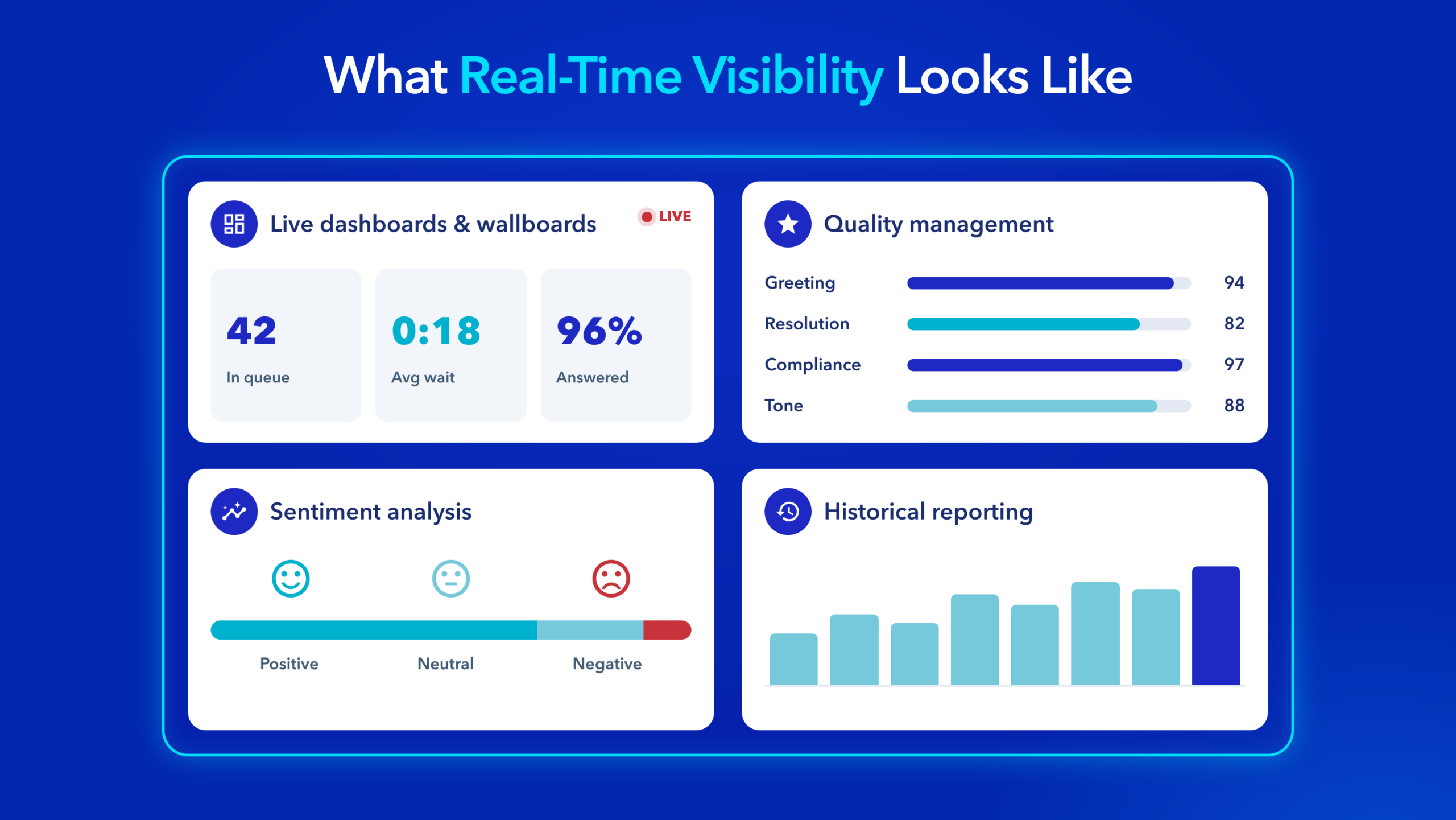
The business value is measurable. When Al Tazaj, one of the Kingdom’s largest restaurant chains, modernized its customer service with Alnafitha, average handle time dropped by 25 percent and customer satisfaction rose by 12 points, with the platform live in six weeks. Those are the kinds of numbers visibility produces, because you cannot improve what you cannot see.
Where AI agents fit alongside human agents
AI agents handle the high-volume, repetitive questions so human agents can focus on the conversations that need judgment, empathy, or a decision. That is the entire design principle, and it is worth stating plainly because the market often overpromises here.
A modern virtual agent uses natural language understanding to hold a real conversation, remember context, and complete tasks such as answering a delivery question or updating an appointment. When a request goes beyond its scope, it hands the customer to a human agent, and the crucial detail is that the full conversation transfers with it. The customer does not start over, and the agent picks up mid-thread.
The value shows up in two numbers: containment (the share of contacts the AI resolves without a human) and average handle time on the contacts that do reach an agent, because the AI has already gathered the context. The goal is not a call center with no people. It is a call center where people spend their time on work that deserves them.
A practical caution for Saudi deployments: confirm that AI features, from the virtual agent to automated quality scoring, support Arabic to the standard your customers expect, and that any data the AI processes stays inside your PDPL controls.
How Alnafitha delivers cloud contact center solutions in the Kingdom
Alnafitha delivers Zoom Contact Center locally in Saudi Arabia as a Zoom partner, pairing the platform with local implementation, PDPL-aware onboarding, and Arabic-English enablement. The platform choice matters, but so does who stands up the deployment and supports it afterward.
Zoom Contact Center is a cloud-native CCaaS platform built on the same infrastructure as Zoom Meetings and Zoom Phone. It brings voice, video, chat, SMS, email, and WhatsApp into one agent console, adds AI-powered virtual agents and real-time agent assist, and connects natively to CRMs such as Salesforce, Microsoft Dynamics 365, and ServiceNow. Because it was recognized in the 2025 Gartner Magic Quadrant for CCaaS, it carries the analyst credibility that enterprise procurement teams look for.
What local delivery adds:
- Assessment and planning that maps your current channels and identifies where consolidation delivers the fastest return.
- Solution design built around your compliance needs, with PDPL consent, data-flow, and retention controls documented up front.
- Deployment and integration into your existing CRM, ITSM, and identity stack, with most rollouts going live in two to three weeks.
- Training and ongoing local support so adoption sticks and the operation keeps improving after go-live.
You can review the full capability set, integrations, and security posture on the Zoom Contact Center in Saudi Arabia page, which also outlines the phased implementation approach.
Turning modernization into your next step
Fragmented channels, long wait times, and no supervisor visibility are not permanent conditions. They are the symptoms of an architecture that predates how your customers now behave. Cloud contact center solutions resolve all three at once: one console for every channel, Arabic and English service to the same standard, PDPL-aligned controls, real-time visibility for supervisors, and AI agents that lift repetitive load off your team.
The organizations pulling ahead in the Kingdom are the ones treating customer experience as measurable infrastructure rather than a cost to contain. A short, scoped assessment is the lowest-risk way to see what that looks like for your operation, including an ROI model and a delivery timeline.
Ready to modernize your contact center? Talk to Alnafitha’s team.
Frequently asked questions
What is the difference between a cloud contact center and a cloud call center?
A cloud call center handles voice calls only. A cloud contact center handles every channel, voice, chat, email, WhatsApp, and social, in one place. For Saudi customers who move between phone and WhatsApp constantly, the contact center model is the one that matches real behavior.
Are cloud contact center solutions PDPL compliant?
The platform provides the controls, and your configuration delivers compliance. Look for data minimization, documented consent handling, retention controls, encryption, role-based access, and audit logging. A local implementation partner should document your consent and data flows during onboarding, which is what SDAIA audits look for.
Do these platforms support Arabic?
Leading platforms support Arabic across agent interfaces, IVR prompts, and virtual agents, with right-to-left layouts where relevant. Because feature-level Arabic support varies, confirm which specific capabilities support Arabic before you commit.
How long does a deployment take?
Most cloud contact center deployments go live in two to three weeks, depending on how many channels and integrations are in scope. A phased approach, discovery, pilot, then go-live, keeps risk low.
Will AI agents replace our human agents?
No. AI agents resolve repetitive, high-volume questions and hand off to human agents with full context when a request needs judgment. The result is a team that spends more time on the work that actually needs a person.
How is pricing structured?
Cloud contact center solutions are typically licensed per agent, with add-ons for extra channels. A scoped assessment usually produces a tailored ROI model and pricing bands for your specific operation.