

Introduction: Understanding Industry 4.0 in Simple Terms
What is Industry 4.0 in simple terms? Industry 4.0 represents the fourth industrial wave, where smart technologies, artificial intelligence, and the Internet of Things converge to transform traditional manufacturing and business operations into intelligent, interconnected systems. For Saudi Arabia, embracing Industry 4.0 isn’t just an option—it’s a strategic imperative aligned with Vision 2030’s ambitious goals for economic diversification and digital transformation.
The Kingdom’s commitment to Industry 4.0 technologies reflects a broader understanding that digital transformation is essential for remaining competitive in the global economy. From smart factories in Jubail to automated logistics centers in Riyadh, Saudi businesses are increasingly asking: What does Industry 4.0 mean for our operations, competitiveness, and future growth?
What Does 4.0 Stand For? Decoding the Fourth Industrial Wave
What does 4.0 stand for? The term “4.0” signifies the fourth major industrial epoch in human history. Following mechanization (Industry 1.0), mass production (Industry 2.0), and computerization (Industry 3.0), Industry 4.0 introduces cyber-physical systems that blur the lines between physical and digital realms.
What is the 4.0 concept? At its core, Industry 4.0 encompasses:
- Smart Manufacturing: Autonomous systems that self-optimize production
- IoT Integration: Connected devices sharing real-time data
- Artificial Intelligence: Machine learning algorithms that predict and prevent issues
- Big Data Analytics: Converting massive datasets into actionable insights
- Cloud Computing: Scalable infrastructure supporting digital operations
For Saudi Arabia, Industry 4.0 means transforming sectors from oil and gas to healthcare, logistics, and beyond. The National Industrial Development and Logistics Program (NIDLP) explicitly incorporates Industry 4.0 principles to enhance the Kingdom’s industrial competitiveness.
Industry 4.0 Standards and Frameworks: Building a Foundation
What are the Industry 4.0 standards? Global frameworks guide Industry 4.0 implementation, ensuring interoperability and security. The Industrial Standard 4 encompasses protocols for data exchange, cybersecurity, and system architecture. Saudi Arabia has adopted internationally recognized standards while developing Kingdom-specific guidelines through the Saudi Standards, Metrology and Quality Organization (SASO).
What is the Industry 4.0 framework? The framework consists of:
- Horizontal Integration: Connecting value chains across organizations
- Vertical Integration: Linking hierarchical levels within factories
- End-to-End Engineering: Digital continuity across product lifecycles
- Exponential Technologies: AI, robotics, 3D printing, and advanced materials
The Saudi government, through initiatives like the National Strategy for Industry, has prioritized Industry 4.0 standards implementation across manufacturing sectors, particularly in automotive, pharmaceuticals, and petrochemicals.
Is Industry 4.0 Still a Thing? Current Relevance and Future Outlook
Is Industry 4.0 still a thing? Absolutely—and it’s more relevant than ever. While some question why Industry 4.0 fails in certain contexts, the technology continues evolving rapidly. In Saudi Arabia, Industry 4.0 adoption accelerated significantly during 2020-2025, driven by pandemic-induced digital transformation needs and Vision 2030 commitments.
Are we in the 4th Industrial Wave? Yes, we’re firmly in this transformative period. When did 4.0 start? The term emerged around 2011 at Germany’s Hannover Fair, but widespread adoption began in the mid-2010s. Saudi Arabia’s serious Industry 4.0 journey intensified around 2016-2017 with Vision 2030’s launch.
Is Industry 4.0 the future? More accurately, it’s the present evolving into Industry 5.0—a human-centric approach emphasizing collaboration between humans and machines. However, most Saudi businesses are still implementing foundational Industry 4.0 capabilities, making it highly relevant for the next decade.
Industry 4.0 in Saudi Arabia: Key Business Sectors and Applications
Industry 4.0 is transforming multiple sectors across Saudi Arabia:
Manufacturing and Production
Industry 4.0 for mechanical engineering has revolutionized Saudi Arabia’s growing manufacturing base. Smart factories in industrial cities like Yanbu and Dammam utilize predictive maintenance, reducing downtime by up to 40%. Industry 4.0 technologies such as digital twins allow engineers to simulate production processes before physical implementation.
Oil, Gas, and Petrochemicals
Saudi Aramco leads the region in Industry 4.0 adoption, implementing AI-driven drilling optimization and IoT sensors monitoring pipeline integrity. The company’s digital transformation demonstrates how Industry 4.0 can enhance even traditional industries.
Healthcare and Pharmaceuticals
Industry 4.0 for the built environment extends to healthcare infrastructure. Smart hospitals in Riyadh employ robotic surgery systems, AI diagnostics, and interconnected medical devices. The pharmaceutical sector uses Industry 4.0 principles for quality control and supply chain optimization.
Logistics and Supply Chain
Industry 4.0 and logistics integration has transformed Saudi Arabia’s position as a regional hub. Automated warehouses, drone deliveries, and blockchain-enabled tracking systems exemplify Industry 4.0 applications in this critical sector.
Construction and Infrastructure
Industry 4.0 technologies are revolutionizing mega-projects like NEOM and The Red Sea Project. Building Information Modeling (BIM), 3D printing, and autonomous construction equipment represent Industry 4.0 in action.
Who Benefits from Industry 4.0 in Saudi Arabia?
Is Industry 4.0 only for big companies? No—while large enterprises like SABIC and Saudi Aramco lead adoption, small and medium enterprises (SMEs) increasingly benefit from Industry 4.0 technologies. The Saudi government provides funding and support through programs like the Industrial Development Fund (IDF) to help SMEs implement smart manufacturing solutions.
Target Business Categories
- Manufacturing Companies: From food processing to electronics assembly
- Logistics Providers: Transportation and warehousing operators
- Healthcare Facilities: Hospitals and pharmaceutical manufacturers
- Construction Firms: Building contractors and project developers
- Energy Sector: Oil, gas, renewable energy, and utilities
Government and Regulatory Bodies
Saudi ministries and agencies actively promote Industry 4.0 adoption:
- Ministry of Industry and Mineral Resources: Drives industrial digitalization
- Saudi Arabian General Investment Authority (SAGIA): Attracts Industry 4.0 investments
- Communications and Information Technology Commission (CITC): Provides digital infrastructure
- Saudi Standards Organization (SASO): Develops national Industry 4.0 standards
The Critical Question: Why Does Industry 4.0 Fail?
Despite its potential, Industry 4.0 implementations sometimes falter. Common reasons include:
- Insufficient Digital Infrastructure: Inadequate connectivity hinders IoT deployment
- Skills Gap: Shortage of workers trained in advanced technologies
- Legacy Systems: Difficulty integrating old equipment with new digital platforms
- Cybersecurity Concerns: Fear of data breaches and industrial espionage
- Cultural Resistance: Workforce anxiety about automation and job displacement
- Unrealistic Expectations: Misunderstanding what Industry 4.0 can realistically achieve
Is Industry 4.0 worth it? For Saudi businesses, the answer is increasingly yes—but success requires realistic planning, adequate investment in training, and phased implementation rather than attempting wholesale transformation overnight.
Alnafitha’s Role in Industry 4.0 Implementation
Alnafitha serves as a crucial bridge connecting Saudi businesses with Industry 4.0 solutions. As a technology solutions provider delivering 47 specialized solution areas across 9 business units, Alnafitha offers end-to-end digital transformation services:
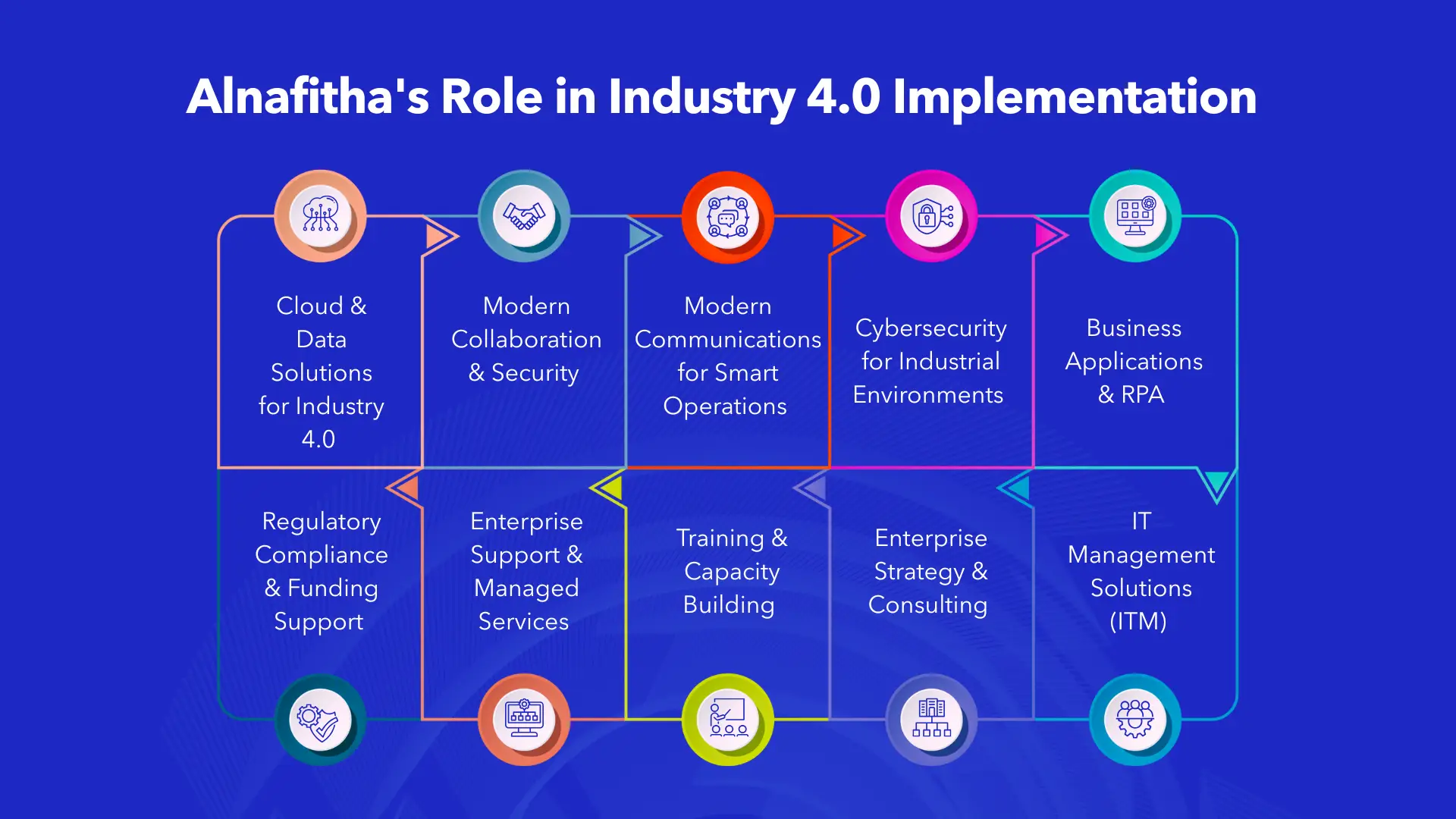
Cloud & Data Solutions for Industry 4.0
Alnafitha delivers enterprise cloud infrastructure, hybrid IT, and multi-cloud strategies across Microsoft Azure, AWS, Google Cloud, and Oracle Cloud. Their Industry 4.0 services include AI-driven data analytics, business intelligence, data governance, and DevOps automation—essential components for smart manufacturing and digital operations. The Cloud & Data Solutions unit helps manufacturers implement predictive maintenance systems, IoT sensor networks, and real-time production monitoring platforms.
Modern Collaboration & Security
Industry 4.0 requires a digitally connected workforce. Alnafitha provides Microsoft 365, SharePoint, Copilot AI, and enterprise content management solutions that enable seamless collaboration across factory floors, offices, and remote locations. Their security practice ensures zero-trust architectures, identity access management (IAM), endpoint detection, and compliance frameworks using Microsoft Defender, Sentinel, Purview, and Entra IAM—protecting industrial control systems and sensitive manufacturing data.
Modern Communications for Smart Operations
Enterprise communication infrastructure is vital for Industry 4.0 operations. Alnafitha specializes in cloud-based telephony, AI-powered contact centers, and video conferencing through Microsoft Teams, Zoom, and Genesys. These solutions optimize internal collaboration, customer service operations, and supply chain coordination—all critical for modern manufacturing environments.
Cybersecurity for Industrial Environments
Protecting Industry 4.0 infrastructure from cyber threats is paramount. Alnafitha’s Cybersecurity unit provides network protection, privileged access management (PAM), SIEM, SOAR, and threat intelligence solutions using leading vendors like Palo Alto, Fortinet, CrowdStrike, and CyberArk. They secure industrial control systems (ICS), SCADA networks, and IoT devices against ransomware, nation-state attacks, and industrial espionage.
Business Applications & RPA
Alnafitha’s Business Applications unit focuses on CRM, ERP, HR systems, and Industry 4.0 automation through Robotic Process Automation (RPA). Using tools like UiPath and Automation Anywhere alongside Zoho and LinkedIn Business Solutions, they help manufacturers automate repetitive processes, optimize supply chains, and integrate AI-driven business intelligence into daily operations.
IT Management Solutions (ITM)
For Industry 4.0 operations requiring unified IT management, Alnafitha provides ManageEngine solutions for IT service management (ITSM), endpoint security, IT observability, and identity management. These tools ensure manufacturing IT environments achieve maximum operational efficiency, security monitoring, and proactive maintenance.
Enterprise Strategy & Consulting
Alnafitha guides organizations through IT governance, compliance frameworks (ISO 27001, COBIT, ITIL, NIST, PDPL), business continuity planning, and Industry 4.0 readiness assessments. Their consultants help Saudi businesses develop digital transformation roadmaps aligned with Vision 2030 objectives and international Industry 4.0 standards.
Training & Capacity Building
Addressing Saudi Arabia’s digital skills gap, Alnafitha offers training programs and certification courses teaching professionals how to operate, maintain, and optimize Industry 4.0 systems. From cloud computing to cybersecurity to RPA, their training ensures sustainable technology adoption and knowledge transfer to Saudi talent.
Enterprise Support & Managed Services
Alnafitha provides managed IT services, custom SLA-based support, and dedicated IT staffing—ensuring organizations receive proactive maintenance, 24/7 monitoring, and rapid issue resolution for their Industry 4.0 infrastructure. Their Enterprise Support unit guarantees business continuity and operational stability.
Regulatory Compliance & Funding Support
Navigating Industry 4.0 standards and Saudi regulatory requirements requires expertise. Alnafitha provides guidance ensuring implementations meet SASO standards, NCA cybersecurity requirements, and international best practices. Additionally, they help businesses access government funding programs supporting Industry 4.0 adoption through the Industrial Development Fund (IDF), NIDLP initiatives, grants, subsidized loans, and tax incentives.
Industry 4.0 Comparisons and Related Concepts
Industry 4.0 vs Industry 5.0: While Industry 4.0 emphasizes automation and data exchange, Industry 5.0 adds human creativity and sustainability considerations. What is the 5.0 industry? It represents collaborative intelligence where humans and machines work together, each contributing unique strengths.
Industry 4.0 and AI: Artificial intelligence is fundamental to Industry 4.0, enabling predictive maintenance, quality control, and autonomous decision-making. Is Industry 4.0 related to AI? Absolutely—AI serves as the brain powering smart factories and intelligent systems.
Industry 4.0 examples in Saudi Arabia include:
- Aramco’s digital oilfields with real-time monitoring
- SABIC’s smart chemical plants optimizing production
- King Abdullah Economic City’s automated logistics facilities
- Smart city initiatives in NEOM incorporating IoT infrastructure
Getting Started with Industry 4.0 in Saudi Arabia
For Saudi businesses considering Industry 4.0 adoption:
- Assess Current Capabilities: Understand your digital maturity level
- Define Clear Objectives: Identify specific problems Industry 4.0 should solve
- Start Small: Pilot projects prove concepts before full-scale implementation
- Invest in People: Train existing workforce and recruit digital talent
- Partner with Experts: Work with experienced consultants like Alnafitha
- Use Government Support: Access available funding and incentive programs
- Ensure Cybersecurity: Implement robust security measures from day one
Conclusion: Industry 4.0 as Saudi Arabia’s Competitive Advantage
What is Industry 4.0 in simple words? It’s the intelligent integration of digital technologies into industrial operations, creating smarter, more efficient, and more responsive businesses. For Saudi Arabia, Industry 4.0 represents more than technological upgrade—it’s fundamental to achieving Vision 2030’s economic diversification goals.
Is Industry 4.0 good or bad? Like any transformative technology, it presents both opportunities and challenges. For Saudi businesses that approach it strategically—with proper planning, investment in human capital, and support from partners like Alnafitha—Industry 4.0 offers tremendous competitive advantages in global markets.
The question isn’t whether to adopt Industry 4.0, but how quickly and effectively your organization can integrate these transformative technologies. With government support, growing digital infrastructure, and increasing expertise, Saudi Arabia is well-positioned to become a regional leader in the fourth industrial wave.
Ready to begin your Industry 4.0 journey? Alnafitha provides full support for Saudi businesses navigating digital transformation. From initial assessment to complete implementation, our experts ensure your Industry 4.0 initiative succeeds.
Contact Alnafitha today to start your transformation.